u.today
As on-chain and derivatives data indicate increasingly pessimistic sentiment, Shiba Inu is undergoing yet another round of intense selling pressure.
Shiba Inu clearly struggles
Despite the fact that $SHIB has struggled to establish a sustainable recovery for the majority of the year, the most recent metrics indicate that market participants are growing more defensive.
According to recent exchange flow data, $SHIB recorded roughly 457 billion tokens in exchange outflows, compared to the 347 billion tokens that entered exchanges during the same period. A significant shift in capital away from trading venues is reflected in the resulting negative netflow of about 110 billion $SHIB.
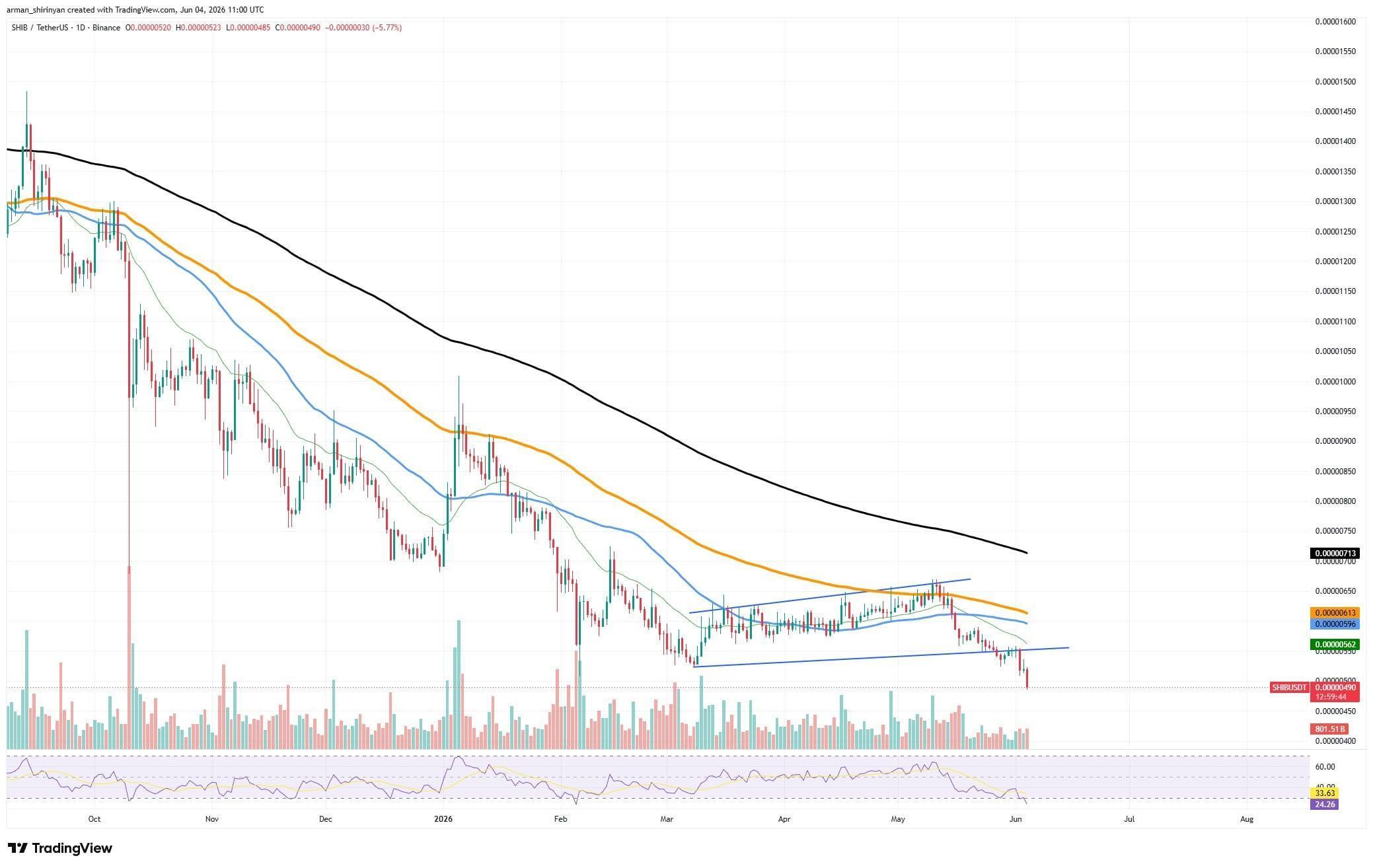 $SHIB/USDT Chart by TradingView
Because investors transfer assets into self-custody, significant exchange outflows are typically seen as bullish. However, the larger context of $SHIB presents a more nuanced picture.
The price action is still clearly negative. $SHIB is still trading below all significant moving averages after breaking below the lower boundary of a multi-month consolidation structure. The Relative Strength Index has plummeted toward extremely oversold territory near 24, and the asset has lost more than 8% over the past day.
Futures market gets thinner
Similar caution is being displayed by derivatives traders. According to futures flow data, the net change fell by more than 140%, with 24-hour net futures outflows reaching about -$2.38 million. Additionally, three-day futures flows are still negative, suggesting that leveraged investors are lowering their exposure rather than preparing for a recovery.
Spot market activity provides a similar narrative. With about $826,000 leaving spot markets over the past 24 hours, and more than $2.2 million leaving over the preceding three days, net spot flows continue to be negative over a number of time periods. These numbers imply that persistent selling pressure is currently outweighing buying demand.
The technical picture is still difficult. $SHIB is still printing lower highs and lower lows after breaking below important support in the vicinity of $0.0000050. Sellers are likely to keep control of the asset until it can recover significant moving averages and stabilize above previous support levels.
However, sharp countertrend rallies are frequently made possible by extreme pessimism. Traders should keep an eye out for indications of stabilization as momentum indicators approach severely oversold levels. However, for the time being, it appears that bearish pressure is still dominating the $SHIB market due to the combination of declining price action, negative futures flows, and significant exchange activity.