

 news.bitcoin.com
Stablecoin use is accelerating beyond crypto trading, with filtered transaction velocity reaching a record 49.7 times annualized. At the same time, bitcoin and ethereum spot ETFs are facing sustained outflows, raising questions about the depth of institutional demand.
Key Takeaways:
- Visa data shows stablecoin velocity hit a record 49.7x as $320B in supply gains utility.
- Bitcoin ETFs have lost $6.6B since Oct. 2025, with Blackrock IBIT now seeing outflows.
- Ethereum ETF demand weakened in May 2026 as Blackrock ETHA posted sustained outflows.
Bitcoin ETF Outflows Hit $6.6B as Stablecoin Payments Accelerate
Stablecoins are showing signs of a major shift from trading tool to payments infrastructure, even as crypto exchange-traded funds (ETFs) struggle to hold investor capital.
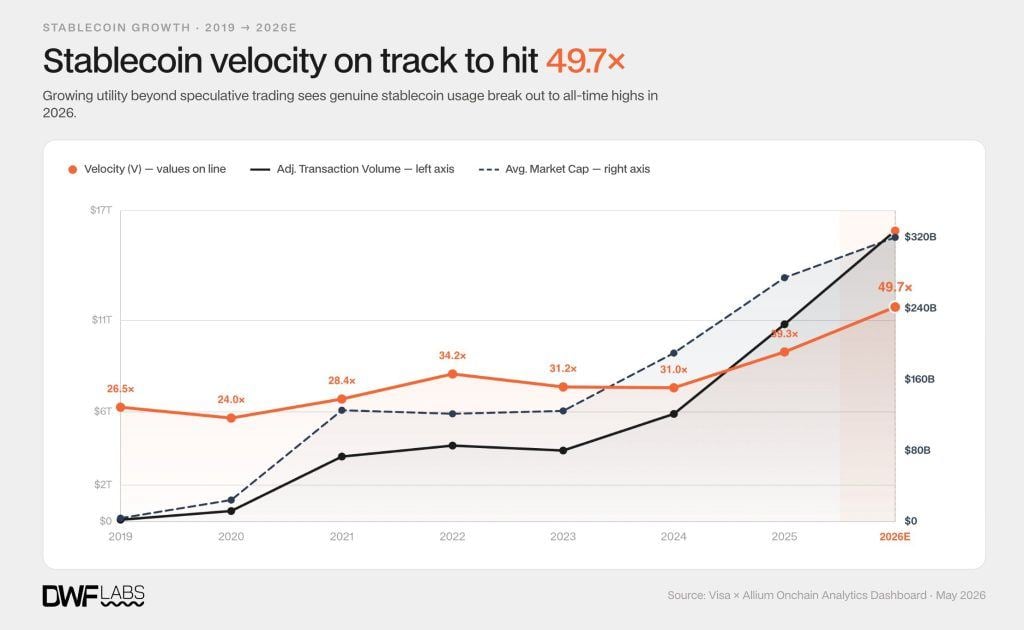
A report by DWF Labs, using filtered data from Visa and Allium Labs shows stablecoin velocity has reached an annualized record of 49.7 times. The metric measures how often each tokenized dollar changes hands in a year. A higher figure suggests stablecoins are being used more actively, rather than sitting idle in wallets or exchange accounts.
The market now includes about $320 billion in stablecoins. In less than five months this year, those tokens have processed $6.64 trillion in filtered transaction volume. The data removes bots, high-frequency trading loops and internal transfers.
 Source: DWF Labs
The composition of that activity is also changing. Remittances, business-to-business payments, and consumer payments are now the fastest-growing areas. Exchange-linked volume, once the main driver of stablecoin use, has fallen to a smaller share of total activity.
That shift marks what analysts describe as the third phase of stablecoin adoption. From 2019 to 2021, growth was largely speculative, with velocity holding between 24 and 28 times as supply expanded. From 2022 to 2024, stablecoins were stress-tested during the Terra and FTX collapses, with velocity peaking at 34.2 times as users moved funds away from riskier venues.
Since 2025, transaction volume has grown faster than supply. Velocity first rose to 39.3 times and has now climbed to 49.7 times, pointing to broader real-world use.
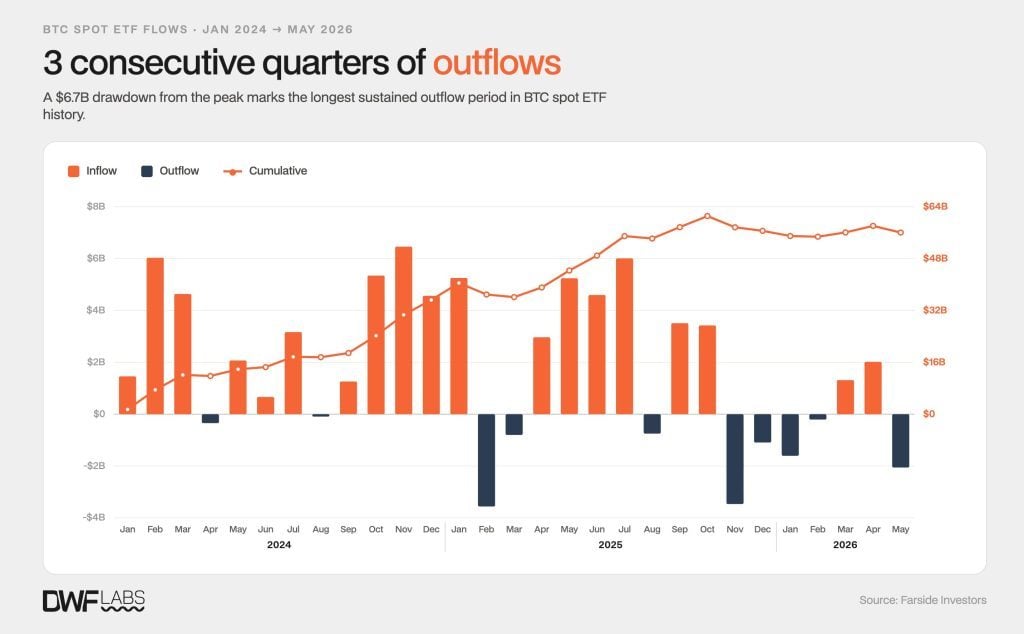
The trend contrasts with spot crypto ETFs, where demand has weakened. Bitcoin ETFs have now seen their longest sustained outflow period since launch, following six straight quarters of net inflows. Outflows began in October 2025 and have continued across three quarters. Total drawdowns from the peak have reached $6.6 billion.
Earlier ETF outflows were often driven by investors leaving Grayscale’s higher-fee GBTC and moving into cheaper products such as Blackrock’s IBIT or Fidelity’s FBTC. Recent activity looks different. On May 27, IBIT itself saw outflows, while total net redemptions across issuers reached $733.4 million for the day.
That suggests some institutional buyers may be treating bitcoin ETFs as macro momentum trades, rather than long-term portfolio allocations.
 Source: DWF Labs
Ethereum ETFs face a different problem. After launching in July 2024, they were hit by heavy redemptions from Grayscale ETHE, including $484 million on the first day. Demand later surged in July and August 2025, when Blackrock’s ETHA attracted $4.2 billion and $3.38 billion, respectively.
But that momentum has faded. Grayscale outflows have slowed, yet capital has not meaningfully rotated into rival products. Several issuers are posting flat flows, while ETHA saw outflows through much of May.
The result is a split market: stablecoins are gaining real economic traction, while crypto ETFs are testing whether institutional demand is durable or simply cyclical.


