
Multiple bearish factors have been fully priced in, upcoming data next week may trigger a gold rebound

Huitong Network, September 25—— Yesterday, the crowded gold short positions caused by consensus expectations were highlighted, and a rebound was imminent.
On Friday (during US and European trading hours), spot gold rebounded and is now trading around 4296. Previously, the darkest moment for gold was mentioned, but the trend is not actually weak. This week, gold has generally remained under pressure, as the market has been pricing in three major bearish factors throughout: sticky inflation, economic resilience, and Fed rate hike expectations.
US Treasury yields continued to rise, with the 30-year yield hitting its highest in more than 20 years and the 10-year yield standing firm at the key 5% level. Gold, which yields no interest, is persistently suppressed by rising opportunity costs, leaving the bulls with no room to rebound, and market pessimism is fully released.
Macro Logic Strengthens: Economic resilience combined with strong capital expenditures support tightening expectations
Recent US economic data continues to confirm economic resilience.
The market expects 100,000 new non-farm jobs in September and the unemployment rate to remain low, showing that the labor market is generally robust.
At the same time, August US durable goods orders showed structural strength: although total orders were dragged down by transportation, core capital goods orders excluding aircraft far exceeded expectations, highlighting the resilience of corporate investment demand, reflecting that the real US economy has not cooled down, further supporting market judgment of a “hot economy and sticky inflation,” which provides the fundamental basis for further Fed rate hikes.
Fed’s stance turns more hawkish on the margin: shifting away from ignoring supply shocks to being alert to entrenched inflation
The latest speech by New York Fed President Williams has become this week’s macro anchor point, completely correcting prior market perceptions.
Williams made it clear that the Fed can no longer simply “look through or ignore” short-term inflation disturbances and must be alert to persistent supply shocks that could entrench inflation expectations.
Currently, inflationary pressure does not come from the labor market but instead comes from supply shocks related to factors like oil prices, tariff costs, and the structural demand pressure from the AI industry.
Market policy focus has completely shifted to supply-side inflation risks. Williams directly stated that another rate hike before the end of the year is reasonable, further reinforcing market tightening expectations and solidifying the bearish logic behind this round of gold weakness.
Currently, the probability of a Fed rate hike in October has surpassed 60% according to market pricing.
Market Nature: Gold continues to be heavily suppressed, with bearish factors fully priced in
In summary, gold this week is experiencing a classic expectation-driven suppressed market: all bearish themes are realized—sticky inflation, strong economic data, hawkish Fed comments, surging Treasury yields, and heightened rate hike expectations.
Several days of heavy bearish pricing have fully absorbed short-term negative sentiment. Downward momentum in gold prices is gradually exhausted, and the chart shows an “extremely tight” condition.
Next week: Super Data Week—crucial data concentrated, providing a verification window
Next week, the global market will enter a super macro verification cycle, with multiple key data released including CPI from various countries, US PCE inflation, global PMI, and US non-farm payrolls.
Market expectations of “high inflation, strong employment, continued rate hikes” that have been priced in advance will now face concrete data tests.
This is also the key inflection point for gold’s short-term market structure: the market will shift from trading on expectations to realizing those expectations.
Trading Logic Going Forward: All bad news exhausted, gold enters “spring-like” rebound market
The current gold trend fully aligns with the principle of a spring: the more bearish pressure beforehand, and the longer it lasts, the greater the rebound once data materialize.
Currently, all bearish narratives have been fully priced in, and there is no room for new, unexpected negative factors.
Even if next week’s data remain strong, it merely confirms existing expectations and is unlikely to further suppress gold prices;
Once inflation edges lower, employment data cools, and supply shocks ease, gold—which has been continuously suppressed—will quickly trigger short covering, valuation repair, and capital inflow.
Overall, gold’s downside in the short-term is limited. The super data week next week is likely to bring a style shift, with the trend moving from “under sustained bearish pressure” to a spring-like rebound amidst exhausted bearish factors and oscillating strength.
Technically: Watch the descending wedge pattern formed by the head-and-shoulders neckline and the descending trendline, which is a common bullish reversal pattern.
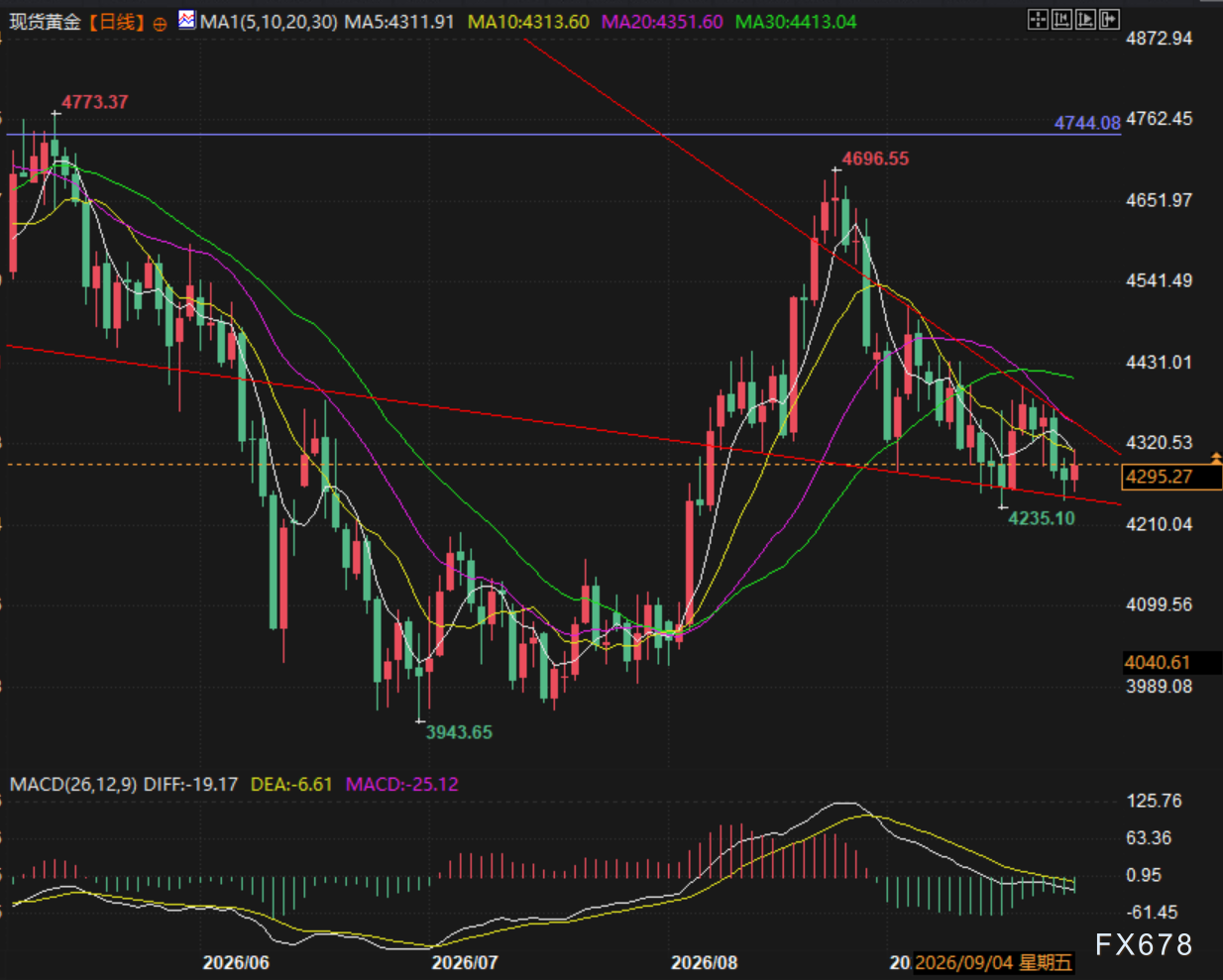
(Spot gold daily chart, source: Easy Huitong)
21:19 (GMT+8), spot gold is now quoted at $4,291/oz.
Disclaimer: The content of this article solely reflects the author's opinion and does not represent the platform in any capacity. This article is not intended to serve as a reference for making investment decisions.
You may also like
U.S. diesel prices surge 83% this year! Apollo Chief Economist warns: Cost pass-through may make core inflation more stubborn, Federal Reserve can't ignore it
Torsten Slok, Chief Economist at Apollo Global Management, has warned that the inflation threat posed by the surge in U.S. diesel prices to historic highs may be more serious than the Federal Reserve currently realizes.
Goldman Sachs Estimates AI Compute Power Gamble: Six Tech Giants Need to Earn an Extra $1.42 Trillion from 2028 to 2030 to Sustain 15% ROIC
Goldman Sachs recently released a research report on the US technology industry, estimating the necessary scale of the AI economy required to justify the ROIC of hyperscale cloud providers' AI capital expenditures.
Bond market volatility hits highest since March as Bitcoin, stocks stay calm

Pete Hegseth’s latest financial filing reveals Bitcoin holding, major stock sales
Crypto prices
More


