
Back to pre-war levels, RMB stands out alone

Morning FX
Just one day before Trump’s “final ultimatum” threatening to bomb Iran’s power plants, the USD/CNH exchange rate returned to its pre-war level, with USDCNH briefly dropping to 6.8550. Compared to other Asian currencies like the yen and the won, which are still trading at low levels, the yuan’s performance is quite impressive.
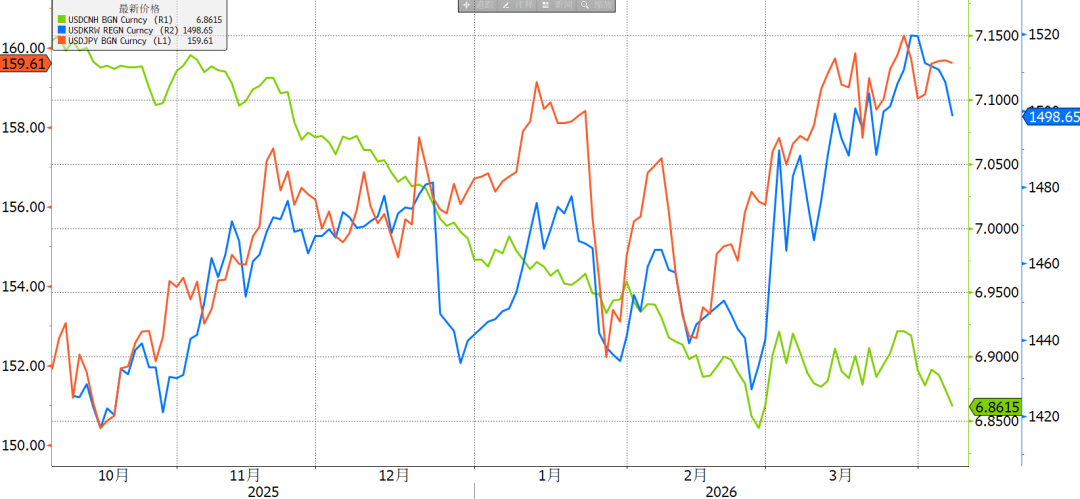
Figure: The yuan outperformed other currencies
I. The negative impact of the war on the yuan is fading
As the US-Iran conflict has reached its current stage, its impact on the yuan is diminishing, regardless of escalation.
First, the yuan is least affected by oil prices. With expectations of a prolonged closure of the Strait of Hormuz, Brent oil prices have remained above $100, prompting central banks to briefly adopt aggressive rate hike expectations, which evolved into recession fears. However, the yuan’s monetary policy signal remained steady, and with accommodative liquidity in Q1, overnight repo rates actually declined and long-term bond volatility narrowed, making it a safe haven amid the global government bond sell-off.
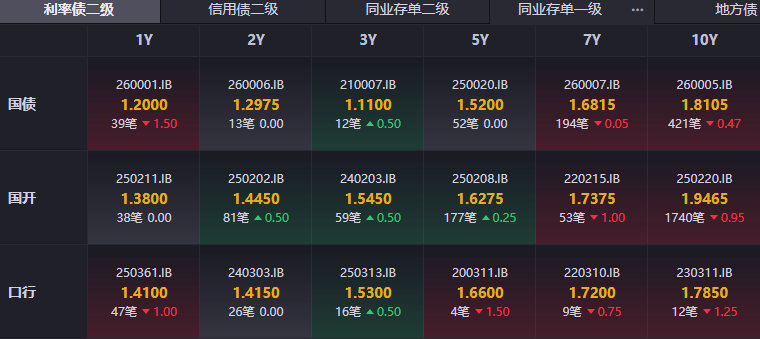
Figure: Long-term yuan bond yields remain stable
Second, forex supply and demand are still driven by clients rather than sentiment. In Q1, spot plus forward net FX settlements still maintained a monthly scale of $100 billion, and the war actually provided a window for settlement above 6.90. As proprietary trading desks remain cautious, client flows exert a stronger impact on liquidity.
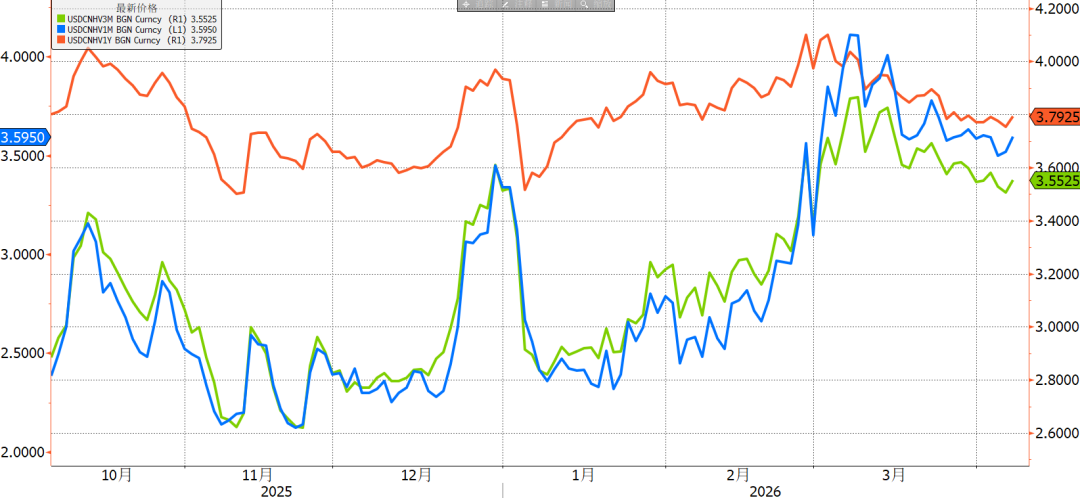
Figure: Volatility decreases
The yuan’s steady progression is also reflected in its exceptionally calm implied volatility. Except for a brief spike at the beginning of March caused by panic, implied volatility steadily declined throughout the month and has already returned to pre-war levels. This means that from short to medium and long term, there are no excessive expectations for appreciation or depreciation of the yuan.
II. Outlook
In last week’s article Why is a US-Iran ceasefire so hard to achieve? we mentioned that the market reaction function could change and one possibility is that the yuan, as a potential alternative to the “petrodollar system,” outperforms other Asian currencies.
Now, the yuan’s relative advantage is clear. After the Japanese and Korean currencies fell due to stock market crashes and Southeast Asian currencies weakened due to oil vulnerability, the yuan exchange rate index has reached its highest level in over a year.
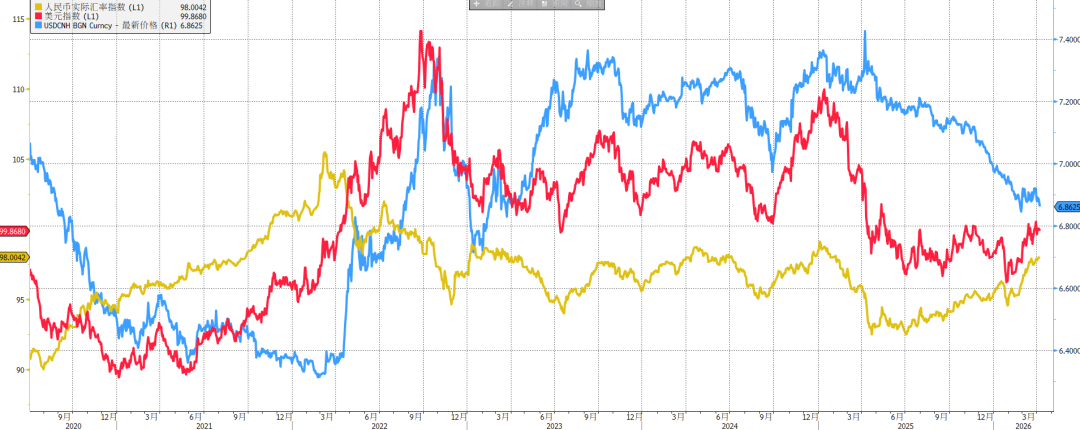
Figure: New high for the yuan index
From this perspective, the yuan’s appreciation is already significant. Unless the war ends sooner than expected, which could drive the yuan towards the year’s low of the 6.80 level, the short-term adjustment is already in place.
III. Summary
(1) The USD/CNH exchange rate has returned to pre-war levels, the negative impact of the conflict is gradually fading, and sensitivity to the event is decreasing.
(2) From the yuan index’s perspective, the short-term correction is in place, and the likelihood of breaching the 6.80 level before the war ends is not high.
Disclaimer: The content of this article solely reflects the author's opinion and does not represent the platform in any capacity. This article is not intended to serve as a reference for making investment decisions.
You may also like
U.S. stocks opened higher and fluctuated, the Japanese yen rebounded more than 1% intraday, 10-year U.S. Treasury yields broke above 5.22% again, and U.S. crude oil once fell nearly 3%.
After the release of U.S. consumer confidence data, the S&P and Nasdaq turned negative, while the Dow is poised to break a three-day losing streak but is set for a fourth consecutive weekly decline. Meta pulled back, falling more than 3% during the session. The U.S. 10-year Treasury yield surpassed 5.22% again, marking a new high for the third day in a row since 2007, while the 30-year yield reached its highest level since 2004. The yen/dollar pair surged 1.2% intraday, as Japanese and U.S. officials successively signaled concerns over the weak yen. Expectations for a diplomatic resolution between the U.S. and Iran are rising, halting crude oil's two-day climb.
US Treasury volatility surges, triggering alarms! BofA’s Hartnett warns of rising deleveraging risks as higher yields become main threat to the market
Bank of America strategist Michael Hartnett warns that the recent sharp rise in volatility in the US bond market is increasing the risk of broader deleveraging in financial markets.
U.S. diesel prices surge 83% this year! Apollo Chief Economist warns: Cost pass-through may make core inflation more stubborn, Federal Reserve can't ignore it
Torsten Slok, Chief Economist at Apollo Global Management, has warned that the inflation threat posed by the surge in U.S. diesel prices to historic highs may be more serious than the Federal Reserve currently realizes.
Crypto prices
More


