
Deutsche Börse exec says tokenization is an evolution, not a threat

A Deutsche Börse Group executive says tokenization is a natural evolution of market infrastructure, not a threat to traditional markets, and said the exchange operator is positioning itself to integrate tokenized and traditional assets.
Carlo Kölzer, head of digital assets at Deutsche Börse and CEO of the group’s trading platform 360T, expressed a bullish outlook on real-world (RWA) asset tokenization, forecasting a future in which digital and traditional markets operate in a closely linked ecosystem.
“Our role as Deutsche Börse Group is not just to build a bridge between two separate worlds, but to create a truly hybrid market,” Kölzer told Cointelegraph, describing the company’s vision for a unified trading environment.
The comments came shortly after 360T integrated Kraken-backed xStocks, a major tokenized equity platform, on Feb. 9, enabling clients to trade tokenized shares of companies such as Nvidia, Google and Circle.
The role of traditional market infrastructures is crucial
“Tokenization enhances capital market flexibility and efficiency, not by making traditional market infrastructures obsolete, but by transforming how they deliver their core functions,” Kölzer said, adding:
“In a tokenized environment, trusted institutions remain essential for risk management, supervision, and ensuring orderly markets, with technology demanding even greater resilience and transparency.”
Deutsche Börse views the shift as a strategic evolution and does not see it as a threat.
“For us, tokenization is an opportunity to pioneer new models and guide the market’s transformation while bringing the same trust and confidence we bring to our markets today,” he said.
Tokenization-linked risks and regulatory concerns
As tokenized assets continue to expand, with the market up roughly 18% year-to-date, some analysts have reiterated concerns around the backing of commodity-based RWAs and stablecoins.
Critics have also pointed to the lack of clear regulatory frameworks across jurisdictions, warning that investor rights and protections may vary depending on structure and venue.
In early February, tokenization platform Securitize warned that the European Union risks falling behind the United States, urging lawmakers to amend the bloc’s DLT Pilot Regime to address restrictive asset scopes and slow regulatory updates.
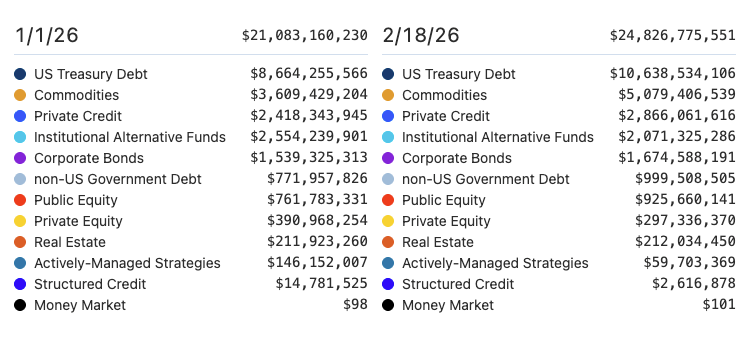 RWA market valuation by categories (Jan. 1 versus Feb. 18, 2026). Source:
App.RWA.xyz
RWA market valuation by categories (Jan. 1 versus Feb. 18, 2026). Source:
App.RWA.xyz
Despite those concerns, Deutsche Börse and 360T remain bullish on tokenization in Europe, citing progress within established regulatory frameworks such as the Markets in Financial Instruments Directive (MiFID).
“We welcome the ongoing work to evolve the initial approach and align it with the market demand to enable growth and accelerate tokenization activities,” Kölzer said, adding that this work will ensure that Europe continues to attract new innovation.
The exec also addressed criticism over “paper Bitcoin,” a term used to describe synthetic or derivative-based exposure to Bitcoin via futures, perpetual swaps, exchange-traded funds and some centralized exchanges.
“This issue highlights the core importance of market integrity and regulated infrastructure,” he said, adding that Deutsche Börse and 360T aim to offer regulated access so clients can gain exposure to assets without uncertainty over trading venues or service providers.
“Our approach remains the same for crypto assets and tokenized products. We aim to provide robust, trusted and fully regulated services,” he added.
Magazine: Is China hoarding gold so yuan becomes global reserve instead of USD?
Disclaimer: The content of this article solely reflects the author's opinion and does not represent the platform in any capacity. This article is not intended to serve as a reference for making investment decisions.
You may also like
Strategists Say Market's ‘Wall of Worry' Is Healthy, Not a Warning Sign

Canadian Dollar seems vulnerable near August 7 low amid sliding oil prices, trade tensions
Houthis claim attacks on Saudi capital, thick smoke seen near Riyadh airport
Multiple unions threaten strikes at Barrick’s flagship Mali gold mine, documents show
Crypto prices
More


