
SK Hynix Q3 Earnings Preview: Can HBM4 Ramp and DRAM Price Increases Reverse the Stock’s Decline?
 2026/10/26 05:29
🔥 US Stock Hotspot Radar is Live! Content: 3 major themes + 6 selected stocks + 7 key events. Where are this week’s opportunities? Click the link to see all 22 trading directions in one chart →
1.Investment Highlights
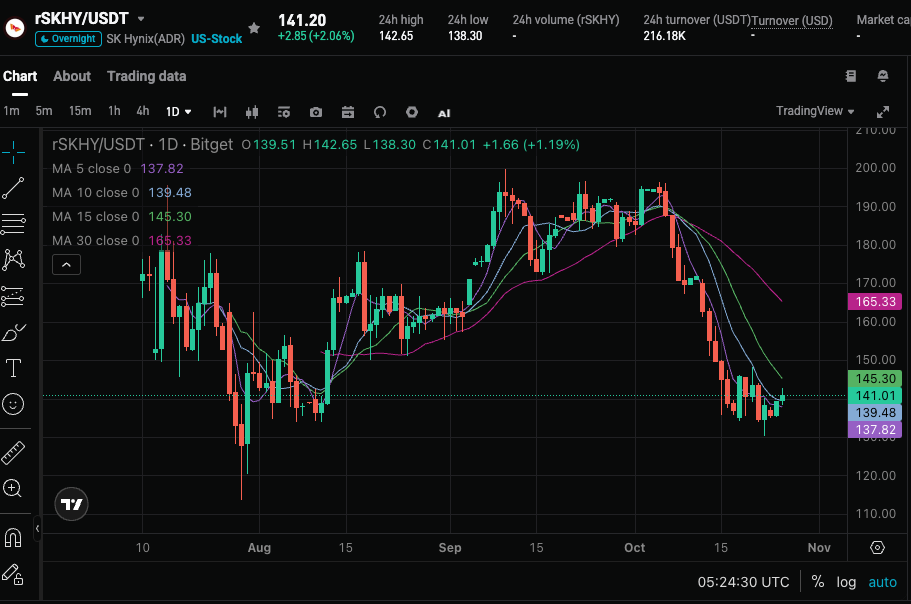
SK Hynix (SKHY.US) will report its fiscal 2026 third-quarter results on October 28, 2026. Consensus expectations call for revenue of approximately $74.81 billion, adjusted EPS of $6.25 (GAAP EPS $6.12). The stock has fallen about 28% from its historical high. The market is closely watching the pace of HBM4 volume ramp, whether DRAM and NAND contract price increases materialize, the sustainability of high operating margins, and management’s Q4 guidance along with any potential special dividend.
Focus 1: HBM4 Volume Ramp and Yield Progress
HBM remains the core growth engine. The company began mass production and shipments of 12-layer HBM4 chips to key customers in Q2, with yields and quality already approaching mature HBM3E levels. The current priority is steadily increasing capacity. Management previously confirmed that HBM4 volume ramp in the second half, combined with rising 1c-nanometer conventional DRAM shipments, should drive higher bit growth and improved blended ASP. The market will monitor actual shipment scale and its contribution to margins. Successful ramp-up could support further earnings upgrades.
Focus 2: Realization of DRAM and NAND Price Increases
According to TrendForce, Q3 2026 DRAM contract prices are expected to rise 13%–18% quarter-on-quarter, while NAND Flash contract prices are projected to increase 10%–15% QoQ. DRAM prices are forecast to rise a further ~20% QoQ in Q4. In Q2, DRAM blended ASP rose 30% QoQ and NAND ASP jumped more than 50% QoQ. The company has guided for roughly 10% QoQ growth in DRAM bit shipments in Q3. If both price and volume gains materialize, high-margin performance should be reinforced.
Focus 3: Sustainability of High Margins and Impact of Long-Term Agreements (LTAs)
In Q2, SK Hynix generated approximately $45.2 billion in operating profit on $54.55 billion in revenue, achieving an EBIT margin of 76.3% (in KRW terms)—surpassing TSMC and Micron in the same period. The company locked roughly 50% of shipments under multi-year long-term agreements, deliberately forgoing some short-term spot-market flexibility in exchange for more predictable cash flow, and deferred certain high-value DRAM and HBM shipments to the second half. Investors will watch whether high margins can be maintained as HBM4 scales and how LTAs affect actual price transmission.
Focus 4: Q4 Guidance, Special Dividend Potential, and Valuation Recovery Room
The market expects the company may provide a strong Q4 outlook and discuss the possibility of a special cash dividend (related to prior discussions of shareholder returns from the sale of Kioxia equity). The current forward P/E based on FY2027 EPS is only about 4.37x. Some analysts believe the cycle has not yet peaked and that valuation remains low. The strength of guidance and any capital-return announcements could serve as a key sentiment inflection point.
3. Risks and Opportunities
Upside Catalysts:
- HBM4 shipments and DRAM bit growth exceed expectations, combined with contract price increases, driving revenue and profit significantly above consensus.
- Management raises Q4 guidance or announces a special dividend, validating the sustainability of high margins and willingness to return capital.
- Continued expansion of AI inference-related storage demand (context windows and KV cache) offsets concerns about algorithm optimization.
Downside Risks:
- Results merely meet or fall slightly short of expectations, or price increases come in weaker than TrendForce forecasts, raising fears that the cycle is peaking.
- Chinese competitors (e.g., CXMT) make faster-than-expected technological progress, or macro factors slow AI capital spending, pressuring valuation.
- Even a significant beat may produce limited positive price reaction due to high transparency of pricing dynamics, or “buy the rumor, sell the news” dynamics.
4. Trading Strategy Suggestions
Bull Case: If revenue and profit clearly beat consensus, HBM4 ramp and price increases are confirmed, and management delivers positive Q4 guidance plus capital-return signals, market confidence in SK Hynix’s position as an AI memory leader could strengthen and support a valuation recovery.
Bear Case: If core data are only in-line or weak, price transmission is softer than expected, or guidance is cautious, the stock could face continued downside pressure, especially given the cyclical nature and high volatility of memory stocks.
Key Metrics to Watch:
- Total revenue and YoY/QoQ growth rates
- DRAM/NAND bit shipment volumes and ASP changes
- Operating profit and EBIT margin
- Q4 guidance and full-year outlook
- Capital return commentary (special dividend or buybacks)
Operational Suggestions: When results beat expectations and guidance is constructive, consider positioning on pullbacks. If data are merely in-line or weak, remain cautious of short-term volatility and avoid chasing. Position sizing and stop-losses should be adjusted according to individual risk tolerance.
Disclaimer: The above content is for reference only and does not constitute investment advice.
Disclaimer: The content of this article solely reflects the author's opinion and does not represent the platform in any capacity. This article is not intended to serve as a reference for making investment decisions.
You may also like
Report: SK Hynix Plans to Launch KRW 50-60 Trillion Shareholder Returns, Setting a Historic Record
According to Seoul Economic Daily, SK Hynix plans to announce an additional shareholder return plan of 50 to 60 trillion Korean won, mainly through special dividends, when it releases its Q3 report on October 28. Including the previously completed share buybacks and cancellations, the total shareholder return for this year will reach a record 90 to 100 trillion Korean won.
The UK plans to issue more short-term bonds, which may lower gilt yields, and investors are also watching closely to see if the Autumn Budget can maintain fiscal discipline.
The UK is set to increase its use of short-term debt. This shift could lower yields on UK government bonds and alleviate the country's increasingly strained public finances. Meanwhile, the potential market reaction to the upcoming autumn budget remains a risk factor for the British bond market.
Tech Earnings Week Arrives: US Stock Market Pre-Market - SK Hynix Rises Over 1%, Petrobras Falls Over 20%, Oil Prices Retreat, US Treasury Bonds Strengthen
Before the U.S. market opens, SK Hynix rises over 1%. The company plans to distribute a special dividend of $12.1 billion, using proceeds from the sale of its Kioxia equity to reward shareholders. U.S.-listed Neocloud companies generally fell before market open: Nebius dropped 4.5%, CoreWeave fell 4.4%, and Iren decreased 4.1%. Petrobras ADRs dropped over 20% before market open, while Itaú Unibanco fell more than 27%. Brent crude retreated 1.5% from a six-month high, currently trading at around $114.95 per barrel.
Cybercab goes viral, Berlin factory achieves record production! Behind the Tesla (TSLA.US) buzz, Phillip Securities still sees a 38% downside
Tesla (TSLA.US) rose nearly 1% in pre-market trading on Monday, following a series of events including the intensive debut of the Cybercab at the Austin F1 circuit, a production milestone at the Berlin factory, and the release of new details about the Roadster.
Crypto prices
More


