
Crypto: A White House Adviser is Allegedly Bought Off by Tether

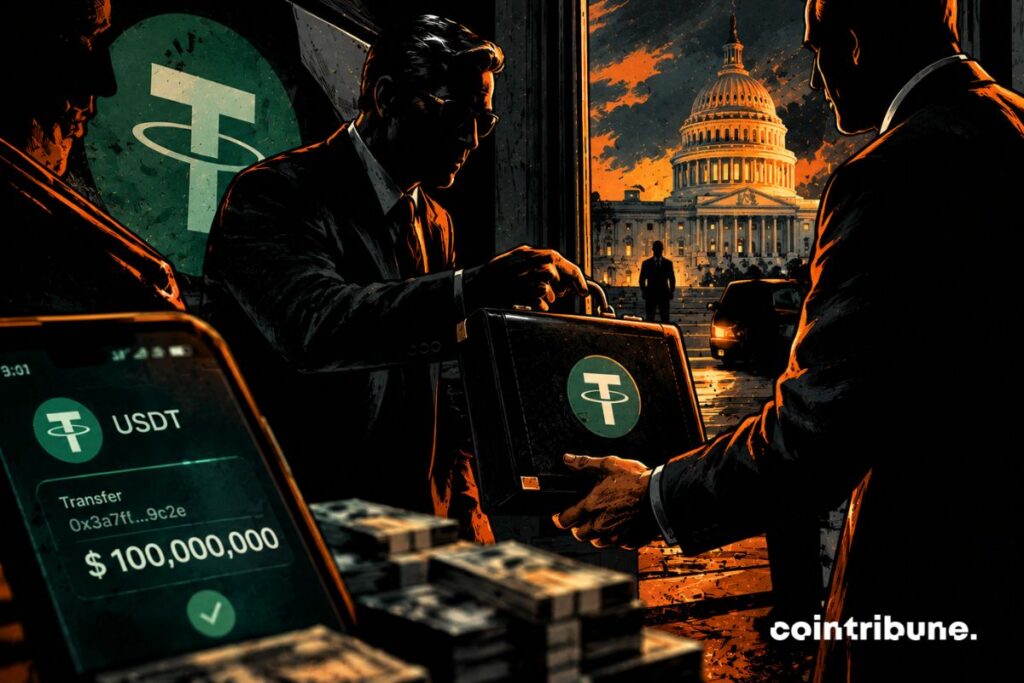
A major political and judicial storm has just erupted at the heart of the American crypto ecosystem. The issuer of the USDT stablecoin, Tether, is under fire from a federal investigation led by the United States Senate. At the center of the accusations is the payment of several million dollars to a senior White House official aimed at influencing the regulation of digital assets and tailoring laws to measure.
In brief
- The US Senate is officially investigating the issuer of the USDT stablecoin, Tether.
- Tether allegedly paid $6.3 million to a firm linked to Bo Hines, then a crypto adviser at the White House.
- These funds allegedly served to negotiate strategic relaxations under the GENIUS Act.
- The chairman of the Senate investigative subcommittee demands all contracts and exchanges be handed over under threat of sanctions.
Crypto: $6.3 Million Paid by Tether to the White House
The case broke out following an investigative report published by the Wall Street Journal. According to the economic daily’s revelations, Tether allegedly paid about $6.3 million to a consulting firm called Nxum. A major issue is that this firm was co-founded and partially owned by Bo Hines, at the very time when he was acting as senior adviser on digital asset and crypto policies at the White House.
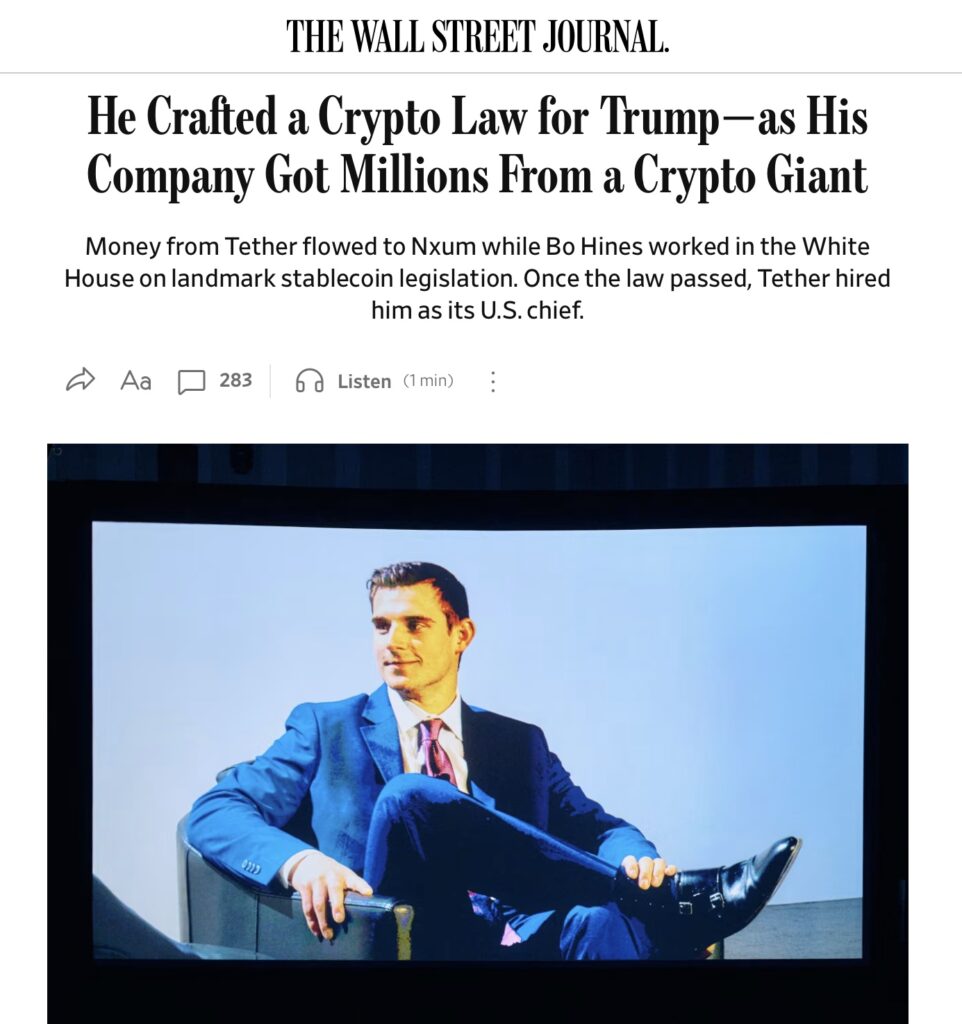 Wall Street Journal article on Tether’s transaction to Bo Hines.
To conceal this direct financial link between the USDT issuer and the executive adviser in office, the payments were allegedly not made transparently. The report indicates that Tether routed its crypto funds through an intermediary agency (Notorious), which then transferred them to Nxum. This arrangement aimed to bypass the strict ethical controls imposed on officials in the US administration.
| Entity involved | Role in the case | Amount / Key action |
| Tether (USDT) | Issuer of the stablecoin | $6.3 million paid via intermediaries |
| Bo Hines | White House crypto adviser / CEO of Tether U.S. | Modification of the GENIUS Act & conflict of interest |
| Nxum Group | Intermediary consulting company | Recipient of secret funds |
| US Senate (Richard Blumenthal) | Parliamentary investigation body (PSI) | Official injunction set for November 6, 2026 |
Genius Act: A Tailor-Made Law for USDT? The US Senate’s Reaction
The consequences of these suspicious payments apparently quickly manifested on the legislative front. During his tenure at the White House, Bo Hines weighed heavily in negotiations surrounding the GENIUS Act, a key law aimed at regulating stablecoins in the United States. He reportedly obtained strategic exemptions and an extension of the compliance timeline from 18 to 36 months, thus offering crucial relief to Tether to continue its crypto operations without risk of blockage.
Only a few weeks after leaving the government in August 2025, Bo Hines executed a perfect “revolving door” move by becoming CEO of the American branch, Tether U.S. Faced with these revelations, the political reaction was swift. Democratic Senator Richard Blumenthal, chairman of the United States Senate Permanent Subcommittee on Investigations (PSI), officially seized the case:
The alleged payment of several million dollars by Tether to a company controlled by the White House official primarily responsible for crypto policy calls into question federal laws on ethics, anti-corruption, and lobbying.
Ultimatum by November 6 for Tether: What Does the Crypto Company Risk?
The US Senate immediately took action by sending formal injunction letters to Paolo Ardoino, CEO of Tether, as well as to Nxum’s management. Lawmakers demand the submission of all contracts, financial statements, and encrypted message exchanges by November 6, 2026. Investigators are particularly interested in internal directives from Tether’s management instructing to “crush” any opposition to their legislative amendments.
This procedure exposes Tether to significant legal and operational risks in the United States. If suspicions of violations of anti-corruption and illegal lobbying laws are confirmed, the repercussions could go beyond simple financial fines. While Tether seeks to strengthen its presence on American soil with Tether U.S., this political scandal could severely undermine institutional trust and push regulators to impose unprecedented constraints on the crypto market.
This political interference scandal in crypto calls into question Tether’s lobbying methods and casts a shadow over the negotiations of the GENIUS Act in the United States. Do you think this US Senate investigation could weaken the dominant position of USDT against its regulated competitors?
Maximize your Cointribune experience with our "Read to Earn" program! For every article you read, earn points and access exclusive rewards. Sign up now and start earning benefits.
Disclaimer: The content of this article solely reflects the author's opinion and does not represent the platform in any capacity. This article is not intended to serve as a reference for making investment decisions.
You may also like
Apple Prints TD Sequential Sell 9 — Last Two Led to 15.66% and 13.63% Corrections

The Collapse of "Consensus Trading" and the Birth of a New Consensus! Goldman Sachs Explains: Why Institutions Are Currently Significantly Reducing AI Holdings
The extremely crowded trade of "going long on AI, short on everything else" is undergoing a painful unwinding—markets are no longer satisfied with the "burn rate narrative." Mega-scale cloud providers must deliver real, visible revenue conversions alongside $1.1 trillion in capital expenditures. A power gap of 40-50 gigawatts, rising capital costs, and a macro paradigm shift from an era of "overspending" are turning AI trades from a matter of faith into a harsh test of monetization.

Starknet TVL crashes 3.7x to $42M after getting 93% vote to become L1
Pundit to XRP Holders: Listen to This SWIFT Interview With Finextra Research

Crypto prices
More


