
High interest rates put heavy pressure on gold prices, but ETFs are still increasing their holdings! Three completely different scenarios may unfold for gold by the end of the year

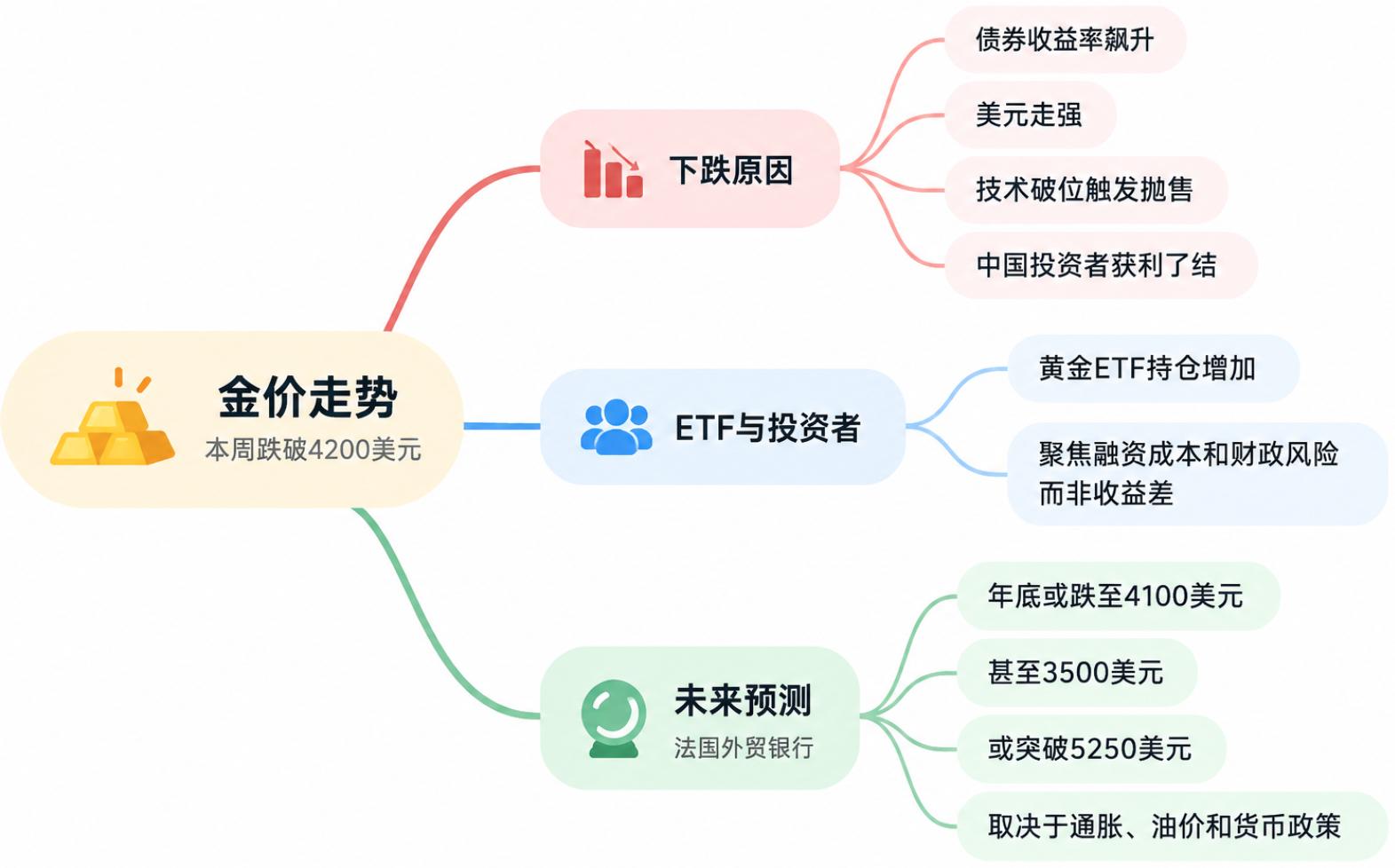
Gold prices fell below $4,200 per ounce earlier this week, triggered by a new wave of selling due to surging bond yields, a stronger dollar, and a technical breakdown. Meanwhile, holdings in gold ETFs continue to rise, indicating some investors are not withdrawing from this market.
Ole Hansen, Head of Commodity Strategy at Saxo Bank, stated that gold currently faces a core dilemma: rising interest rates are weakening the appeal of holding non-yielding assets, but higher rates are also increasing pressure on fiscal and financial systems.
Hansen pointed out that the U.S. 10-year real yield has climbed to 2.85%, an 18-year high, and the short-term interest rate market is currently pricing in three more Fed rate hikes by next April, each of 25 basis points.
“The weakness in gold prices reflects surging bond yields, a stronger dollar, and technical sell-offs following the break of support levels, possibly magnified by profit-taking from Chinese investors ahead of the Golden Week holiday.” Hansen wrote.
ETF Fund Flows Become a Key Support
Gold currently still shows a signal that runs counter to interest rate trends: while real yields keep rising, gold ETF holdings continue to increase.
Hansen believes this indicates that some investors are more focused on the financial and fiscal risks that high funding costs may bring, rather than simply comparing the yield gap between gold and bonds.
“The key question is whether this demand can be sustained. Therefore, attention will remain on ETF fund flows, especially from those investors who seem less sensitive to interest rates and more concerned about the financial consequences of persistently high borrowing costs.” he said.
However, higher interest rates are also putting pressure on the corporate financing market. Hansen pointed out that signs of stress are already appearing at the weaker end of U.S. corporate credit, with CCC-rated bond spreads widening significantly and the gap with B-rated debt reaching levels previously associated with significant economic slowdowns.
Last Friday, the spread between U.S. high-yield corporate bonds and Treasuries widened a further 12 basis points to 294 basis points, the highest since April.
If financing pressures continue to mount, investors may need to sell their most liquid assets to satisfy margin calls and other cash needs. Hansen believes that because the gold market is large and highly liquid, it could in turn become a source of cash raising.
“The financial and fiscal pressures caused by higher yields could strengthen the long-term investment logic for gold, while severe liquidity tightening could initially trigger selling and depress prices.” he said.
Low U.S. Equity Volatility Temporarily Cushions Gold
Joy Yang, Global Index Product Management Director at MarketVector Indexes, also believes that gold has recently shown a certain degree of resilience.
In an interview with Kitco News, she said that despite a sharp rise in U.S. Treasury yields, equity market volatility remains low. The VIX has recently hovered around 15, while gold prices have held initial support above $4,150 per ounce.
“I think this resilience in gold also reflects the low volatility in the stock market.” Yang said.
She believes that both stock and gold investors are currently watching to see if high inflation will persist and if the latest round of oil price shocks will continue. Some investors may be using gold to hedge against these risks.
Since September, fund flows into gold ETFs have remained strong. Yang believes that this reflects a shift in how some investors view gold: it is no longer simply an asset competing with bonds for yields, but is also used as a hedge against broader macro risks.
However, this demand does not mean gold will not continue to fall. Yang points out that if the market really enters a cash scramble phase, gold ETF investors may also sell gold, in which case gold could see fund outflows alongside equities.
She does not expect gold prices to return to the lower price ranges of recent years, but believes that uncertainty brought by debt, geopolitics, sanctions, and supply shocks may keep gold in a structurally higher range.
“I don’t really see a breakout, but I also don’t think gold will fall back to last year’s or even two years ago’s levels.” said Yang.
Natixis: Gold May Fall to $4,100 by Year-End, Could Also Break Above $5,250
Bernard Dahdah, precious metals analyst at Natixis, offers a wider price range for gold.
The bank’s latest report proposes three scenarios: the gold price falls to $4,100 by year-end, drops to an extreme of $3,500, or, if inflation drops rapidly and forces the Fed to pivot, breaks out above $5,250.
This is a clear change from Natixis’ view at the end of August, when Dahdah raised the year-end gold price target to $5,000, mainly based on safe-haven demand due to instability in U.S. debt and bond markets.
However, over the past month, the relationship between gold and oil prices has turned negative again. Natixis believes that higher crude oil prices intensify inflationary pressures, thus raising expectations for further Fed rate hikes and increasing the opportunity cost of holding gold.
The bank also pointed out that the correlation between gold and the U.S. 10-year Treasury yield has re-emerged since the end of August, while the relationship between gold and the U.S. Dollar Index has remained relatively stable this year.
Even with gold’s price decline, physical gold ETF holdings continue to rise. Dahdah stated: “Some investors are buying the dip in ETFs, but structural demand cannot offset the rate-driven repricing.”
Central bank demand is also a variable. Previous strong official sector gold purchases helped gold withstand high bond yields, but Natixis believes that if oil prices remain elevated and the dollar stays strong, some central banks may prioritize curbing inflation and supporting their currencies rather than continuing to increase gold reserves.
In the base case scenario, Natixis expects the Fed to hike rates again in December, with gold prices pressured for the remainder of 2026, heading toward $4,100 by year-end. If the Fed keeps rates unchanged through 2027, de-dollarization, a rebound in investor demand, and central bank gold buying could push gold to about $4,750 by the end of next year.
In a pessimistic scenario, if the Middle East situation escalates further and results in the closure of the Strait of Hormuz, oil prices could climb even higher and inflation would remain elevated, forcing the Fed to keep rates high for a longer period.
If, at the same time, central banks switch from gold buyers to net sellers to release reserves and support their currencies, Natixis believes the gold price could fall to $3,500.
The other scenario is the complete opposite. If the Strait of Hormuz returns to normal, oil prices fall back significantly, and inflation cools rapidly, the Fed could have room to pivot to easing. In this scenario, Natixis believes gold would stabilize above $5,250.
Disclaimer: The content of this article solely reflects the author's opinion and does not represent the platform in any capacity. This article is not intended to serve as a reference for making investment decisions.
You may also like
Apple (AAPL.US) plans to enter the next major category of smart homes in the new AI application sector, with a central device set to be released on October 13
Apple is finally preparing to enter the next major sector: smart home.
Oil prices returning to $100 increase inflation concerns; global government bonds expected to record their worst quarterly performance since 2024
Global government bonds are heading for their worst-performing quarter since 2024.
Mercuryo’s zero-fee offer waives fees on first three MetaMask buys in Canada
CSD BR and Ripple launch live fund record mirroring on XRP Ledger for $4 trillion assets

Crypto prices
More


