
Goldman Sachs TMT Conference Transcript: Top OpenAI clients use 8 times more than regular clients, “pay for results” will replace “pay per token”

Yesterday, Goldman Sachs and Citigroup simultaneously held TMT conferences. Here are some highlights from GIR. This time, there's a lot of information, and both conferences are still ongoing. We will keep updating everyone with the latest on-the-ground news.
TMTB: Astra also received significant attention over the weekend, although the early consensus is that, aside from 3D modeling, spatial reasoning, and a handful of other use cases, it has not yet achieved a comprehensive leap over Fable 5.1. More importantly, given the lineup and pace of model releases before OAI’s DevDay on September 29 (such as Grok 4.7, Fable 5.1, META’s Watermelon, etc.), investors seem more confident about the September trajectory.
Meanwhile, we’re seeing these models being applied more concretely: Grok Bot for workplace tasks, Instinct for consumers, and META's newly launched Muse also joined this lineup today.
Bullish interpretation in the semiconductor field: if better tools can empower intelligence to be effective across a wider set of tasks, you may not need an exponential leap in intelligence itself. This could provide the elusive next major use case for semiconductors that bulls have been anticipating since programming.
openai: The overall tone is optimistic, as expected, but there's not much new data...
The main line is enterprise business. Consumers: The enterprise ratio, which was 60:40 at the start of the year, reached 50:50 by mid-year ahead of schedule. In July, the total annualized run-rate revenue grew by +20% month-on-month, with enterprise revenue up +32%—this is on a high base already. Truly new numbers concern usage intensity: the top 10% frontier enterprise customers now use 8x the tokens of ordinary customers (previously 3x); internal OpenAI usage is 33x higher, which Friar defines as a preview of existing customer trajectory, suggesting enterprise growth relies not on acquiring new users but on increased consumption per customer. Codex grew from 100,000 users to 25 million, and Canva code is now 100% generated by OpenAI—these all support this growth curve.
Model: Rather than focusing on cost per token, focus on cost per task—output tokens needed for the same result are 68% fewer than competitors. The response to open weights is most aggressive: Luna’s deployment on Cloudflare is even cheaper than GLM 5.3, meaning cutting-edge labs can drive inference costs below open-source self-deployment. The pricing model is subscription → by usage → by outcome, making it clear they aim to move away from token-based billing to vertical revenue-sharing.
Computing power: Still feels extremely tight, with weekly trade-offs between training, research, and inference; full-stack is a spectrum rather than a binary, and more in-house builds are happening. ROI is measured as the ratio of total income (so far + next 12 months' expected) to invested compute for each model series, checking for a significant positive turn; gross margin expansion depends on higher revenue per GW and a declining cost curve. In response to criticism of over-investment, they stated this year there were real returns.
AMD up 6% due to strong demand spillover for CPUs from the computing use cases (need for more CPUs). The CFO and CEO showed confidence in MI450/Helios ramp progress during the Citigroup event, even as execution concerns circulate in the market. They stated that demand and shipments for 2027 now exceed AMD’s original plans, and forecasts from all three anchor customers (Meta, OpenAI, Anthropic) are above expectations; current constraints are supply, not demand.
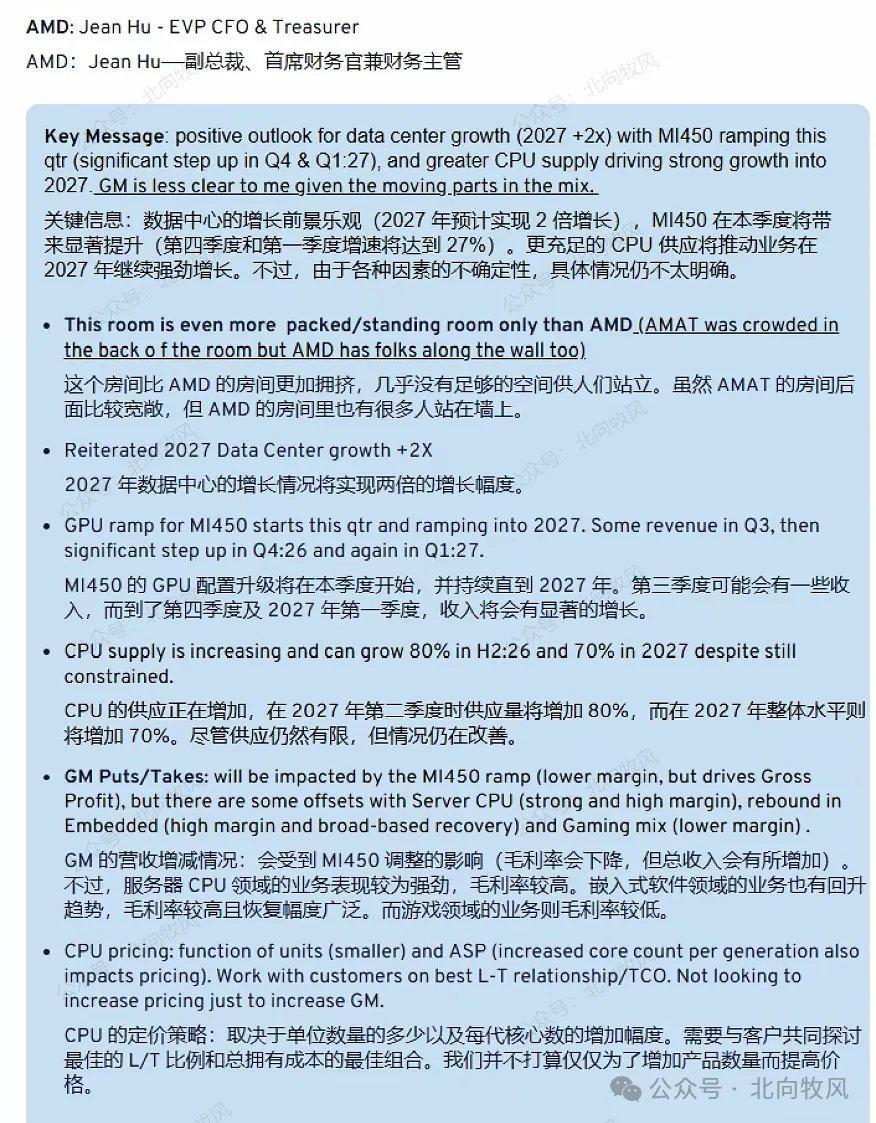
Optical Communications (LITE +11% / COHR +7%)
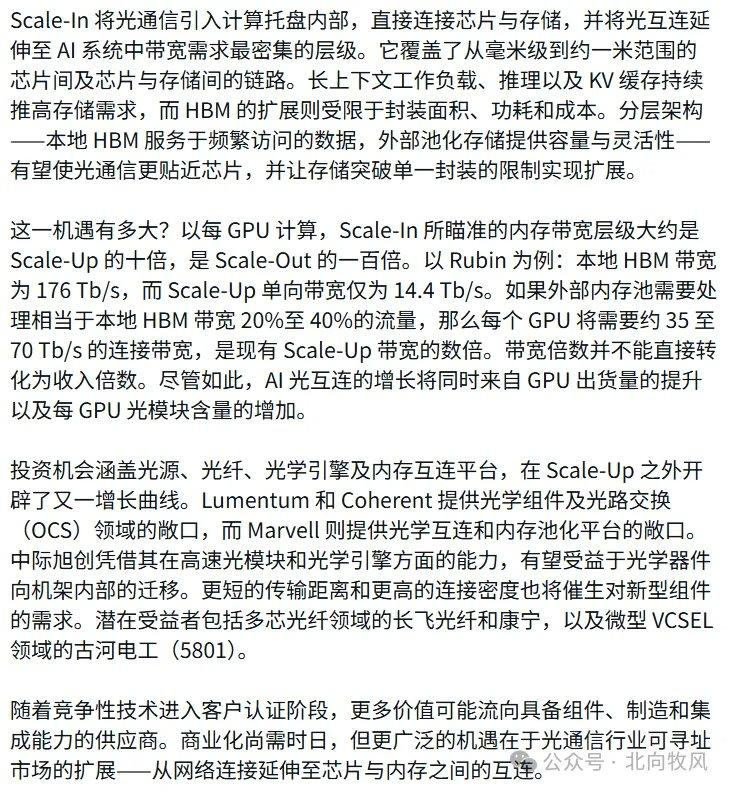
At the Citigroup TMT conference, riding AMD’s buying momentum: The company plans to launch accelerators in H2 2027 for a larger-scale extended domain (you can refer to an earlier article for this; yesterday, Corning also announced fiber orders signed through 2032, confirming strong demand: scale-across (inter-data center connectivity) TAM), simultaneously providing copper-based and near-packaged optical interconnect solutions. Copper and optics are likely to coexist across several product generations rather than undergoing a single all-industry switch.
This is the first time a commercial GPU vendor has given a clear timeline and roadmap for bringing optical communications into the extended domain core (where each GPU’s bandwidth is multiples of that outside the extension—scale-out), rather than just at the switch level. This validates the LITE CEO’s statement last week from the customer side: the next 12 to 18 months will be a critical window for optical communications inside server racks. Also, AWS is partnering with QCOM to fund 1.6T optical interconnects, further reinforcing the trend.
At Deutsche Bank’s tech forum last week, Lumentum CEO Michael Hurlston also mentioned viewing Scale-In as the next big opportunity: this is the direction to watch in the next 12 to 18 months.
AVGO +3.0%
CEO Hock Tan defended the $115B/$230B AI revenue path at Goldman Sachs, stating the limiting factor is power-ready sites, not silicon wafers. Broadcom can already lock in capacity for 2027.
Its value framework is the key message: for top frontier models, each GW of power can yield about $30 billion in annual recurring revenue, with operating costs around $10 billion; their token-based calculations show global inference costs of about $200 billion annually and model income at $150 billion. Frontier models earn at least 75% of that revenue with only half the tokens, while open weight players spend $100 billion to make just $30 billion, so the value flows to where intelligence keeps advancing, while second place gains nothing.
He also rebutted claims of cyclicality on the Apollo/Blackstone platform (saying it creates demand through financing, not cycles), and outlined the chip roadmap from dual-chip to quad-chip to octa-chip.
Applied Materials (AMAT) up 4.0%
CFO Brice Hill said at the Citigroup conference that all indicators still point to growth: each quarter this year, the top customer’s rolling eight-quarter forecast is rising; fab monitoring now covers over 100 factories; advanced logic and DRAM utilization is near 100%; ramp bottleneck is clean room construction, not demand.
New information includes DRAM capacity build-out estimates—with 300,000 to 400,000 wafers initiated annually the next few years; each 100,000-wafers initiated means about $1 billion in equipment investment, whereas upgrades only need about a quarter of that. That’s why he calls this a larger investment cycle. He also said HBM spec downgrades are neutral for equipment demand, as the number of systems matched per memory chip is rising, not falling.
ALAB -7%
Negative spillover from QCOM/AWS deal: Amazon is its biggest customer, and the QCOM deal addresses internal network bottlenecks with co-developed optical interconnects at up to 1.6T, using Qualcomm’s SerDes and optical DSP—a core field for ALAB (Aries, Taurus, Scorpio). Amazon holds ALAB warrants, conditional on $6.5 billion in purchases, while QCOM signed parallel $60 billion warrants, raising investor concern about potential market share loss.
SNDK -0.1%
CFO Luis Visoso told Citigroup the new business model already covers 50% of storage bits this fiscal year and will reach two-thirds by fiscal 2028, with a gross margin floor around 80%. Two contracts have been reopened because customers wanted to up order volumes and extend the term. Bit supply growth is entirely driven by process node advances, with no new fab capacity, keeping industry bit growth rate at a mid-high 15–17% range.
His view is that, by definition, demand cannot outpace supply. New info: the KV cache demand model behind high-bandwidth flash has been revised upwards in every recent update, with related products set for customer delivery in 2027; $4.5 billion out of last quarter's $5 billion free cash flow was used for stock buybacks.
ANET up 0.6%
CTO Ken Duda and CFO Chantelle Breithaupt explained the revenue guide raise at Goldman Sachs: supply chain efforts combined with two quarters of order visibility through August, and a nearly 3x surge in procurement commitments to $9.7 billion is a demand signal—not inflation.
Horizontal scaling is about 30% of this year’s $3.5 billion AI target, as clients can’t secure enough power at single sites; vertical scaling is white space—ANET has almost no share, but expects ramping to start at end-2027 with volumes in early 2028. Price hikes are only for future orders with memory-intensive BOMs to keep profit margin neutral. On new cloud vendors, CFO's principle is prepayment or exit, since not all new cloud providers will succeed.
Disclaimer: The content of this article solely reflects the author's opinion and does not represent the platform in any capacity. This article is not intended to serve as a reference for making investment decisions.
You may also like
Hollywood Plans "Film Production Reshoring"! US Economic "Soft Landing" Welcomes a $249.1 Billion Film Incentive Blueprint
A study shows that federal incentives for film and television production will bring $249.1 billion in revenue to the U.S. economy by 2035 and add 143,500 full-time jobs. The Motion Picture Association has been working with Hollywood unions to launch a campaign for national incentives to better compete with markets such as the United Kingdom and Australia.

Tonight, a "dovish rate hike"?
The Federal Reserve is almost certain to raise interest rates tonight, but the key issue is "what will be said after the hike." Citi characterizes this move as a "fine-tuning" adjustment, suggesting there is no inevitable future rate hike, yet warns that if Chairman Powell does not provide clear forward guidance, it will trigger significant market volatility. Goldman Sachs bluntly stated that there is insufficient economic foundation for this rate hike, with inflation being merely a one-off factor, and expects this to be a "signal-less rate hike."
JPMorgan: "Open source disruption" and "AI safety" are not issues, there is still room for capital expenditure in the next two years, semiconductor equipment will become the "new bottleneck"
JPMorgan believes that open-source models are not a threat, regulatory disruptions are only short-term, and cloud vendors’ leverage remains low—the fundamentals of computing power investment have not changed. It forecasts that the capital expenditure of the seven major tech giants will soar from $443 billion in 2025 to $1.577 trillion in 2027, with semiconductor equipment becoming the core bottleneck of the supply chain and a new round of price increases expected in wafer foundry and advanced packaging.
Micron executive: Storage determines AI limits, substantial new capacity will come after 2028
Micron executive Sumit Sadana stated that memory bandwidth and capacity have become the core factors determining the performance ceiling of AI systems. In the face of structural imbalances between supply and demand, Micron expects to increase capital expenditure to over $45 billion in fiscal year 2027, but due to process complexity, substantive new capacity will not be released until 2028. Additionally, long-term supply agreements are reshaping the industry's business model, and humanoid robots will trigger the next wave of massive demand.
Crypto prices
More


