Bitget App
Trade smarter
Buy cryptoMarketsTradeFuturesEarnAISquareMore
Why Are Bitcoin, Ethereum and XRP Prices Crashing Today?

Why Are Bitcoin, Ethereum and XRP Prices Crashing Today?

CryptoNewsNetCryptoNewsNet2026/09/02 04:18
By:CryptoNewsNet
Back to the list

Why Are Bitcoin, Ethereum and XRP Prices Crashing Today?

Why Are Bitcoin, Ethereum and XRP Prices Crashing Today? image 0  coinpedia.org 5 m
Why Are Bitcoin, Ethereum and XRP Prices Crashing Today? image 1

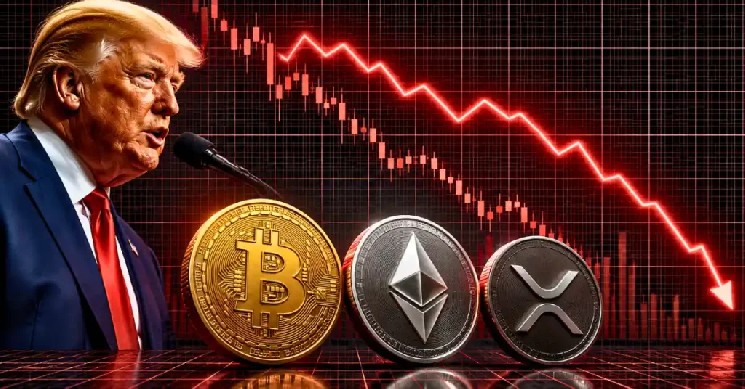
Bitcoin has slipped to $76,926.53, down 2.2% over the past day, pulling Ethereum and $XRP lower with it after US forces struck Iranian targets near the Strait of Hormuz, sending oil prices to their highest level in 40 days and rattling investors across every major asset class.

A Fast-Moving Geopolitical Shock

President Trump confirmed the strikes and warned Iran against retaliating, later adding he isn’t trying to push Iran back to the negotiating table and “couldn’t care less” whether Tehran signs any deal.

Oil surged past $90 a barrel on the news, its highest print in roughly six weeks, as traders priced in the risk of a prolonged disruption to one of the busiest shipping lanes for global crude.

The fallout wasn’t contained to oil or crypto. Japan’s Nikkei tumbled 2.7%, erasing an estimated ¥31.8 trillion, around $202 billion, in market value, with the damage concentrated heavily in tech stocks. South Korea’s annual inflation came in at 3.1%, slightly below the 3.2% forecast, doing little to offset the broader risk-off mood sweeping through Asian and global markets.

Where the Numbers Stand

Total crypto market cap has slipped to $2.7 trillion, down 1.4% on the day, with $82.4 billion in trading volume. Ethereum has fallen to $2,395.12, down 3.0%, while $XRP has dropped to $1.33, down 3.7% on the day. Solana is down 4.0% at $98.77, and BNB has slipped 1.8% to $681.55.

A Familiar Pattern on the Charts?

Not everyone reading the pullback as purely bad news. Analyst Ali Charts pointed to similarities between Bitcoin’s current price structure and its 2023 bottoming pattern, when Bitcoin tested resistance three separate times, each attempt followed by a roughly 20% pullback toward the middle of its trading range, before finally breaking out on a fourth attempt and igniting its last major bull run.

Bitcoin has already been rejected once near the top of a similar channel this time around, and if the pattern repeats, Ali Charts said further failed breakout attempts and a pullback toward the $70,000 zone could come before any decisive move higher.

For now, the immediate driver remains geopolitical. With US-Iran tensions escalating in real time and oil prices climbing on fears of a wider disruption, crypto markets are trading defensively until there’s more clarity on how far the conflict extends.

0
0

Disclaimer: The content of this article solely reflects the author's opinion and does not represent the platform in any capacity. This article is not intended to serve as a reference for making investment decisions.

Understand the market, then trade.
Bitget offers one-stop trading for cryptocurrencies, stocks, and gold.
Trade now!

You may also like

The Capital Trends Behind the AI Computing Power Rebound: JPMorgan Fund Flows Reveal Retail Buy-In "Shrinking," Pouring Into Nvidia, SanDisk and Other Computing Power Core Companies

What has been revealed is not a "complete withdrawal of retail investors from AI," but rather a significant slowdown in overall market entry pace under macroeconomic pressure, with stock selections becoming more concentrated. In response to the Federal Reserve's unanimous decision to raise interest rates by 25 basis points, increasing the policy rate to 3.75%–4.00%, JPMorgan's assessment is: if this is simply a withdrawal of last year's "insurance-style rate cuts" during a shallow rate hike cycle—and if corporate earnings remain strong and the Middle East situation does not further spiral out of control—the stock market is still capable of absorbing rising interest rates.

智通财经2026/09/18 03:36

Vote Result 7-2! Bank of Japan Raises Interest Rates at Fastest Pace Since 1990, Does Not Signal a Clearly More Hawkish Stance

The Bank of Japan has raised interest rates to 1.25%, marking the highest level since 1995 and the sixth increase since exiting the negative interest rate policy in March 2024. Out of the nine committee members, Asada and Sato voted against the hike, citing the current economic situation, reflecting ongoing internal disagreements over further tightening. In its statement, the Bank of Japan indicated it will continue to raise rates and adjust the degree of monetary easing, but the forward guidance language showed limited changes from the July statement, without sending notably more hawkish signals.

华尔街见闻2026/09/18 03:36