
Vitalik updates Ethereum roadmap: Privacy, quantum security, and simplification become higher priorities

Author: Vitalik Buterin
Translated by: DengChain Community
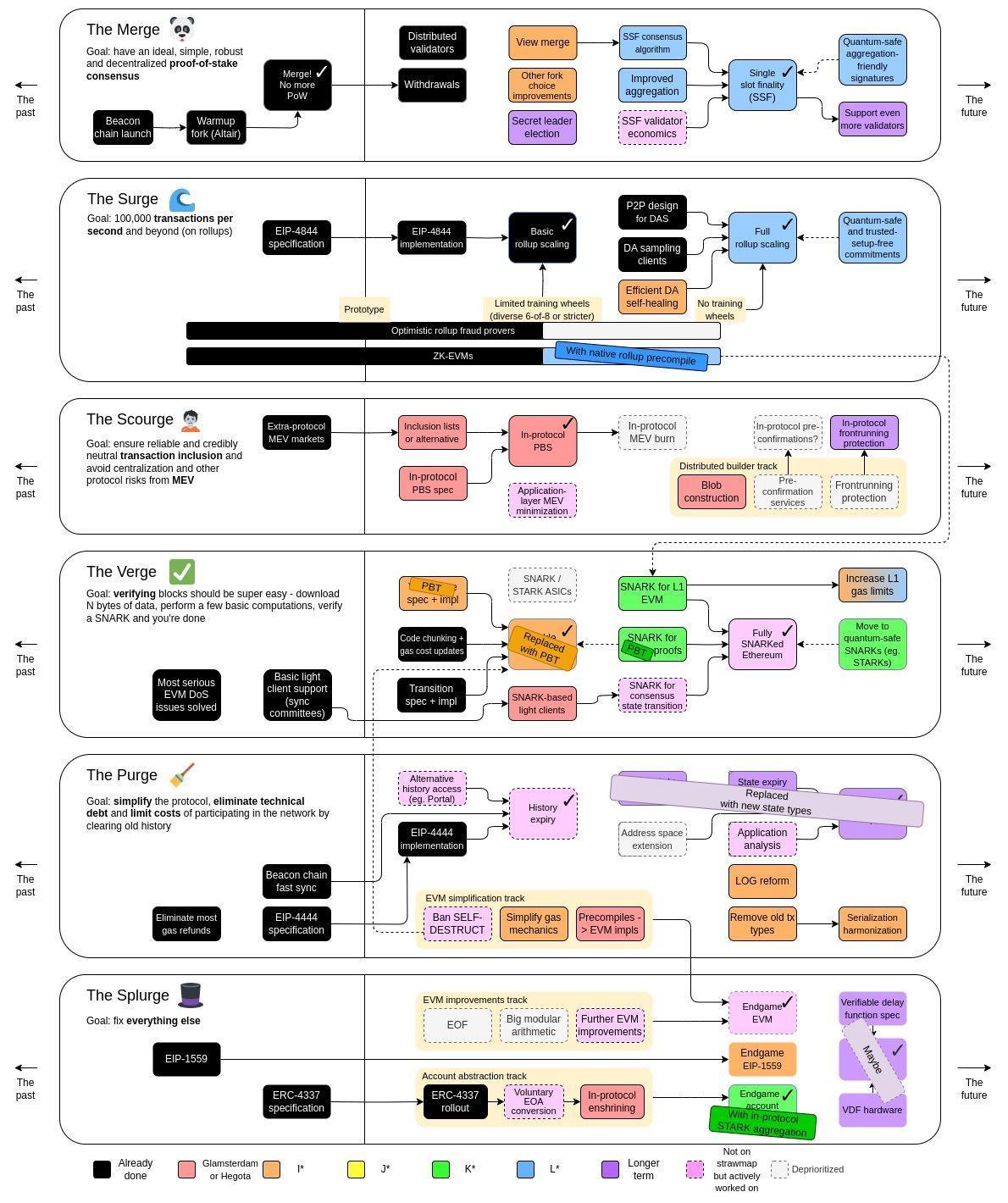
I have updated the 2023 roadmap and overlaid the positions of the original items onto their current locations in the Strawmap.
Overall, there is a high degree of overlap, however:
- The order of some items has been adjusted (for example, quantum security is now a higher priority)
- Some items have been downgraded (for example, VDF; many EVM improvements)
- Some items have been replaced by better constructions (for example, Verkle -> unified BT -> PBT; state expiry -> new state types)
New Additions Beyond the 2023 Roadmap
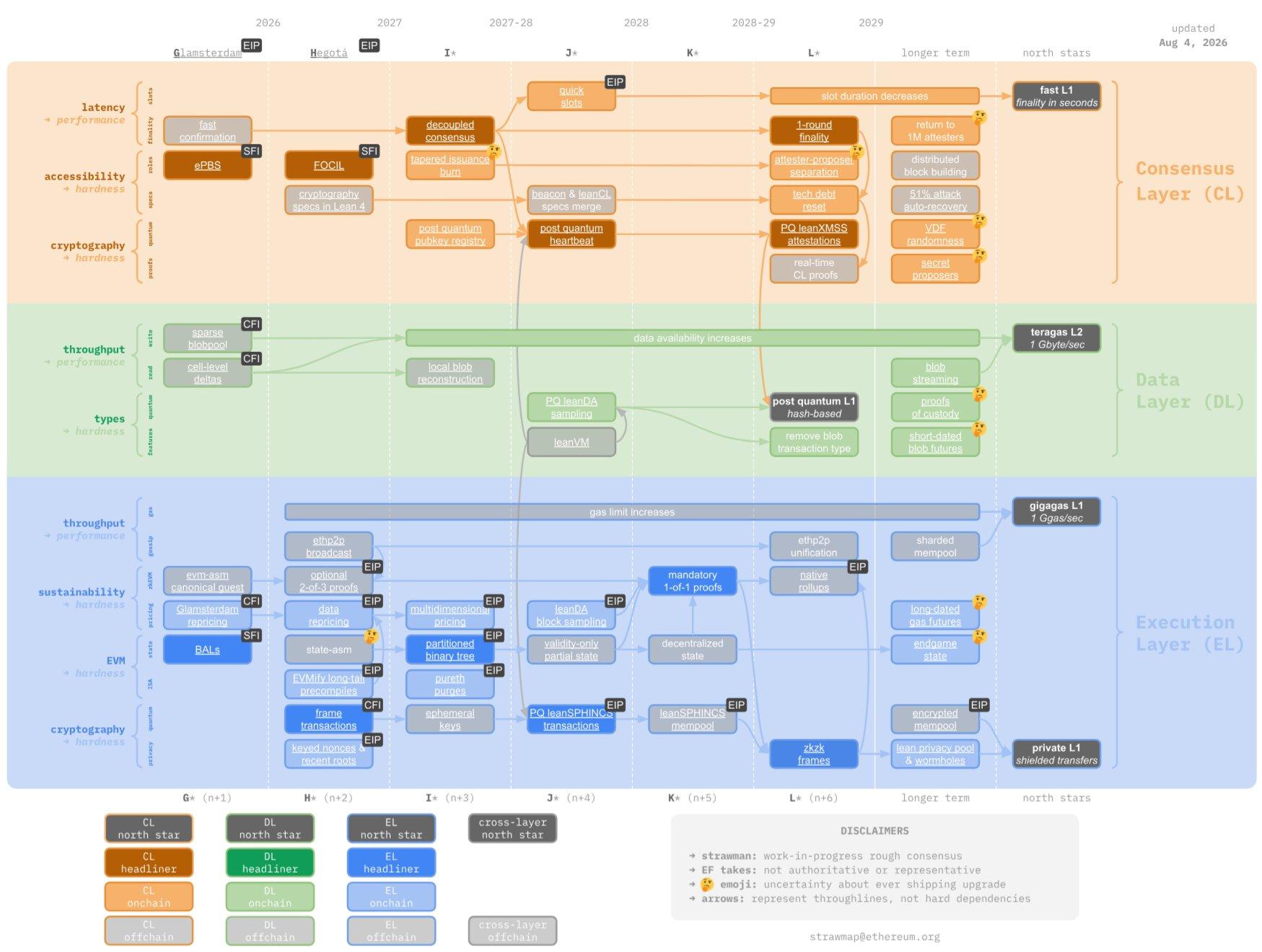
However, most notably, there are some brand new contents in the Strawmap that do not appear above, because they simply did not exist in the 2023 roadmap. These reflect changes in priorities.
Take note of the following:
- A primary focus on strong privacy. This covers: keyed nonces and recent roots, multiple aspects of FOCIL, lean privacy pool and wormholes
- Radical scaling in a post-quantum context. This covers: leanSPHINCS signatures and aggregation, zkzk frames
- Simplification of specifications to aid formal verification (only with modern AI is full formal verification of all aspects possible)
- Blob and gas futures (this idea did not exist at all in 2023)
- Native rollups (in 2023, SNARKs were far from advanced enough to consider this)
- Allowing for a more open design space for “the future of EVM.” zkzk frames already mean the protocol will expose some non-EVM ISA (Instruction Set Architecture) to users — with leanISA and RISC-V currently as the leading candidates. These ISAs are simpler, more modern and efficient than EVM. Once they exist, why not expose them to all developers? (And then, why not make EVM an IR on top of those ISAs, instead of enshrining it as a fixed and highly complex base protocol feature?) That said, deeper explorations here are premature even for Strawmap.
- New state types are not just a replacement for state expiry; they represent a fundamentally different Ethereum scaling paradigm.
 Common Themes in Scaling
There is a common theme in scaling, which also appears in state types and zkzk frames (both new ideas): rather than trying to maximize the scaling of all Ethereum activity, we are attempting to create specialized mechanisms with stricter properties that are more scaling-friendly, while supporting users and applications with the heaviest loads both today (e.g. token transfers, exchanges) and tomorrow (e.g. privacy protocols).
Another common theme is treating STARK and AI-accelerated FV as first-class citizens—Ethereum’s technical future will bet on them. There is recursive STARK at many layers of the protocol, and one specific primitive (“aggregate-to-union verification dependency” primitive) is expected to be used in three places: EL, CL and DL. This is only safe with formal verification, which is only possible in practice with modern AI tools.
Many Steps Forward in Maturity
Overall, we have made many steps forward in maturity. Behind this is the enormous effort of dozens of Ethereum researchers and developers working on all these features.
Ethereum will be quantum secure. Ethereum will put users’ privacy first. Ethereum will be secure. Ethereum will be censorship-resistant. Ethereum will perform highly and scale, while meeting the above requirements. And Ethereum will be Lean.
Disclaimer: The content of this article solely reflects the author's opinion and does not represent the platform in any capacity. This article is not intended to serve as a reference for making investment decisions.
You may also like
Qualcomm (QCOM.US) acquires robotics software company PickNik to strengthen its presence in the physical AI field
Qualcomm announced on Wednesday that it will acquire the robotics software company PickNik to enhance its presence in the field of physical AI and robotics.
10-Yr Benchmark Govt Yields - Germany vs Other Nations
Four Mac Studio systems run trillion-parameter models, Apple challenges Nvidia's narrative on inference
Apple's hardware chief pointed out that after enterprises purchase devices outright, there is no need to pay by token, and the cost-effectiveness of local computing power might be superior to long-term rental of cloud GPUs. Goldman Sachs believes that if more inference tasks shift to end devices, Nvidia's share in incremental AI activity may fall short of market expectations. Currently, Nvidia's implied volatility is at its lowest since before the pandemic, and option pricing has almost no risk premium allocated for this narrative change. Therefore, Goldman Sachs recommends buying Nvidia put options and going long on Apple.
Canadian Prime Minister: US-Canada trade agreement is still possible, but Ottawa will not give up its right to deepen cooperation with the EU
Canadian Prime Minister Carney stated that while it remains possible to reach a trade agreement with the United States, Canada will not trade its sovereignty for any deal, particularly insisting on its right to independently sign trade agreements. Meanwhile, Carney is actively promoting deeper cooperation between Canada and the European Union, covering critical minerals, energy, scientific research, and student exchanges, aiming to reduce dependence on the US and defend national sovereignty. He emphasized that in an era when connectivity can be weaponized, diversified cooperation is a necessary choice for safeguarding sovereignty.
Crypto prices
More


