
"Rather Not Earn Than Touch Musk": US Retail Investors Begin to "Dodge Landmines" with SpaceX

As SpaceX was officially included in mainstream indices such as the Nasdaq 100 this week, a value-driven “portfolio mine-sweeping” campaign is quietly spreading among U.S. retail investors.
After SpaceX completed the largest IPO in history in June, its share price once surged and then fell back more than 24%. What makes some investors even more anxious, however, is not the stock price volatility itself, but the fact that the passive investment mechanism is forcibly stuffing this company into millions of retirement accounts. According to Bloomberg, several index providers have specially revised relevant rules to accelerate the inclusion of SpaceX, a move that has sparked widespread criticism. In the meantime, at least $5.4 billion in index-tracking funds will be passively buying the stock, providing support for the pressured share price.
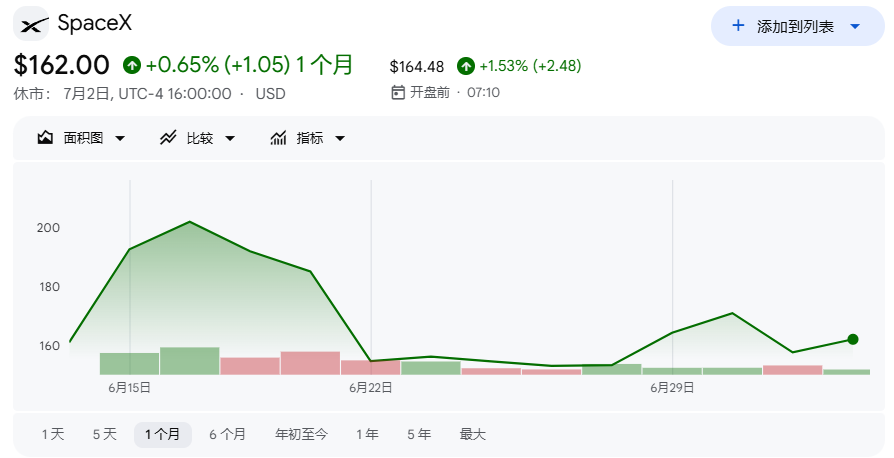
For investors who see Musk as both a political and business risk, the inclusion of SpaceX in major indices represents an unavoidable dilemma—accept passive exposure, or actively restructure their investment portfolios, even if that means higher costs or missing out on potential returns.
From Reddit to TikTok, “mine-sweeping” sentiment turns into a movement
According to the latest report from Bloomberg, Philadelphia software engineer Christopher Bejnar spent months meticulously studying ETF terms, contacting financial advisors, and transferring $50,000 into a European index fund while also buying Rocket Lab Corp, a SpaceX competitor. His sole purpose: to have his $1 million portfolio completely insulated from SpaceX.
"Even if the exposure is only one-tenth of a percent, I don’t want a penny of my money going to him," Bejnar said. He lists Musk’s political radicalism and SpaceX’s heavy reliance on debt to support "unproven technology visions" as his main concerns.
This sentiment is not unique. On Reddit’s r/investing, r/ETFs, and r/EnoughMuskSpam, posts discussing how to avoid SpaceX exposure have recently surged, with one titled “How to Avoid Investing in Musk Companies” sparking extensive discussion.
Thirty-year-old data analyst David Greer had already moved his $650,000 retirement savings out of U.S. index funds and into international index funds back in April. He described Musk as "Trump for the tech industry" and said SpaceX’s IPO was “the straw that broke the camel’s back.”
Musk’s massive assets make “avoidance” costly
Investors critical of Musk face a structural dilemma: the market capitalization of his companies is so large it’s hard to avoid them. Tesla currently makes up about 2% of the Vanguard S&P 500 ETF (VOO) and over 3% of the Invesco QQQ Trust. SpaceX is valued at around $2.1 trillion, roughly 1.4 times Tesla, placing it among the U.S. stock market’s top ranks almost overnight after going public.
With SpaceX’s official inclusion in the Nasdaq 100 after the market closed this week, and its recent additions to FTSE Russell and MSCI indices, tens of billions of dollars in passive funds will mechanically buy the stock. Emily Green, head of wealth management at Ellevest, said she’s received a surge of client inquiries hoping to exclude SpaceX. “If it weren’t for him, we wouldn’t be having this conversation,” she said, comparing the current anti-Musk sentiment to the public backlash faced by Meta after the 2016 election.
Direct indexing becomes the mainstream “mine-sweeping” tool
Faced with the “forced inclusion” of the passive investment mechanism, some investors are turning to direct indexing — buying a basket of individual stocks to replicate index performance while removing companies they don’t want to hold. Ellevest builds portfolios of about 300 stocks for such clients, covering large, mid, and small-cap U.S. stocks and developed international markets, allowing for deep personalization.
Green says that excluding one or two stocks from a broad portfolio usually does not significantly impact overall performance; previously, clients who chose to avoid Tesla also “accepted” missing out on its rally.
With the help of a financial advisor, Bejnar moved part of his funds from custodied brokerage accounts to an ETF subset that does not include SpaceX. His advisor warned him that as SpaceX continues to rise and is added to more benchmark indices, it will become harder to avoid. But Bejnar remains firm: “No matter how well SpaceX does, I won’t regret not owning it.”
The passive investment wave amplifies “winner-takes-all” effects
Behind this controversy lies a deeper contradiction in this era dominated by passive investing. Omar Qureshi, Managing Director at Hightower Signature Wealth, points out that as more and more retirement savings automatically flow into passively managed funds, index inclusion itself has become a highly valuable “privilege.”
“If you’re a big player, you’re guaranteed fund inflows,” Qureshi says, “Fund inflows boost performance, which attracts more capital to the index, creating a self-reinforcing cycle.” Despite personally avoiding SpaceX due to his negative views on Musk, as a financial advisor he still assisted clients in participating in the latest IPO.
Bejnar is dissatisfied with the revision of index rules. He believes that SpaceX will not be included in the S&P 500 in the short term—the index requires companies to be listed for at least 12 months and meet profitability and public shareholding requirements. As for the $25 billion debt financing completed by SpaceX at the end of June, he sees it as just shifting resources within Musk’s broader business empire.
Disclaimer: The content of this article solely reflects the author's opinion and does not represent the platform in any capacity. This article is not intended to serve as a reference for making investment decisions.
You may also like
Why suspend RMPs? Explanation from New York Fed SOMA Manager Perli
"Agent vs US Treasury" — Who Will Dominate the US Stock Market?
The wave of AI Agents and US Treasury yields are splitting the US stock market into two worlds: Meta's release of the Muse model boosted its market value by $220 billion in a single week, propelling the Nasdaq's standout performance; however, excluding AI stocks, the S&P 500 actually fell 1% this week, with the number of new lows on the New York Stock Exchange surpassing new highs for nine consecutive days, signaling the near end of "breadth trading." Goldman Sachs bluntly stated that this is a "frustrating cat-and-mouse game" between the stock market and interest rates—any breakout can be snuffed out by the bond market at any time, so equity holders must short US Treasury bonds to hedge simultaneously.
Hopes for a ceasefire between the US and Iran encounter obstacles again! Trump rejects Iran's seven-day proposal; inflation pressure under $100 oil prices remains difficult to ease
Trump rejects a ceasefire with Iran, and it is expected that bombings will occur again after the midterm elections. The president doubts whether Tehran will meet his demands.
Tesla ramps Optimus production 10-fold but robot hands are holding Elon back
Crypto prices
More


