

 u.today
As the asset continues to trade close to its lowest points of the year, Shiba Inu is once again facing a crucial test as exchange activity soars. Recent on-chain data indicates that more than 493 billion $SHIB entered exchanges, raising questions about whether investors are getting ready for another round of selling pressure.
Since exchange inflows frequently show that holders are transferring assets to trading venues where they can be sold, they are among the most closely monitored metrics in cryptocurrency markets.
Even more pressure on $SHIB
A half-trillion-token transfer is hard to ignore, even though inflows by themselves do not ensure a selloff, particularly given how precarious $SHIB's price action is. The technical picture is already skewed toward bears. After breaking out of a multi-month consolidation structure, $SHIB lost a smaller ascending triangle pattern that provided momentary hope for a recovery. The asset is currently trading significantly below its 50-, 100-, and 200-day moving averages at $0.0000042.
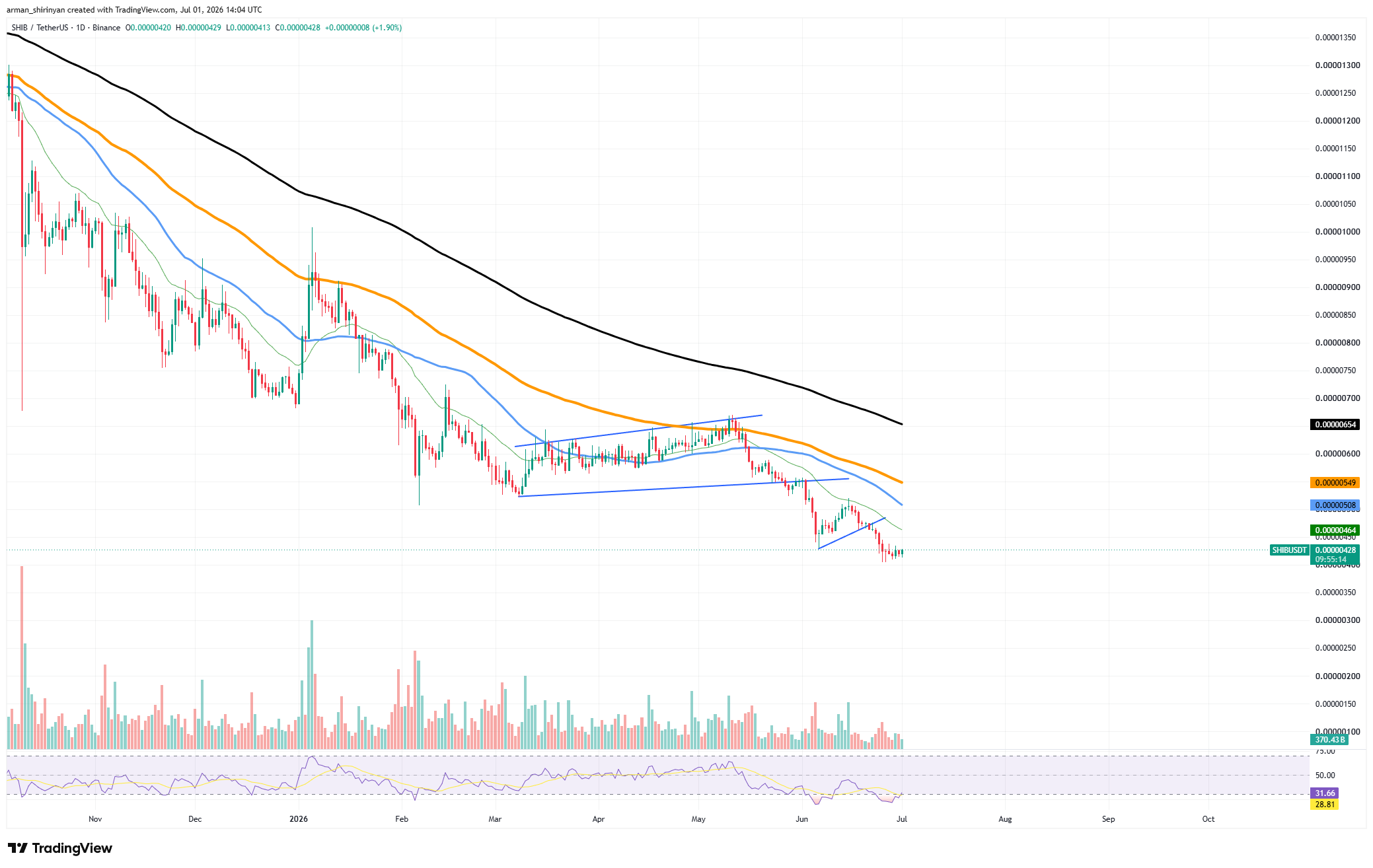 $SHIB/USDT Chart by TradingView
The downward trend of those moving averages confirms that the overall market structure remains bearish. Exchange-related metrics, however, paint a conflicting yet alarming picture. Exchange outflows totaled about 585 billion tokens, while exchange inflows surpassed 493 billion $SHIB.
Exchange reservers stay up
Large holders are actively repositioning their assets, though, as evidenced by the size of incoming transfers. There are almost no positive signals around $SHIB, even worse, things are getting more complicated. Exchange reserves have spiked to about 86.9 trillion $SHIB in an unexpected injection on exchanges only a few days ago.
Reduced reserves typically mean that long-term holders are withdrawing their coins from exchanges, which lessens the immediate selling pressure. There has not been enough network activity to compensate for the technical weakness. There has been a slight improvement in active addresses and transaction counts, but not at a rate that would indicate a significant increase in demand. A market caught between accumulation and distribution is the end result.
While the significant inflow activity indicates that some investors are preparing for possible liquidation opportunities, on-chain data indicates that other investors are still withdrawing $SHIB. Buyers must absorb this new supply while pushing the token back above key moving averages if $SHIB is to change direction. The recent half-trillion-token exchange inflow should be seen as a warning sign rather than a bullish catalyst until that time. It is still the bulls' responsibility to prove their case.


