
Chainlink joins European and Korean bank consortia to develop FX settlement network

Chainlink has joined a working group with European and South Korean banking organizations to explore the use of stablecoins for foreign exchange (FX) settlement, underscoring how blockchain technology is increasingly being tested to modernize legacy financial infrastructure.
On Tuesday, Chainlink announced Project Pangea alongside South Korean digital asset infrastructure company FairSquareLab, the Unified Korea Alliance (UniKA) — a consortium that includes more than a dozen Korean commercial banks — and Qivalis, a euro stablecoin consortium backed by 37 European banks.
Project Pangea aims to bring together financial institutions across Europe and South Korea to evaluate direct, atomic swaps of euro- and South Korean won-denominated stablecoins using Chainlink’s data infrastructure alongside FairSquareLab’s onchain foreign exchange settlement technology.
The initiative is another example of financial institutions evaluating stablecoins for wholesale financial infrastructure rather than consumer payments. According to the Bank for International Settlements, the global foreign exchange market processes roughly $9.6 trillion in daily trading volume.
Project Pangea is a working group rather than a live payment network, and no production implementation timeline has been announced. The initiative reflects a broader trend of banks experimenting with tokenized deposits and regulated stablecoins to improve cross-border payments and settlement.
Similar initiatives are also emerging. Fintech startup OpenFX recently raised $94 million to expand its stablecoin-based payments network, with an initial focus on Southeast Asia and Latin America.
Related: Brazil bars crypto settlement in regulated cross-border payment rails
Stablecoins gain traction among banks and corporations
Global financial institutions are increasingly exploring stablecoins to improve corporate payments, cross-border settlements and foreign exchange transactions, aided by clearer regulatory frameworks in the United States, Europe and other major financial hubs.
Ripple CEO Brad Garlinghouse recently described stablecoins as having a “ChatGPT moment” as more financial institutions evaluate how the technology could fit into their operations. The trend helps explain why Citigroup projects the global stablecoin market will grow to $1.9 trillion by 2030, up from roughly $315 billion today.
According to Citigroup, that expansion will be driven by continued adoption within crypto markets, a gradual shift from physical US dollar banknotes to digital dollars and the growing use of stablecoins as a store of short-term liquidity in both US dollars and local currencies.
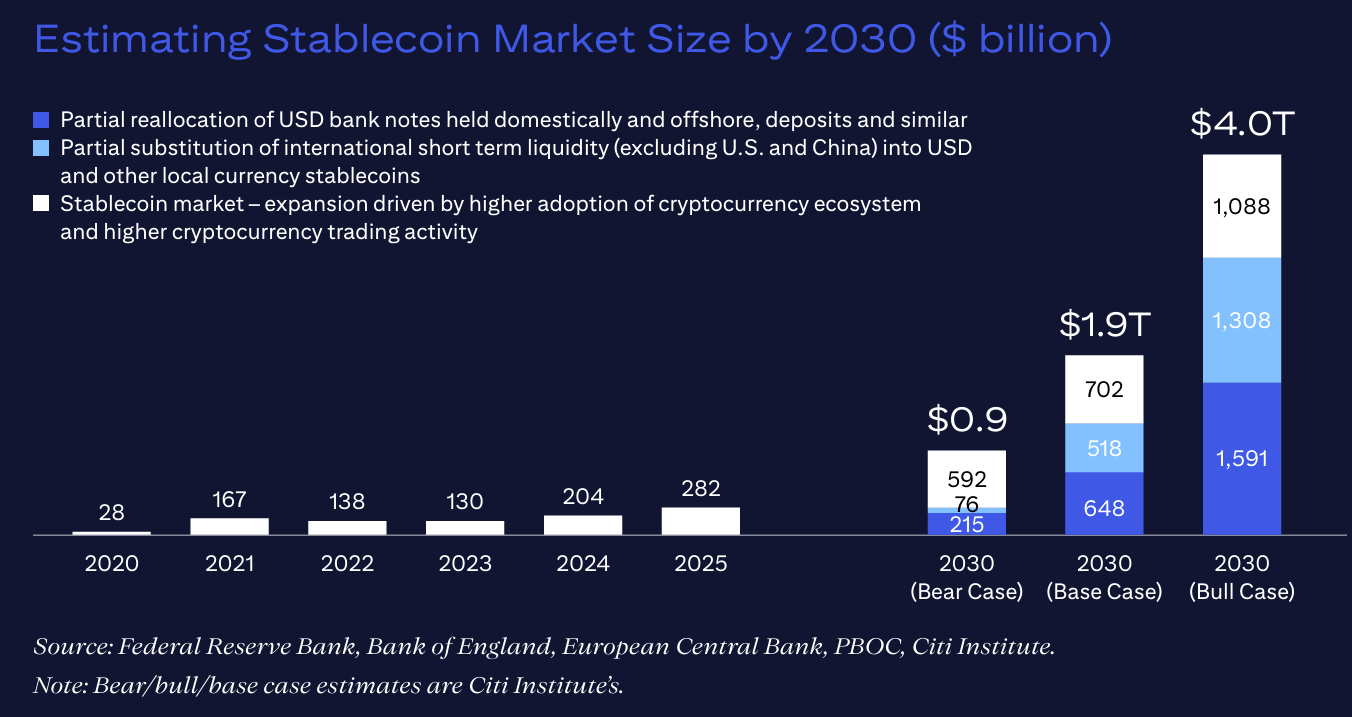
Citigroup estimates the stablecoin market could grow to as much as $4 trillion by 2030 in its most optimistic forecast. Source: Citigroup
Related: Malta proposes DeFi rulebook covering DAOs under MiCA-era framework
Disclaimer: The content of this article solely reflects the author's opinion and does not represent the platform in any capacity. This article is not intended to serve as a reference for making investment decisions.
You may also like
US Stock IPO Preview: Rapid Revenue Expansion, How Will TTG International (TTG.US) Seek New Growth Opportunities in Cross-Border Logistics?
In the future, changes in the company's business scale, customer structure, and profitability will be key dimensions to observe its growth potential.
$100 Oil Ignites BP (BP.US) Revaluation Expectations! JPMorgan Calls for "Overweight"
From a cash flow perspective, as long as production and costs are controllable, high oil prices can expand the operating cash surplus of oil and gas producers, providing support for debt repayment, dividends, and stock buybacks. This is also why Wall Street financial giants such as JPMorgan, Goldman Sachs, and Morgan Stanley have recently been frequently issuing bullish research reports to energy giants.

Microsoft (MSFT.US) Makes Heavy Bet on the Middle East! Plans to Invest Over $10 Billion in AI and Cloud Computing Infrastructure by 2030, But Geopolitical Risks Remain the Biggest Variable
Microsoft announced on Wednesday that it plans to invest over $10 billion in capital and operating expenditures in the Middle East by 2030 to expand its cloud computing and artificial intelligence (AI) infrastructure in the region.
Meta (META.US) goes all-in on Muse AI Agent, building full-scene access via VR headsets, smart glasses, and Charm
On September 23 local time, Meta held its annual Connect developer conference in Menlo Park, California.
Crypto prices
More


