
Crypto Hackers Drain Over $36M From Protocols Using Unverified Contracts

By:Newsbtc
Bitget offers one-stop trading for cryptocurrencies, stocks, and gold. Trade now!
A welcome pack worth 6200 USDT for new users! Sign up now!
A crypto hacker who drained $26 million from Ethereum-based protocol Truebit in January had likely practiced the technique on smaller targets first, according to blockchain analytics firm Chainalysis.

A Contract Left Exposed For Years
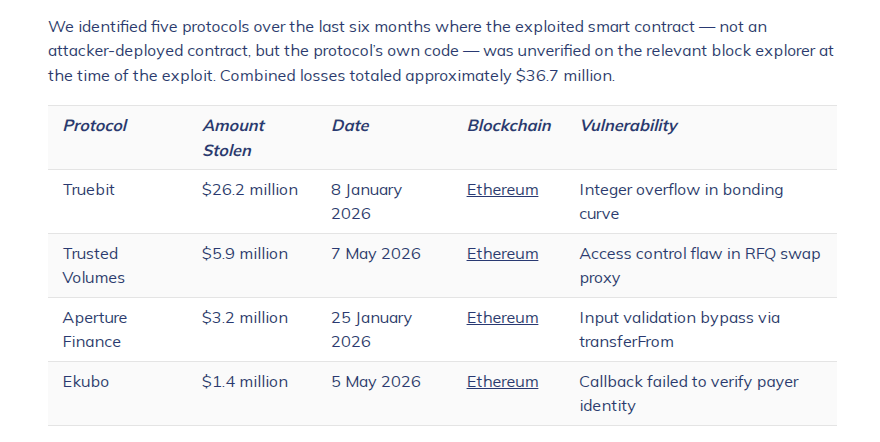
The Truebit exploit was the largest of four incidents Chainalysis identified in a new report covering the past six months. Together, those attacks — targeting Truebit, Trusted Volumes, Aperture Finance, and Ekubo — account for roughly $37 million in losses, all traced back to contracts whose source code had never been publicly verified on blockchain explorers.
The Truebit contract had been sitting on Ethereum since 2021. It was compiled using Solidity v0.5.3, a version released before automatic overflow protections became standard. An attacker found an integer overflow flaw inside its bonding curve mechanism and used it to mint large quantities of tokens at minimal cost before converting them to ETH.
Why Closed Code Creates Open Risk
Verified contracts get reviewed. Bug bounty hunters read them. Independent researchers flag problems before attackers do. Unverified contracts get none of that scrutiny, and many bug bounty programs specifically exclude them from coverage — meaning vulnerabilities can sit untouched for years while millions of dollars flow through the affected code.
 Source:
Chainalysis
Source:
Chainalysis
That gap is what Chainalysis says attackers are now exploiting. Each of the four compromised contracts lacked publicly available source code. Attackers worked instead from decompiled bytecode, converting raw on-chain code into readable output using tools like Dedaub, Heimdall, and Panoramix.
Once decompiled, the code can be fed into AI systems capable of spotting reentrancy flaws, arithmetic errors, and access-control weaknesses at a scale no human reviewer could match.
The $36.7 million figure is a fraction of total DeFi losses during the same period — Chainalysis puts the broader six-month theft total above $1 billion. But the firm argues the unverified contract problem could grow as automated analysis tools become cheaper and easier to use, allowing attackers to scan large numbers of dormant contracts and rank them by exploitability.
The Vulnerabilities Varied, But The Pattern Did Not
Across the four incidents, the specific bugs differed. Reports indicate weaknesses ranged from integer overflow and access-control failures to input-validation errors and identity verification flaws.

A 400 Billion Shiba Inu Surprise: Whale Wallet Springs Back To Life
What they shared was the same protection gap: no public source code, no external review, and no real-time monitoring in place to catch abnormal activity before the funds were gone.
Chainalysis is recommending that protocols treat source-code verification as a baseline requirement for any contract holding user assets.
The firm also says audits and bug bounty coverage should extend to implementation contracts sitting behind proxy structures — components that often go unreviewed even when the front-facing contract is verified.
Featured image from CybersecAsia, chart from TradingView
0
0
Disclaimer: The content of this article solely reflects the author's opinion and does not represent the platform in any capacity. This article is not intended to serve as a reference for making investment decisions.
Understand the market, then trade.
Bitget offers one-stop trading for cryptocurrencies, stocks, and gold.
Trade now!
You may also like
USD/JPY Price Forecast: Tests nine-day EMA support after falling below 157.50
FXStreet•2026/09/29 06:18
PENGU Eyes Fresh Breakout as Seoul Events Boost Market Momentum
Cryptonewsland•2026/09/29 06:09

Japanese Finance Minister Reiterates Concerns: Yen Undervaluation is a "Big Problem," Will Cooperate Closely with the US to Maintain Forex Market Stability
Japanese Finance Minister Masato KATAYAMA stated that the weakness of the yen remains an ongoing concern. Japan and the United States will continue to maintain close contact in order to seek orderly functioning of the foreign exchange market.
智通财经•2026/09/29 04:31
Gold bounces off eight-week low; not out of the woods amid rising Fed hike bets
FXStreet•2026/09/29 04:27
Crypto prices
More
Bitcoin
BTC
$83,852.41
+0.75%

Ethereum
ETH
$2,692.44
+1.47%

Tether USDt
USDT
$0.9995
-0.01%

BNB
BNB
$760.82
-0.70%

XRP
XRP
$1.5
+1.03%

USDC
USDC
$1.0000
+0.01%

Solana
SOL
$118.99
-0.20%

TRON
TRX
$0.3347
+0.33%

Zcash
ZEC
$1,401.78
-9.85%

Hyperliquid
HYPE
$87.9
-1.44%
How to buy BTC
Bitget lists BTC – Buy or sell BTC quickly on Bitget!
Trade now
Become a trader now?A welcome pack worth 6200 USDT for new users!
Sign up now