

 u.today
Another wave of selling pressure is being applied to Shiba Inu, but traders have focused especially on one metric.
Derivatives data claims that $SHIB's futures flow fell by as much as 1,418 percent over the course of eight hours—a striking figure that, at first glance, seems nearly impossible.
Selling pressure through the roof
The crucial point is that price performance is not determined by percentage changes in futures flow. Rather, they monitor the movement of net capital into and out of the derivatives market. Calculating percentages can yield seemingly ridiculous numbers that surpass 100%, 500%, or even 1,000% when the flow from the previous period was relatively small and the most recent reading swung significantly negative.
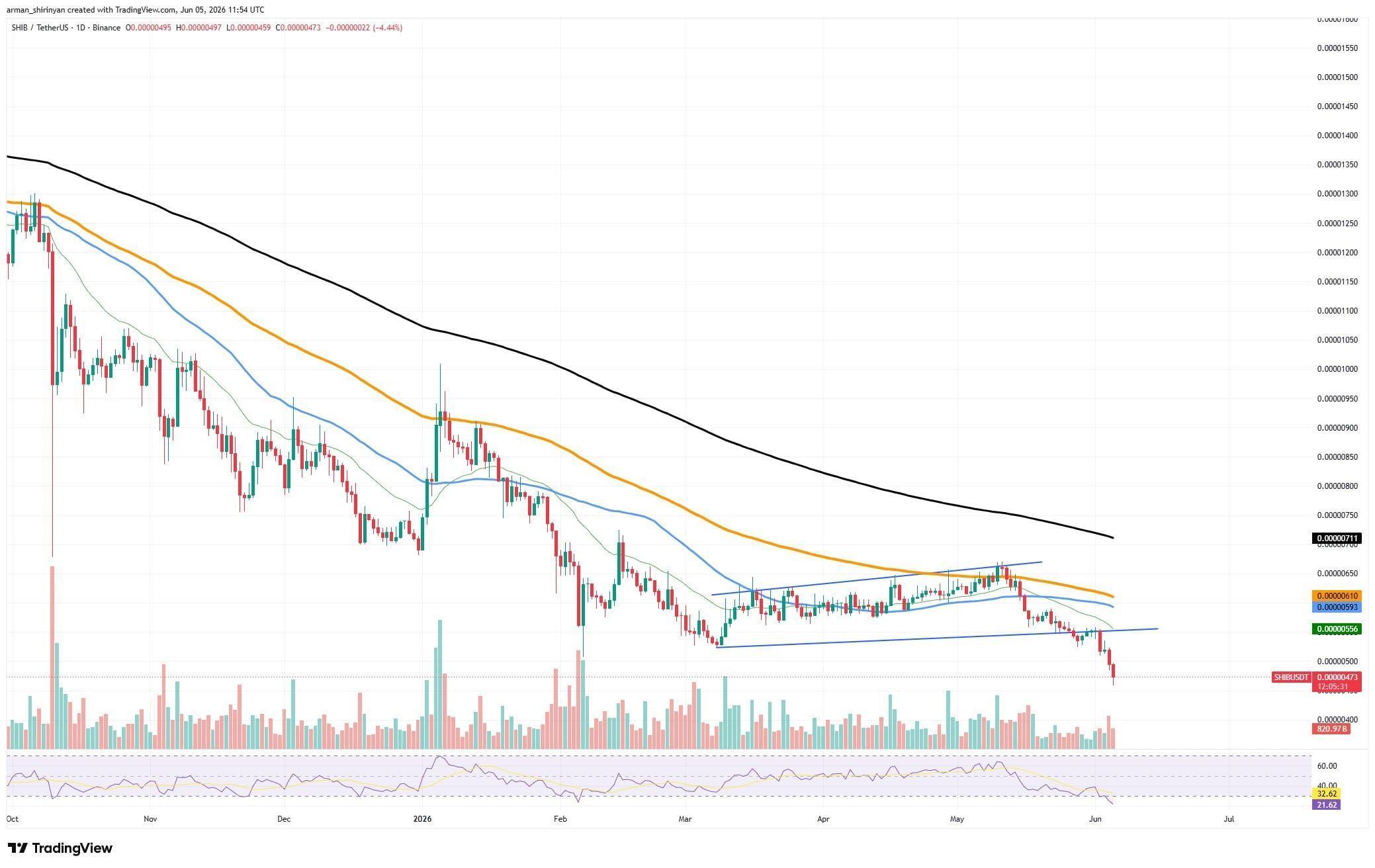 $SHIB/USDT Chart by TradingView
Rather than a literal destruction of value, the number in $SHIB's case represents a sharp reversal in trader positioning. Net flow statistics sharply declined as futures traders quickly shifted from increasing exposure to aggressively decreasing it.
Flows flips to negatives
This interpretation is supported by the more comprehensive market data. Spot flows are still negative, and futures outflows continue to dominate over a number of tracked timeframes. Over $4.4 million in net outflows are seen in seven-day spot flows, while three-day and five-day readings are still significantly negative. This suggests that spot investors and speculative traders have been cutting exposure at the same time.
Metrics from on-chain exchanges present a similar image. Inflows of about 586 billion $SHIB were greatly outweighed by total exchange outflows of over 802 billion $SHIB. Although significant exchange outflows may occasionally be seen as accumulation, the current situation indicates that investors are repositioning in the face of uncertainty rather than actively purchasing the decline.
But for the time being, it's still evident from both spot and derivatives markets that risk appetite for $SHIB has sharply declined. Although the reported 1,418 percent decline in futures flow may seem startling, it mainly illustrates how quickly traders have left leveraged positions, as the market is still dominated by bearish sentiment.


