
Breaking Warning! "Bubble Hunter" Grantham: Even Greater Pain May Be Coming, U.S. Market Outlook Is "Dangerous"

A legendary Wall Street investor is warning investors: even greater pain may lie ahead.
Jeremy Grantham, renowned for his ability to identify asset bubbles and co-founder of GMO, stated that he believes the outlook for the US economy and financial markets currently appears "quite dangerous." In his view, multiple negative factors are stacking up, among which the most concerning are the Iran war and the "painful" consequences of rising oil prices.
Since the outbreak of conflict in the Middle East, international oil prices have surged, with both Brent crude and US crude prices briefly breaking through $100 per barrel. During this period, Brent crude even approached $120 per barrel before slightly retreating.
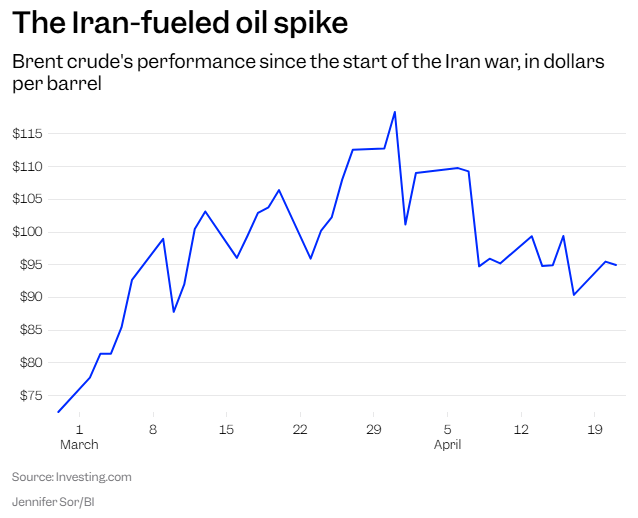
(Image source:Investing.com, Business Insider)
Grantham pointed out that, historically, the US economy has never emerged unscathed or avoided a recession following a "significant rise" in oil prices.
He stated on the podcast "The Master Investor" released Monday (April 20), "No trend lasts forever, but this clearly brings pain and causes a rebalancing effect—such as weaker markets, declining demand, and so on."
He further added, "You know, the situation could deteriorate very quickly in a short time."
Many economists often compare this round of oil price increases, propelled by the Iran war, to the oil shocks of the late 1970s to early 1980s, which triggered economic recessions. The market worries that more expensive oil and related energy products may reignite inflation and weaken consumer spending. Although the US economy is now generally considered less dependent on oil than decades ago, energy price shocks are still viewed as a potential risk.
Grantham rose to fame for accurately warning about the dot-com bubble and the subprime mortgage crisis. Now, he believes the risks facing markets stem not only from war and oil prices, but also from climate change, a global decline in population, and escalating geopolitical and trade tensions.
He also noted that artificial intelligence (AI) presents significant risks. Despite the promise of improved productivity, concerns about AI potentially causing widespread unemployment are growing.
Grantham said, "This will definitely, and profoundly, disrupt the supply-demand balance."
In his opinion, the current stock market does not adequately reflect these risks. He added that the US stock market is currently at the second or third highest valuation level in history.
Previously, Grantham had warned that the size of the current market bubble could be compared to the bubble of the late 1920s, which ultimately triggered the stock market crash.
He bluntly stated, "If you think the future will be one of the best two or three periods in the past hundred years, then you are just indulging in self-delusion."
Grantham concluded: "Today's world is full of risks, laden with dangers, and is restraining growth."
Disclaimer: The content of this article solely reflects the author's opinion and does not represent the platform in any capacity. This article is not intended to serve as a reference for making investment decisions.
You may also like
Gold bounces off eight-week low; not out of the woods amid rising Fed hike bets
The "Endgame" of De-globalization: A Historic Battle for Metals!
Consulting giant Bain sounds the alarm: The global AI industry needs to achieve $6 trillion in annual revenue to sustain the “cash burn” of data centers
Bain stated that by 2031, the global artificial intelligence (AI) industry needs to achieve annual revenue of $6 trillion in order to justify the massive capital investment currently being made in building data centers worldwide.
Samsung Electronics' 2nm yield approaches 60%, aiming at TSMC to compete for tech giants' orders
The yield rate of Samsung Electronics' foundry division's 2nm process has increased to nearly 60%, a significant improvement from around 30% in mid-2023. After stabilizing the yield, Samsung has shifted its engineering focus to power consumption and heat dissipation optimization, and is accelerating the development of the more powerful second-generation process, SF2P, aiming for mass production within the year. Strategically, Samsung plans to supply 2nm chips to Tesla next year, using this as a stepping stone to enter the large-scale tech client market.
Crypto prices
More


