
"Short Squeeze + Quantitative Replenishment" Ignite U.S. Stock Market Rally, Funds Flow Into High-Risk Sectors

Behind the recent rapid rebound in U.S. stocks, the market is experiencing a typical “short squeeze” scenario. Analysts point out that a large number of bearish bets have been forced to close, becoming one of the key drivers of the market rally.
According to ODaily, data shows that Goldman Sachs’ basket of heavily shorted stocks jumped more than 13% this week, significantly outperforming the S&P 500 Index. Financials and industrials became the main sectors where shorts rushed to cover their positions.
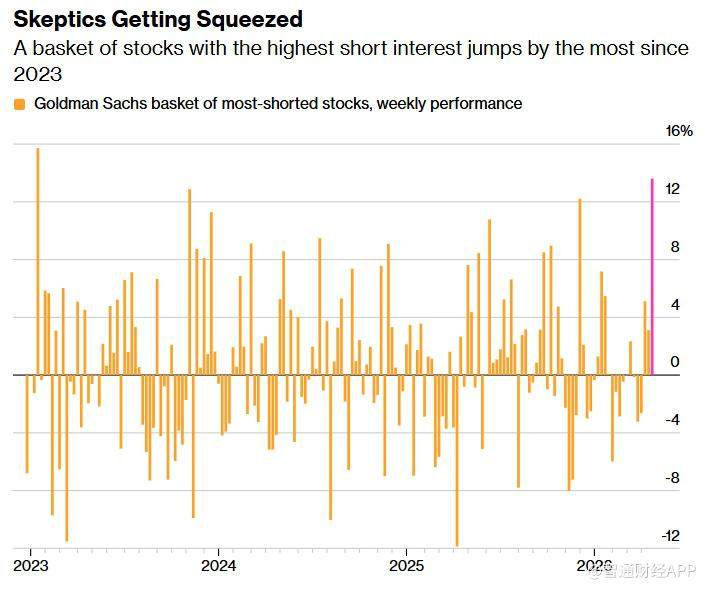
Although risks in the Middle East have not fully subsided and the long-term impact of higher oil prices on inflation remains unclear, as the market bets the most stressful period has passed, the sharp rebound in stocks has forced shorts to quickly stop losses and exit, further amplifying the upward momentum.
S3 Partners data shows that so far this month, short covering in the U.S. stock market has totaled about $93 billion. During the same period, the Russell 3000 and S&P 500 indexes have both risen by more than 9%. Analysts note that this round of “short squeeze” has been amplified by previous position reduction and subsequent covering by institutions and quantitative funds, creating a resonance effect.
Market researchers said: “Currently, almost all sectors are experiencing short covering, especially among traders who established short positions at the bottom.”
As market sentiment recovers rapidly, capital is visibly flowing back into risk assets. Institutional investors are increasing positions through index allocations, while previously heavily reduced quantitative funds are also rebuilding long positions, jointly driving the market rebound.
Meanwhile, market risk appetite is rising significantly. UBS data shows a group of stocks with weak fundamentals surged by about 9% this week, while micro-cap stocks as a whole rose around 7%. Unprofitable tech companies saw an even larger gain of 14%, indicating that capital is flowing into high-risk sectors.
However, some institutions warn that the current market may be experiencing excessive optimism. Some investment firms point out that investors may misinterpret the rapid rise as an “all-in buy signal,” thus ignoring potential risks.
Despite the strong performance of the indices, there is still internal differentiation in the market. The equal-weight S&P 500 index remains below its historical high, and the Dow Jones Index has not fully recovered its previous losses, indicating that the gains are mainly concentrated in a few high-weight stocks.
Disclaimer: The content of this article solely reflects the author's opinion and does not represent the platform in any capacity. This article is not intended to serve as a reference for making investment decisions.
You may also like
Has the poor performance of new stocks in the same track dampened subscription enthusiasm? Bamboo makes an emergency halt the night before pricing, doubling its valuation in a year but struggling to find a "buyer".
Bamboo, the master underwriter for homeowners insurance in California and Texas, postponed its IPO on Tuesday. The company had planned to issue 35 million existing shares at $18–$20 per share to raise $665 million.
Is the AI replacement wave overestimated? Barclays: Only 20% of core workplace skills can be highly replicated, but amplification effects are quietly spreading
The impact of AI on the workforce is milder, yet more profound than previously imagined. Barclays' latest research dispels the panic of a "replacement wave"—only about 20% of core professional skills can truly be replicated by AI, but its "amplification effect" permeates almost every corner of every profession. What is more concerning is that the demand for AI skills is spreading from tech positions to management roles, and the rise of physical AI could even make human professional skills a new, scalable form of intellectual property.
Costco Q4 Earnings Preview: Membership and Capital-Return Test After a Near-Bear Pullback

Crypto prices
More


