
Polymarket odds of Hormuz Strait traffic normalizing by end of May spike to 73%

Polymarket prediction market odds of the Strait of Hormuz “returning to normal” by the end of May spiked to 73% on Friday, following news that Iranian officials have temporarily opened up the Strait of Hormuz as part of a ceasefire deal.
The odds climbed to a high of 82% on Friday, after Iranian Foreign Minister Seyed Abbas Araghchi announced that the Strait of Hormuz is open. Since that time, the odds have fallen back down to 73%. He said in an X post:
“The passage for all commercial vessels through the Strait of Hormuz is declared completely open for the remaining period of the ceasefire, on the coordinated route as already announced by the Ports and Maritime Organization of the Islamic Republic of Iran.”
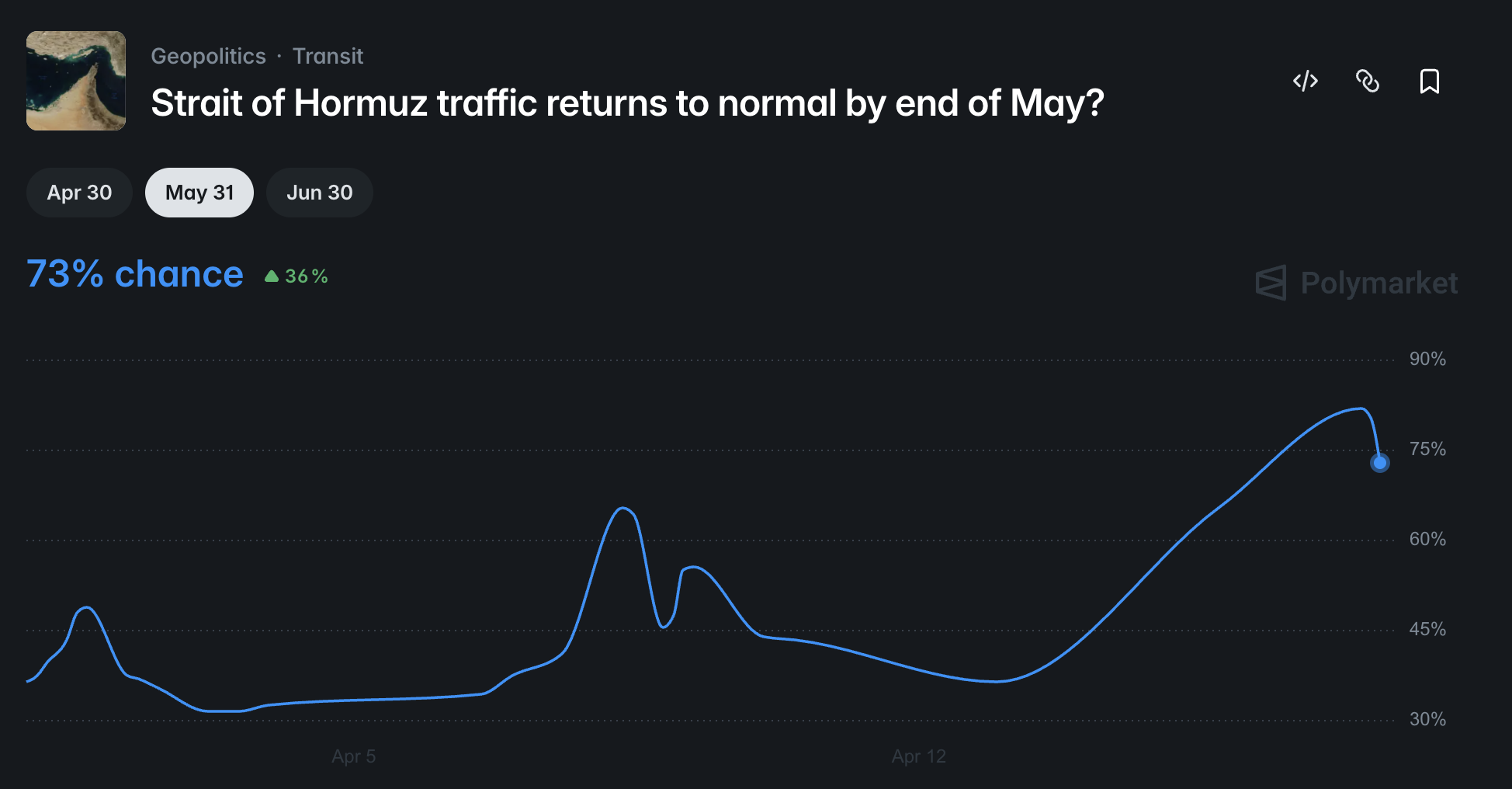 Polymarket odds for oil tanker traffic through the Strait of Hormuz returning to normal by the end of May 2026. Source:
Polymarket
Polymarket odds for oil tanker traffic through the Strait of Hormuz returning to normal by the end of May 2026. Source:
Polymarket
However, traders on the platform placed the odds of the Strait returning to normal activity by the end of April at just 40%.
The war in Iran sent shockwaves through financial markets, impacting crypto and energy prices, as investors and financial analysts react to political developments in the ongoing conflict.
Related: Iran conflict hints Bitcoin’s addressable market could exceed gold: Bitwise
Bitcoin rises on the ceasefire news, but the truce is “fragile”
The price of Bitcoin (BTC) surged on Friday in response to the temporary reopening of the Strait under the ceasefire, briefly tapping $78,000 before climbing down to about $77,358, the price at the time of publication.
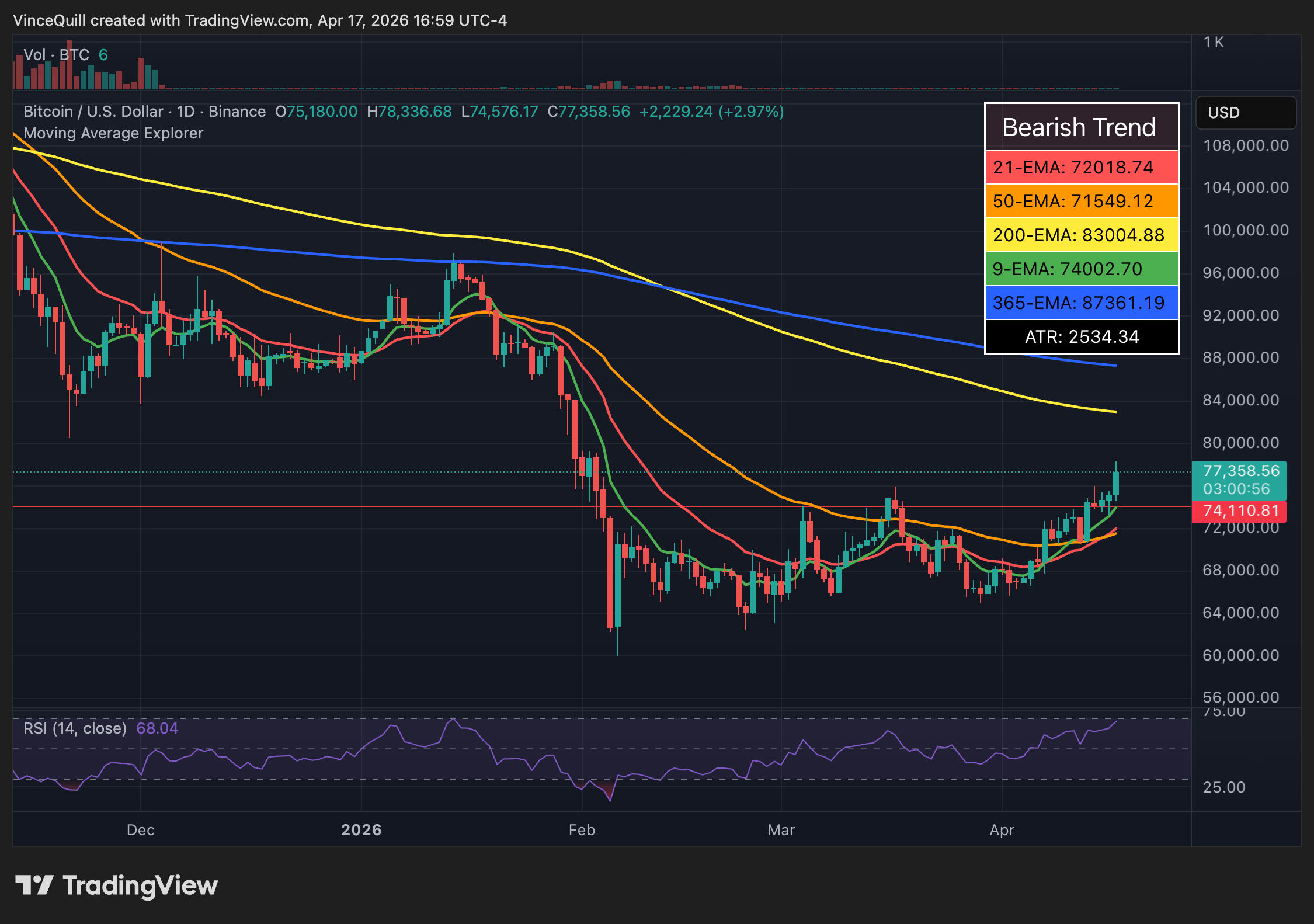 The price of Bitcoin surged after Iranian officials announced that the Strait of Hormuz would remain open during the ceasefire. Source: TradingView
Crypto market analyst Nic Puckrin told Cointelegraph that the ceasefire between the US and Iran announced in April is “fragile” and that core issues remain unresolved.
The fallout from the conflict will likely cast a shadow over financial markets for most of 2026, pushing back any interest rate cuts to Q3 2026 at the earliest, if rate cuts materialize at all this year, Puckrin said.
“A ceasefire that results in the end of geopolitical tensions, a sustained drop in oil prices toward $80, and ideally also softer-than-expected economic data that calms stagflation fears” are all needed for BTC to reclaim the $90,000 level, he said.
US President Donald Trump said on Friday that the US naval blockade on Iran would “remain in full force and effect” until the “transaction with Iran is 100% complete.”
Magazine: Should users be allowed to bet on war and death in prediction markets?
Disclaimer: The content of this article solely reflects the author's opinion and does not represent the platform in any capacity. This article is not intended to serve as a reference for making investment decisions.
You may also like
Micron (MU.US) Q4 earnings call: Management declares "No sign of supply-demand balance," 75% of shipments for next year already locked in; 2028 expected to be tighter than 2027
Micron Technology (MU.US) management expressed optimism during the Q4 earnings call, stating that AI-driven memory demand remains strong and that supply and demand will remain tight in 2027 and 2028.
After experiencing Muse, I cleared out my Airbnb holdings
A senior analyst heavily invested in Airbnb decided to sell all his Airbnb holdings just 10 days after experiencing Meta AI's Muse app. He believes that Muse not only understands his preferences but also helps him bypass Airbnb to book accommodations directly, at 60% lower prices. As AI agents begin to compare prices, cancel, and rebook on your behalf, the "traffic moat" that internet platforms depend on is under threat, and the era of "proactive e-commerce" may be dawning.
Goldman Sachs: AI Must Endure Hardship Before Rewards
Euro weakens below 1.1350 on higher US Treasury yields, Lagarde's dovish tilt
Crypto prices
More


