
Netflix Q1 2026 Earnings Highlights: 16% Revenue Growth Beats Expectations, EPS Surges 86%, But Soft Q2 Guidance Triggers ~10% After-Hours Drop
 Bitget2026/04/17 01:11
Key Takeaways
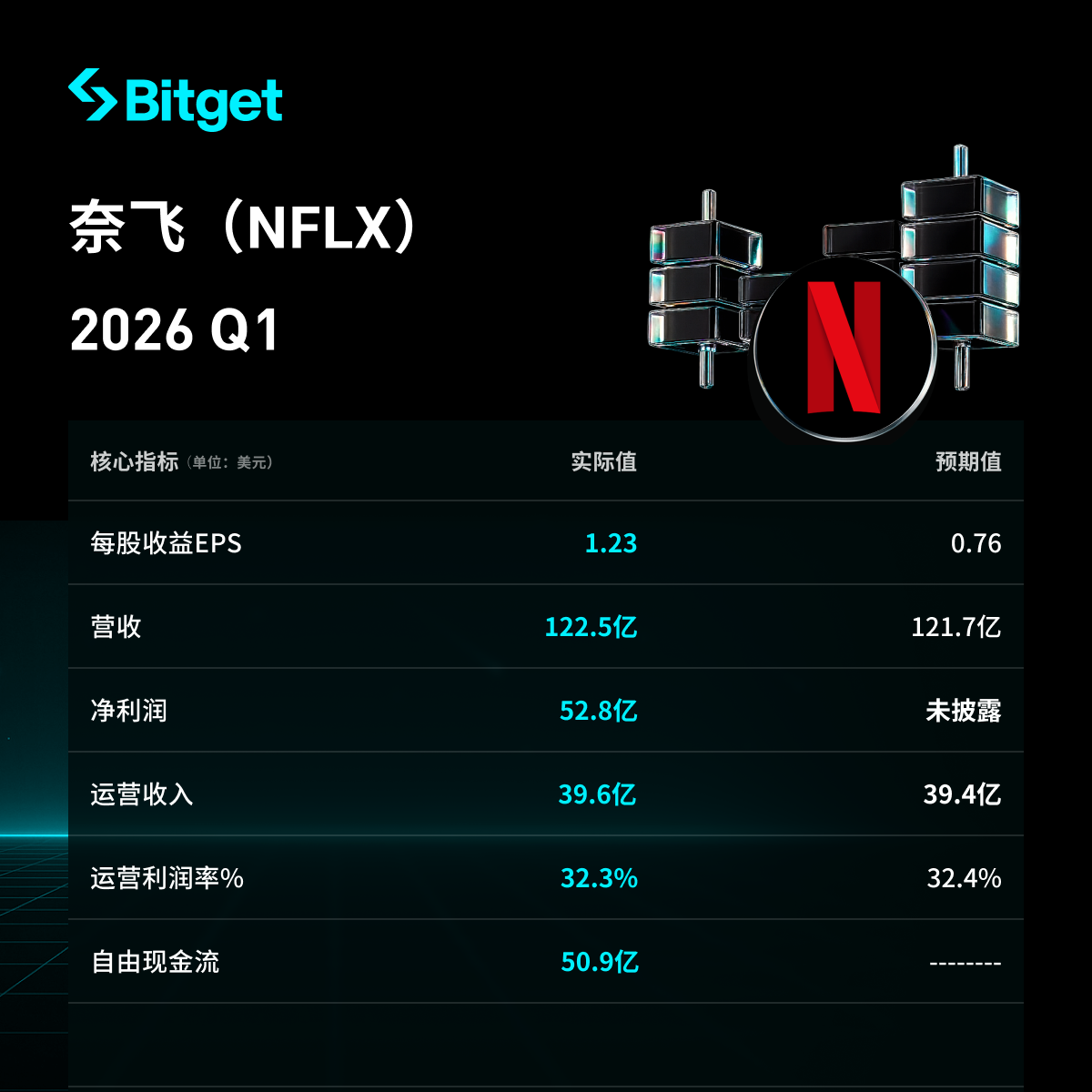
Netflix(NFLX) delivered a strong Q1 2026 beat, with revenue and operating income modestly exceeding estimates and EPS surging well above consensus (boosted by one-time gains). However, the Q2 outlook came in below expectations with no upward revision to full-year operating margin guidance, causing the stock to drop nearly 10% in after-hours trading. Key positives included subscription revenue ahead of plan, continued ad-tier momentum, and double-digit growth across all regions. Investors remain focused on content amortization pressures and the upcoming departure of co-founder Reed Hastings.
Bitget has now listed NFLXUSDT 20x capture returns!
Detailed Breakdown
- Overall Revenue and Profit Performance
- Revenue: $12.25 billion, +16% YoY (down from +17.6% in Q4 2025), beating analyst estimates of $12.17 billion.
- EPS: $1.23, +86% YoY, significantly beating expectations of $0.76 (61.8% above consensus).
- Net Income: $5.28 billion, +81.7% YoY, partly driven by a $285 million one-time gain (including $280 million termination fee from Warner Bros. deal).
- Operating Income: $3.96 billion, +18% YoY, slightly above estimates of $3.94 billion.
- Operating Margin: 32.3% (up slightly from 31.7% YoY, but just below the 32.4% expected).
- Free Cash Flow (FCF): $5.09 billion; Operating Cash Flow: $5.29 billion.
- Other: Repurchased 13.5 million shares for $1.3 billion in Q1; ended quarter with $12.3 billion in cash & equivalents, $14.4 billion in total debt, and $2.1 billion in net debt.
- Subscription & Advertising Business Performance
- Subscription Revenue: Ahead of internal plan, driven by paid sharing, price increases (standard ad-free plan raised $2 to $20/month), and growing ad-tier adoption.
- Advertising Business: Serving as the “second growth engine,” ad customers grew 70% YoY to over 4,000. In markets with the ad tier launched, over 60% of new sign-ups chose the ad-supported plan. Company reaffirmed full-year 2026 ad revenue target of $3 billion (double 2025 levels).
- Key Drivers: Member growth, pricing adjustments, and ad-tier penetration. Plans include launching first-party data measurement & attribution tools, expanding ad formats, and increasing live content.
- Regional Revenue Performance
- UCAN (U.S. + Canada): $5.245 billion, +14% YoY.
- EMEA (Europe, Middle East, Africa): $3.998 billion, +17% YoY (12% at constant currency).
- LATAM (Latin America): $1.497 billion, +19% YoY (18% at constant currency).
- APAC (Asia-Pacific): $1.509 billion, +20% YoY (19% at constant currency), with Japan standing out (WBC event set single-day sign-up record). All regions posted double-digit growth, with APAC delivering the fastest pace.
- Capital Allocation & Shareholder Return Plans
- Q1 share repurchases totaled $1.3 billion, with $6.8 billion remaining authorization.
- Key Investment Areas: Advertising expansion (new tools, more ad formats), live content (leveraging Japan WBC success), content diversification, and product experience improvements.
- Cost Pressures: Content amortization expected to grow fastest in Q2, then moderate to mid-to-high single digits in H2.
- Q2 2026 Guidance
- Revenue: $12.57 billion, +13.5% YoY, below consensus of $12.64 billion.
- EPS: $0.78, below consensus of $0.84.
- Operating Margin: 32.6% (down from 34.1% in Q2 2025), primarily due to peak content amortization in Q2.
- Full-Year Outlook Unchanged: Operating margin target maintained at 31.5% (slightly below street expectation of 32%), ad revenue target $3 billion, FCF raised 13.6% to $12.5 billion.
- Market Context & Investor Concerns
- Core Tension: Solid Q1 beat across revenue/EPS, healthy regional growth, and accelerating ad momentum versus conservative Q2 guidance, no margin raise, and questions around one-time EPS boost sustainability.
- Challenges: Intensifying competition impacting user growth and churn, content cost discipline, and sustainability of growth post-price hikes.
- Investor Reaction: Shares fell as much as 10% in after-hours trading (later narrowing to ~9%), driven by soft guidance, Reed Hastings’ impending departure after 29 years as co-founder (raising questions on strategic continuity), and the “de-founder” transition. While the raised FCF outlook and long-term ad targets were viewed positively, the market focused more on forward growth signals than backward-looking results.
Right now, we're also running the limited-time "Lifetime Zero: The Weekly Jackpot IV" event for US stock contracts:
- Lifetime 0 trading fees on US stock contracts + weekly jackpot draws that never stop!
• 2. Participate and stand a chance to win free TSLA, NVDA, and other hot US stocks!
Disclaimer This content is for reference only and does not constitute any investment advice.
Disclaimer: The content of this article solely reflects the author's opinion and does not represent the platform in any capacity. This article is not intended to serve as a reference for making investment decisions.
You may also like
Why suspend RMPs? Explanation from New York Fed SOMA Manager Perli
"Agent vs US Treasury" — Who Will Dominate the US Stock Market?
The wave of AI Agents and US Treasury yields are splitting the US stock market into two worlds: Meta's release of the Muse model boosted its market value by $220 billion in a single week, propelling the Nasdaq's standout performance; however, excluding AI stocks, the S&P 500 actually fell 1% this week, with the number of new lows on the New York Stock Exchange surpassing new highs for nine consecutive days, signaling the near end of "breadth trading." Goldman Sachs bluntly stated that this is a "frustrating cat-and-mouse game" between the stock market and interest rates—any breakout can be snuffed out by the bond market at any time, so equity holders must short US Treasury bonds to hedge simultaneously.
Hopes for a ceasefire between the US and Iran encounter obstacles again! Trump rejects Iran's seven-day proposal; inflation pressure under $100 oil prices remains difficult to ease
Trump rejects a ceasefire with Iran, and it is expected that bombings will occur again after the midterm elections. The president doubts whether Tehran will meet his demands.
Tesla ramps Optimus production 10-fold but robot hands are holding Elon back
Crypto prices
More


