
All 39 US software companies wiped out!

Since 2026 until now,39 US-listed SaaS companies have all plummeted with no exception.
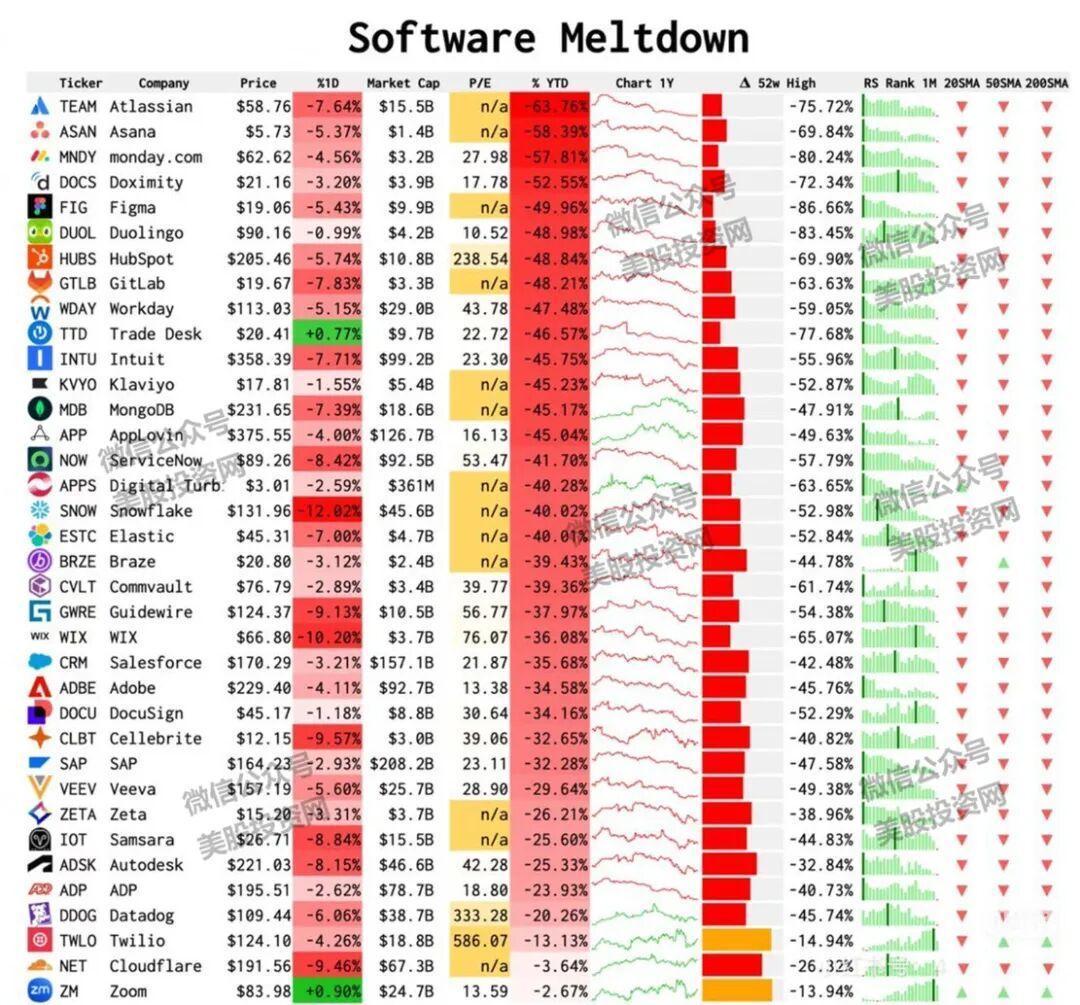
The data in this chart vividly illustrates the drastic downturn of the SaaS industry. The massive drop since the beginning of the year in project management giants like Atlassian(-63.76%), Asana (-58.39%), and Monday.com (-57.81%) is particularly striking.
The US Stock Investing Network’s point that “AI Agent is devouring traditional project management tools” does capture a very real and aggressive shift currently ongoing in the tech sector.
AI ’s Threat to Traditional SaaS Companies
The core value of traditional project management—manual tracking, status updates, and dragging Kanban cards—is exactly whatAI Agent was designed to automate.
As autonomous agents gradually gain the ability to read emails, chat logs, and code commits, and update project status and assign tasks in real time, traditional manually operated tools charging “per-seat” are facing a truly existential threat.
The market, driven by this concern, is aggressively repricing these companies: their core workflows could very soon be commoditized byAI .
A Bigger Reality: It’s Not JustAI
However, although the AI narrative is a major catalyst, to explain the sector’s “collapse” solely by this would be oversimplified. Declines of this magnitude are typically the result of a combination of several severe factors:
1) Valuations returning to reality
Many SaaS companies traded at sky-high price-to-sales (PS) ratios during the high-growth period. The current chart largely reflects the painful “mean reversion” process—the market is no longer willing to pay a premium for growth that does not lead to quick profitability.
2) Enterprise Seat Contraction (Seat Contraction)
Major enterprises are strictly auditing IT budgets:
Large-scale cleanup of software tools
Deduplication and feature consolidation
Cutting down the number of SaaS accounts
This trend had actually begun even before AImatured.
3) A Results-Oriented Market Environment
Today’s investors are very impatient with “traditionalSaaS.”
If a company cannot prove that:
It’s not just “adding a bit of AIfunctionality”
But can truly transform into anAI-first platform
without sacrificing profit margins
Then the market’s response is usually: sell first, explanations can wait.
Which ones did you buy?





Disclaimer: The content of this article solely reflects the author's opinion and does not represent the platform in any capacity. This article is not intended to serve as a reference for making investment decisions.
You may also like
As Starlink challenges telecom operators' pricing power, AT&T (T.US) sells its Mexico business for $2 billion, shifting focus to AI connectivity demand.
AT&T has agreed to sell its Mexico operations to Televisa and Fintech for $2 billion. The transaction is expected to be completed in the first quarter of 2027, pending approval from Mexican regulators.


Dovish Signals Boost Markets: Asia-Pacific Stocks Rebound, South Korea Shares Jump Over 1% Ending Five-Day Slide, Taiyo Yuden Surges 7%
On Wednesday, the MSCI Asia-Pacific Index rose by 0.2%, making a slight rebound from the low point reached on Tuesday, the lowest since August. South Korea's Composite Index briefly rose by over 2%. SK Hynix and Samsung Electronics both surged more than 3% during trading, then fell back. The Nikkei 225 expanded its gains to 0.53%. MLCC giant Taiyo Yuden led the AI hardware sector, while Fujikura rose nearly 4%. The yield on 10-year US Treasury futures remained at 5.21%, up 0.5 basis points from Tuesday.

Apple (AAPL.US) is the “ultimate answer” for AI investments? Amid a semiconductor crash, it hits $5 trillion again; foldable iPhone and AI home devices ignite growth imagination
While the Philadelphia Semiconductor Index has fallen for five consecutive days with a cumulative drawdown of over 8%, Apple hit a historic intraday high of $348.15 on October 13, with its market capitalization surpassing $5 trillion again; it closed at $341.27, with a market value of approximately $4.98 trillion.

Crypto prices
More


