
A fresh estimate suggests Michael Saylor's Strategy added more Bitcoin shortly after the market opened, putting BTC accumulation back in focus.

Michael Saylor’s Strategy added 6,556 Bitcoin BTC +0.00% to its treasury in a single week, spending $555.8 million at an average price of $84,785 per coin, according to a Form 8-K filed with the U.S. Securities and Exchange Commission on April 21, 2025.
What the SEC Filing Reveals About Strategy’s Latest Purchase
The Form 8-K disclosure shows Strategy acquired the 6,556 BTC between April 14 and April 20, 2025. The purchase brought the company’s total Bitcoin holdings to 538,200 BTC, accumulated at an aggregate cost of $36.47 billion and an average price of $67,766 per coin.
Strategy funded the acquisition through its at-the-market issuance programs. The company sold 1,755,000 shares of MSTR common stock for $547.7 million and 91,213 shares of STRK preferred stock for $7.8 million to finance the buy.
The filing also noted that Strategy uses its website dashboard as a Regulation FD disclosure channel, reinforcing the company’s commitment to transparency around its Bitcoin treasury operations. At the time Cointelegraph covered the announcement, BTC was trading near $85,000.
Why the Timing Drew Immediate Attention
Initial reports framed the purchase estimate as surfacing less than an hour after U.S. market open, according to unconfirmed social media reports. That timing matters because early-session institutional activity often sets the narrative for the rest of the trading day, particularly for assets correlated with MSTR’s stock price.
Large Strategy purchases have historically amplified short-term Bitcoin sentiment. Traders tracking Bitcoin ETF inflows and corporate treasury moves treat each new filing as a signal of sustained institutional demand. The pattern reinforces a feedback loop where public accumulation announcements attract additional buyer interest.
Bitcoin was trading at $73,264 at press time, up roughly 1.26% over the prior 24 hours, with a market cap near $1.47 trillion and daily trading volume around $39.3 billion.
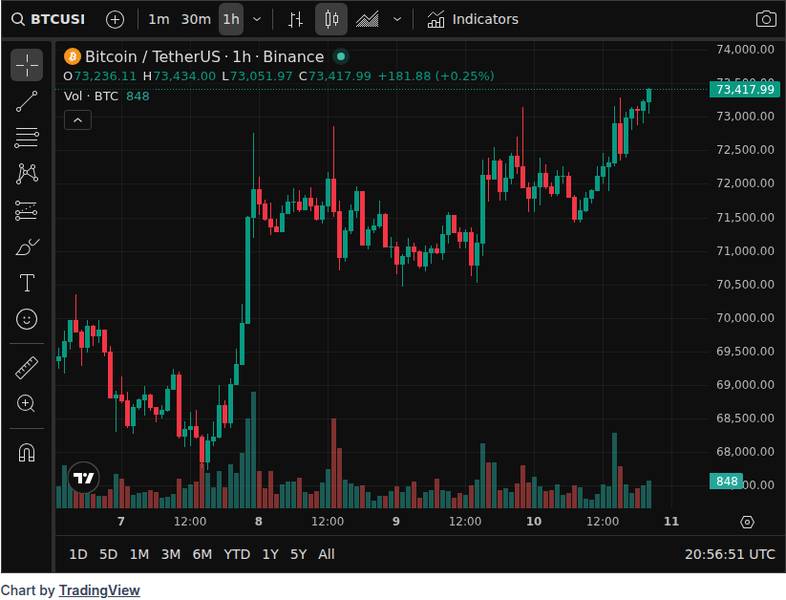 CoinGecko chart illustrating the price backdrop referenced in this article on bitcoin.
The Fear and Greed Index sat at 16, deep in “Extreme Fear” territory. That reading contrasts sharply with Strategy’s willingness to deploy over half a billion dollars at prices well above current spot levels.
What This Means for Strategy’s Bitcoin Accumulation Story
With 538,200 BTC on its balance sheet, Strategy remains the largest publicly traded corporate holder of Bitcoin by a wide margin. The $36.47 billion aggregate cost basis at an average of $67,766 per coin means the company is currently underwater relative to the press-time spot price of $73,264, though still above its blended average.
Each new purchase filing renews debate over corporate treasury exposure to BTC. For investors watching how broader crypto markets are positioning, Strategy’s continued accumulation during a period of extreme fear signals conviction that contrasts with prevailing retail sentiment.
The dual-ATM funding structure, using both MSTR common shares and STRK preferred shares, gives Strategy flexible capital access without taking on traditional debt for these purchases. That mechanism has allowed Saylor’s team to execute repeated large buys across varying market conditions.
Institutional accumulation trends, including developments like protocol-level revenue innovations across the broader crypto ecosystem, continue to draw attention from market participants gauging whether corporate demand can sustain Bitcoin’s price floor through periods of weak sentiment.
The next scheduled SEC filing window will reveal whether Strategy continued buying after April 20 or paused as Bitcoin moved lower in subsequent sessions.
Disclaimer: The content of this article solely reflects the author's opinion and does not represent the platform in any capacity. This article is not intended to serve as a reference for making investment decisions.
You may also like
Why suspend RMPs? Explanation from New York Fed SOMA Manager Perli
"Agent vs US Treasury" — Who Will Dominate the US Stock Market?
The wave of AI Agents and US Treasury yields are splitting the US stock market into two worlds: Meta's release of the Muse model boosted its market value by $220 billion in a single week, propelling the Nasdaq's standout performance; however, excluding AI stocks, the S&P 500 actually fell 1% this week, with the number of new lows on the New York Stock Exchange surpassing new highs for nine consecutive days, signaling the near end of "breadth trading." Goldman Sachs bluntly stated that this is a "frustrating cat-and-mouse game" between the stock market and interest rates—any breakout can be snuffed out by the bond market at any time, so equity holders must short US Treasury bonds to hedge simultaneously.
Hopes for a ceasefire between the US and Iran encounter obstacles again! Trump rejects Iran's seven-day proposal; inflation pressure under $100 oil prices remains difficult to ease
Trump rejects a ceasefire with Iran, and it is expected that bombings will occur again after the midterm elections. The president doubts whether Tehran will meet his demands.
Tesla ramps Optimus production 10-fold but robot hands are holding Elon back
Crypto prices
More


