
Copper prices consolidate at high levels—should you start "buying insurance"? [Pei Fengke Masterclass 3.3]


Highlight Preview
Copper prices tend to move sideways at high levels, which can easily make people lower their guard.
The logic all seems sound:
AI and power grid investments are providing support,
Traditional demand hasn’t fully picked up yet,
And prices haven’t shown obvious weakness.
But anyone who has actually traded will find this feeling very familiar:
The more “everyone can explain the logic” at a certain price point, the more likely things can go wrong.
Why is that?
Because at this stage, what determines the price is no longer only the “fundamentals”, but the shifting behavior of different funds:
Downstream sectors are setting prices between 95,000 and 100,000, but only on the premise that no major risk occurs
Traders are starting to consider the pressure of high inventories as the off-season approaches
Macro funds are reassessing the AI narrative
Once there is any liquidity or geopolitical disruption, the speed of price decline is often much faster than the rise
In other words, the logic for price increases is still there, but the “certainty” supporting it is weakening.
So, when the logic hasn’t been disproved but risk is building, should you take precautions early?
Why do professional traders choose to “pay for protection” in such positions?
If a real shock hits, to what level could copper drop? And how should you get back in?
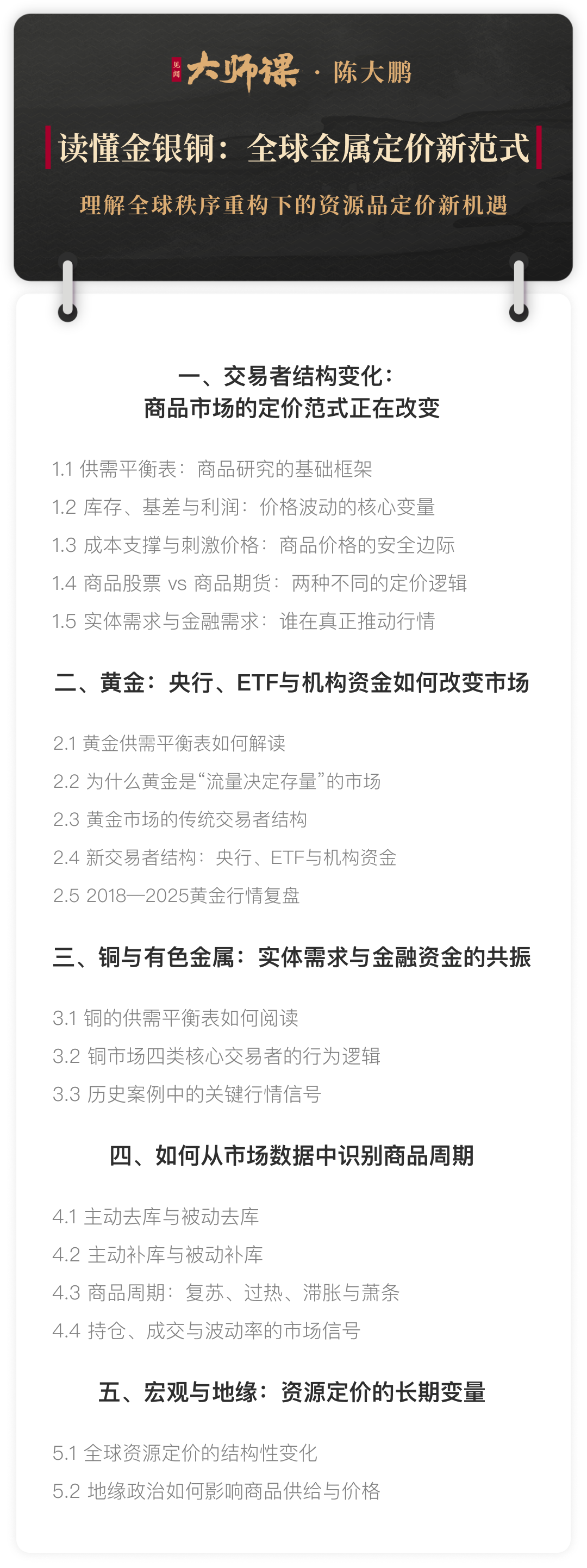
In this section, Peifengke·Chen Dapeng will start with the 2024 short squeeze and the expected high-level fluctuations in 2025, dissecting: when copper prices are at “the easiest place to go wrong”, what choices are different traders really making?
Or check the course schedule below to unlock the full course and see—in this round of high-level consolidation—whether you should stay bullish or lock in your risk first.
Disclaimer: The content of this article solely reflects the author's opinion and does not represent the platform in any capacity. This article is not intended to serve as a reference for making investment decisions.
You may also like
Dow Jones Industrial Average gives back Friday's rally on a Boeing delay
ECB rate hike expectations cool down, Lagarde: Rising long-term rates will suppress growth and inflation
Christine Lagarde, President of the European Central Bank, stated that a significant rise in long-term interest rates will slow economic growth and suppress the transmission of energy prices to overall inflation, exceeding the extent forecasted by the ECB in September. She also emphasized that in the absence of signs of second-round effects, the ECB should adopt "moderate response measures" to control inflation. As a result, the market’s expectation of an ECB rate hike in October has dropped to less than 40%.

BitMine stock trades near golden cross as Ethereum holdings approach 5%
Chainlink’s CCIP upgrade adds extra security layers after $292M hack
Crypto prices
More


