
CoreWeave’s $8.5B loan shows how AI is replacing crypto mining finance

CoreWeave’s recent $8.5 billion AI-backed loan highlights a major transition in how Wall Street finances digital infrastructure, marking a shift from “MinerFi” to “ComputeFi,” according to TheEnergyMag.
In its latest Miner Weekly newsletter, TheEnergyMag examined CoreWeave’s multibillion-dollar raise from a group of banks and investors, backed by Mark Zuckerberg’s Meta Platforms. As Bloomberg reported, the financing underscores how companies are finding new ways to fund data center construction and expand GPU capacity.
Although CoreWeave has pivoted away from the digital asset sector toward AI-focused data center compute, the move offers a broader lesson on the shortcomings of Bitcoin (BTC) mining finance.
Historically, lenders funded Bitcoin mining operations using application-specific integrated circuits, or ASICs, as collateral. However, these models proved fragile due to crypto price volatility and rapid hardware depreciation. When markets declined, both revenues and collateral values fell sharply.
CoreWeave’s financing structure is “what MinerFi tried — and failed — to become,” TheEnergyMag said.
Unlike prior models, CoreWeave’s deal ties financing to active AI infrastructure with contracted customers and predictable cash flows. GPUs must be deployed, operational and revenue-generating before capital is extended, which reduces lender risk.
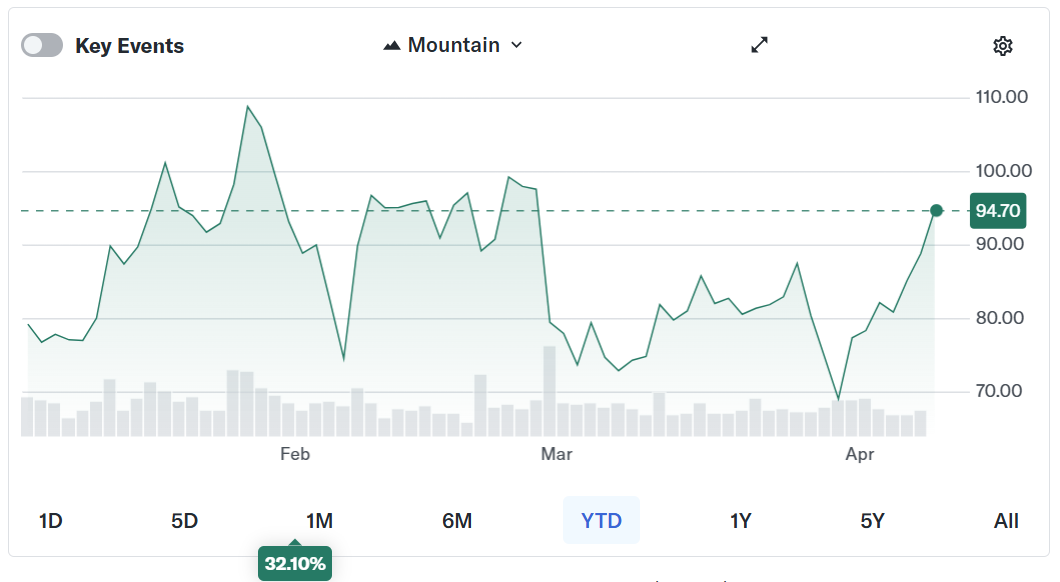 CoreWeave (CRWV) stock. Source:
Yahoo Finance
CoreWeave (CRWV) stock. Source:
Yahoo Finance
Related: Bitcoin mining’s 2026 reckoning: AI pivots, margin pressure and a fight to survive
Bernstein: CoreWeave pivot strengthens position in neocloud market
CoreWeave’s early pivot away from crypto mining has helped position it as a leading “neocloud” provider, a term used to describe companies offering GPU-based cloud infrastructure for artificial intelligence workloads, according to a recent analyst note by Bernstein.
The report compared CoreWeave with peers IREN and Nebius, highlighting differences in scale, infrastructure and financing strategies.
CoreWeave’s head start has translated into a significantly larger backlog of roughly $67 billion, compared with about $9.7 billion for IREN and $47 billion for Nebius.
While all three companies are expanding into AI infrastructure, IREN still generates most of its revenue from Bitcoin mining as it continues its transition.
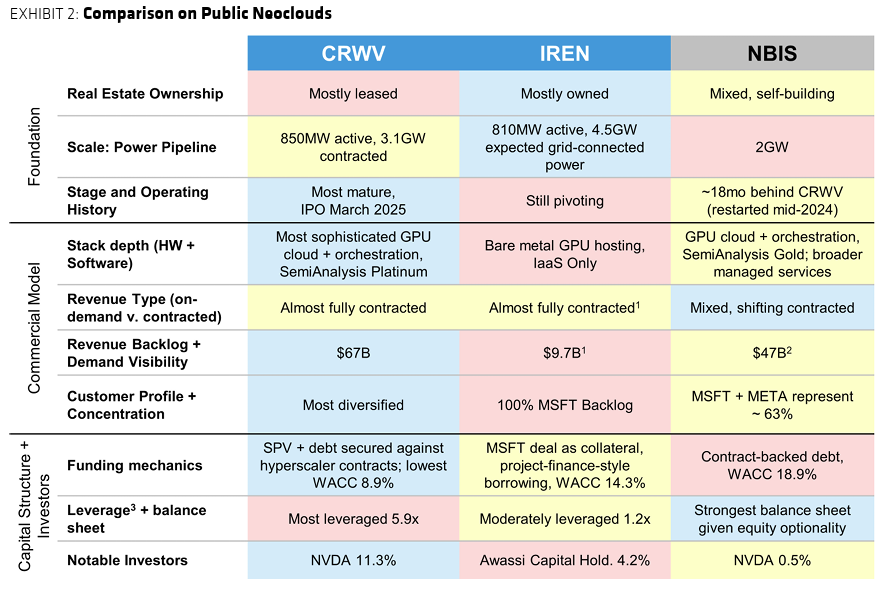 A comparison of CoreWeave, IREN and Nebius across capital structure, commercial model and infrastructure. Source: Bernstein
The Bernstein analysts gave CoreWeave top marks for its “commercial model,” thanks to the “depth in the software stack, a mix of contracted and on-demand revenue, strong backlog and an increasingly diversified customer base.”
However, they said IREN has an advantage in infrastructure, citing its sizable real estate footprint rather than its reliance on leased data center capacity.
Related: Crypto Biz: Mining weakness tests Bitcoin’s market cycle
Disclaimer: The content of this article solely reflects the author's opinion and does not represent the platform in any capacity. This article is not intended to serve as a reference for making investment decisions.
You may also like

UBS: US Companies’ Capex Willingness Rebounds from Bottom, Further Rate Hikes May Have Limited Impact on Economy
UBS believes that traditional U.S. investments have been subdued for a long time and are at a low level, with limited room for further rate hikes to have an impact. Meanwhile, corporate operating cash flow has increased by 25%, providing sufficient internal funds, which may weaken the transmission effect of interest rates on Capex. As capital expenditure willingness rebounds from historic lows and non-AI investments show signs of stabilization, U.S. corporate investment may be entering a recovery phase.
As Nscale submits its IPO application, Bernstein "diagnoses" AI computing power cloud: CoreWeave (CRWV.US) "underperforms the market," IREN (IREN.US) "outperforms the market"
Last Friday, the emerging British AI computing power company Nscale officially submitted its S1 prospectus. This long-anticipated document offers a new reference point for Bernstein to analyze the business model, competitive barriers, and potential risks of the new generation of computing power cloud sector.
Cardano rises 17% in one month, eyes top 10 amid market rally
Crypto prices
More


