
Crypto investment inflows rebound as XRP tops weekly gains of $224M

Cryptocurrency investment products recorded minor inflows last week despite mixed geopolitical signals and increasingly hawkish investor expectations.
Global crypto exchange-traded products (ETPs) clocked $224 million in inflows last week, following a $414 million outflow a week before, CoinShares reported on Tuesday.
The fresh inflows brought total assets under management to about $131.8 billion, roughly in line with levels seen at the same time last year. Year-to-date inflows also totaled about $1.2 billion, compared with $960 million over the same period last year.
The inflows marked a brief rebound in sentiment before later-week macro data and policy expectations reversed momentum, CoinShares head of research James Butterfill said.
XRP leads inflows as Bitcoin trails closely
XRP (XRP) led inflows with about $120 million, contributing more than half of net weekly inflows.
The gains marked XRP’s largest weekly inflows since mid-December 2025, Butterfill noted, bringing its year-to-date inflows to $159 million.
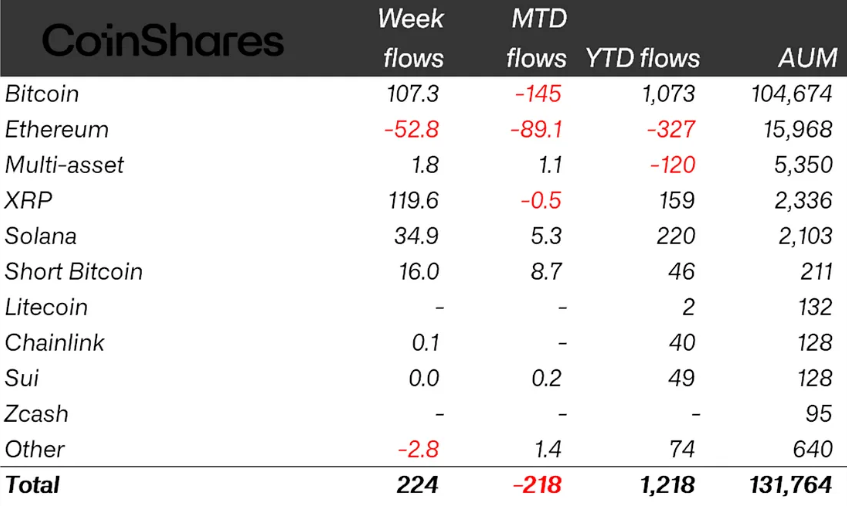 Crypto ETP flows by asset (in millions of US dollars). Source: CoinShares
Bitcoin (BTC) ETPs followed closely with $107 million of inflows, bringing year-to-date flows to slightly above $1 billion. Of those gains, only around $22 million was contributed by US spot Bitcoin exchange-traded funds (ETFs), which remain in negative territory year-to-date.
Solana (SOL) also saw minor inflows totaling around $35 million last week, with steady inflows this year representing 10% of total assets under management.
On the other hand, Ether (ETH) investment products continued to lag, posting $53 million in outflows. That followed $222 million in outflows the prior week, bringing year-to-date outflows to $327 million.
CoinShares’ Butterfill attributed the negative sentiment around Ether to developments tied to the CLARITY Act, a major piece of crypto legislation closely linked to stablecoins, which are largely issued on the Ethereum blockchain. Following months of delays, US Senate Banking Committee member Bill Hagerty said Monday that he expects a potential path for the bill in the coming weeks.
Geographically, Switzerland led last week’s inflows at roughly $157 million, followed by Germany and the US, which both recorded about $28 million each, and Canada with $11 million.
Disclaimer: The content of this article solely reflects the author's opinion and does not represent the platform in any capacity. This article is not intended to serve as a reference for making investment decisions.
You may also like
Arthur Hayes forecasts $1 million Bitcoin by 2030, links target to AI debt risks
AI valuation divergence intensifies! Anthropic IPO: Enthusiastic Silicon Valley bids $2 trillion, while a cautious Wall Street only recognizes $1.5 trillion
The valuation debate surrounding Anthropic’s IPO is exposing a pricing gap between Silicon Valley and Wall Street. Silicon Valley venture capitalists are still betting heavily on AI growth at high valuations, with some investment banks discussing an early valuation of around $2 trillion. Meanwhile, Wall Street public market institutions are focusing on high interest rates, capital expenditure on computing power, and ongoing financing pressures, and are leaning toward a $1.5 trillion valuation.
Micron (MU.US) Q4 earnings call: Management declares "No sign of supply-demand balance," 75% of shipments for next year already locked in; 2028 expected to be tighter than 2027
Micron Technology (MU.US) management expressed optimism during the Q4 earnings call, stating that AI-driven memory demand remains strong and that supply and demand will remain tight in 2027 and 2028.
After experiencing Muse, I cleared out my Airbnb holdings
A senior analyst heavily invested in Airbnb decided to sell all his Airbnb holdings just 10 days after experiencing Meta AI's Muse app. He believes that Muse not only understands his preferences but also helps him bypass Airbnb to book accommodations directly, at 60% lower prices. As AI agents begin to compare prices, cancel, and rebook on your behalf, the "traffic moat" that internet platforms depend on is under threat, and the era of "proactive e-commerce" may be dawning.
Crypto prices
More


