
Russia moves to narrow crypto trading to regulated intermediaries

Russia’s government has approved a package of draft bills that would channel domestic crypto trading through licensed intermediaries and sharply limit retail access.
The Finance Ministry said Monday that the government had approved a package of draft bills on the legalization of the circulation of digital currencies and digital rights in Russia.
“Under the new regulatory framework, transactions involving digital currency without regulated intermediaries are prohibited,” the ministry said. The package would tighten state oversight of digital assets while preserving limited access for non-qualified investors and broader access for qualified investors.
The framework introduces significant limits for retail investors, allowing purchases of the “most liquid digital currencies” to be defined by the Bank of Russia. Under the rules, retail investors must pass a test and are limited to purchases of up to 300,000 rubles ($3,700) per year through a single intermediary.
The proposal would still allow residents to buy crypto abroad using foreign accounts, provided those transactions are reported to tax authorities, signaling that Moscow is trying to domesticate crypto trading rather than ban it outright.
Crypto operators face licensing requirements
The approved package includes bills on digital currencies and digital rights, amendments to certain Russian legislative acts, as well as changes to the country’s administrative offenses code.
The framework establishes a licensing regime for entities involved in crypto operations, including digital exchanges and custodial services, while allowing banks and brokers to participate under specific regulatory requirements.
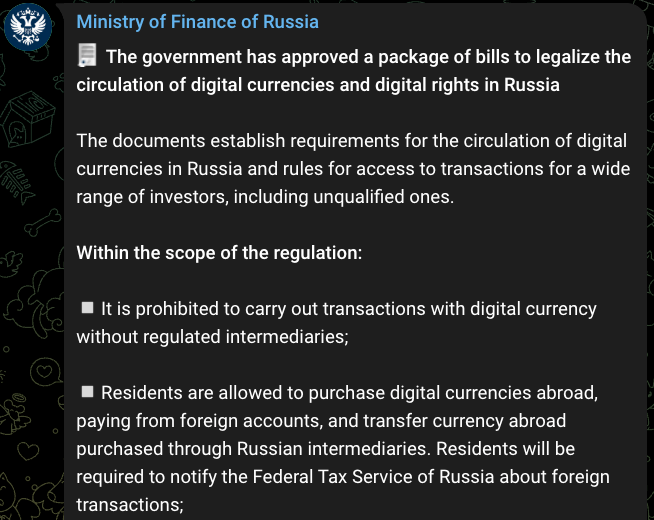 Source: Ministry of Finance of Russia (Minfin), translated by Telegram
“As for banks and brokers, they will be able to carry out such activities provided they comply with specific prudential requirements,” the announcement notes.
The package also provides for administrative liability for violations by organizations engaged in exchange activity, part of a broader push to police unlicensed crypto intermediation.
Critics say rules could backfire on oversight goals
While the government aims to formalize the sector, critics say the rules could have the opposite effect, pushing activity into unregulated channels.
“At a time when the rest of the world is moving toward liberalizing access to equity markets through tokenization, we are, for some reason, doing the opposite by pushing crypto into a framework of securities market regulation,” Exved founder Sergey Mendeleev told Cointelegraph.
“In the end, it will be like with casinos — people won’t play less, but everything will move out of state control into online and underground venues,” he said.
Disclaimer: The content of this article solely reflects the author's opinion and does not represent the platform in any capacity. This article is not intended to serve as a reference for making investment decisions.
You may also like
AMD (AMD.US) Surpasses $1 Trillion Market Cap and Begins Competing for "Computing Power Definition Rights"! Officially Announces $8.2 Billion Acquisition of Fei-Fei Li's World Labs
AMD has agreed to acquire World Labs for $8.2 billion, thereby gaining access to the artificial intelligence startup founded by industry pioneer and researcher Fei-Fei Li. This acquisition is expected to help AMD plan its future hardware launches by bringing in a team of top researchers and their models, as well as deep insights into trends in the field of artificial intelligence.
A Major Reversal Amid the U.S. Bond Selloff! Bond Market Veteran Bianco Turns Bullish for the First Time in Six Years, Calling 5% Yield a "Value Buy Opportunity"
Currently, as benchmark U.S. Treasury yields surge to their highest levels in nearly two decades, bond market veteran Jim Bianco has loosened his bearish stance for the first time and is gradually building long positions as a "value buyer."
New Zealand Dollar steadies near its lows as RBNZ hike bets keep building
Crypto prices
More


