
Geopolitical fire ceases abruptly, but U.S. Treasury yields plunge from highs instead? The market is front-running a script that no one is openly discussing.

FX168 Finance, March 23—— In Monday's (March 23) global financial market session, the US Treasury market saw highly dramatic swings. A sudden reversal in the Middle East situation triggered the movement of the benchmark 10-year US Treasury yield
In Monday's (March 23) global financial market session, the US Treasury market underwent exceptionally dramatic volatility. A sudden reversal in the Middle East situation had an impact on the benchmark
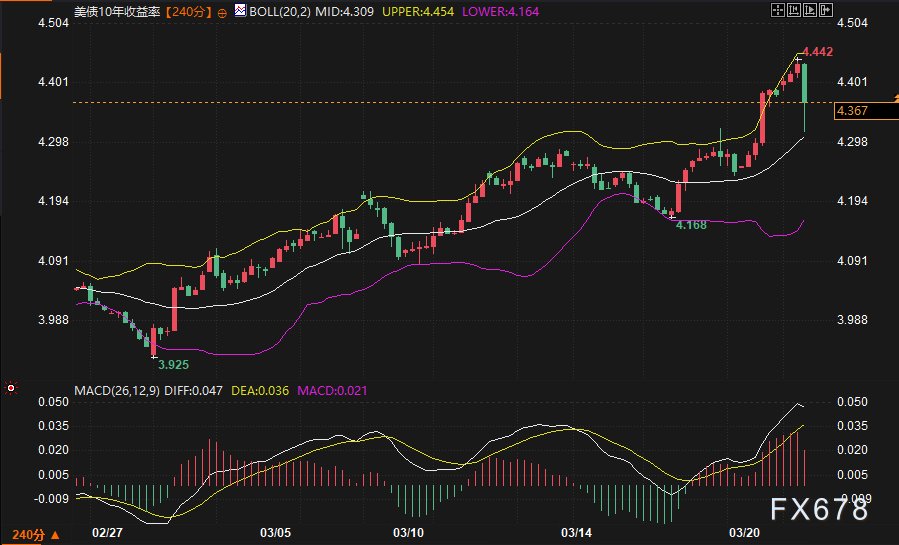
As of press time,
Fundamental Logic Analysis and Technical Long-short Contest
From a macro perspective, the turning point in today's trend originated from the sudden alleviation of geopolitical pressures. Earlier, the tensions in Iran sparked market panic over a potential break in the energy supply chain and a surge in oil prices, a logic that transmitted straight to inflation expectations and pushed up Treasury yields. However, with the US side announcing, after productive dialogue, a five-day ceasefire in strikes on Iranian power facilities and energy infrastructure, the downward pressure on crude prices counteracted forward inflation compensation in the bond market.
This rapid shift in sentiment is clearly evidenced on the
1.
2.
This yield weakness at highs triggered a chain reaction in other markets. As yields declined from their highs, the dollar index's rally lost momentum, thereby providing a support floor for safe-haven assets like gold. In equities, falling yields have eased discount rate pressure, but investors remain cautious about potential protectionism from
Outlook for Future Trends
In the short term, the US Treasury market has entered a "high-volatility observation phase" driven by geopolitical news. Although eased Iran tensions have alleviated immediate selling pressure, there are still underlying supports: mainstream market views have begun to price in the possibility of further Fed rate hikes, a sharp departure from previous expectations for rate cuts.
From a chart logic perspective, as long as
Frequently Asked Questions
A: Bond yields and prices move inversely. When eased Iran tensions send signals, markets worry less about inflation spikes caused by soaring energy prices. Lower inflation expectations mean investors require less yield to compensate for future loss of purchasing power, which leads to buying in bonds, higher prices, and yields falling from highs.
A: Bearish divergence means that while the price (yield) makes a new high (e.g.,
A: According to the latest rate futures data, the market has begun pricing in the possibility of a rate hike this year. This shift mainly stems from the US economy showing more resilience than expected and recent cautious comments by Federal Reserve officials about the pace of inflation's decline. If economic data remains strong and secondary inflation risks rise due to
A: In technical analysis, the BOLL middle band is the dividing line of market strength. If the
A: Today, the Treasury will auction a total of
Disclaimer: The content of this article solely reflects the author's opinion and does not represent the platform in any capacity. This article is not intended to serve as a reference for making investment decisions.
You may also like
British Pound gains as US Dollar weakens despite hawkish Fed, geopolitical tensions
Volatility Divergence Between Individual Stocks and Index! Popular US Stock Trading: Go Long on Stock Options, Hedge with Index Options
With the divergence in the AI narrative, drastic fluctuations in oil prices, and U.S. Treasury yields soaring to a 20-year high, the degree of dispersion among S&P 500 constituents has risen to the 95th percentile in 30 years. As single-stock volatility continues to compress, entry costs have become relatively low, and the volatility gap between individual stocks and the index has widened again. This has opened a rare window for dispersed trading strategies such as "long single-stock options + short index options."
US Treasury yield curve approaches inversion! Is the bond market questioning the outlook for the US economy?
The U.S. Treasury yield curve is rapidly approaching the inversion threshold—the spread between the 10-year and 2-year yields has narrowed to historic lows, and bank stocks have responded with a technical correction. This warning signal, regarded as a "hard rule" for recession, is tearing apart market consensus: some are betting the curve will soon invert, while others firmly believe economic resilience will mitigate the risk. Amid ongoing Federal Reserve rate hikes, the outcome of this bond market game may reshape the narrative logic of the entire asset market.

From ICU to KTV! The Polarized "AI Narrative" Leaves Investors "Exhausted"
In just two weeks, the Nasdaq 100 experienced an extreme rollercoaster: first losing $600 billion in market value due to “AI threat” concerns, then rebounding to reclaim $3 trillion thanks to the viral Meta assistant. Analysts believe that market sentiment is swinging violently between fear and greed, detached from fundamentals. The turmoil has driven Nvidia’s valuation to a ten-year low, intensified the bull-bear divide, and the high volatility driven by narratives has become a long-term norm for investors. This week, Micron will release its financial report; regardless of the outcome, the sharp swings in market sentiment are unlikely to subside.
Crypto prices
More


