
Bitcoin Struggles Near $70,000 as “Quadruple Witching” and Global Tensions Weigh on Markets

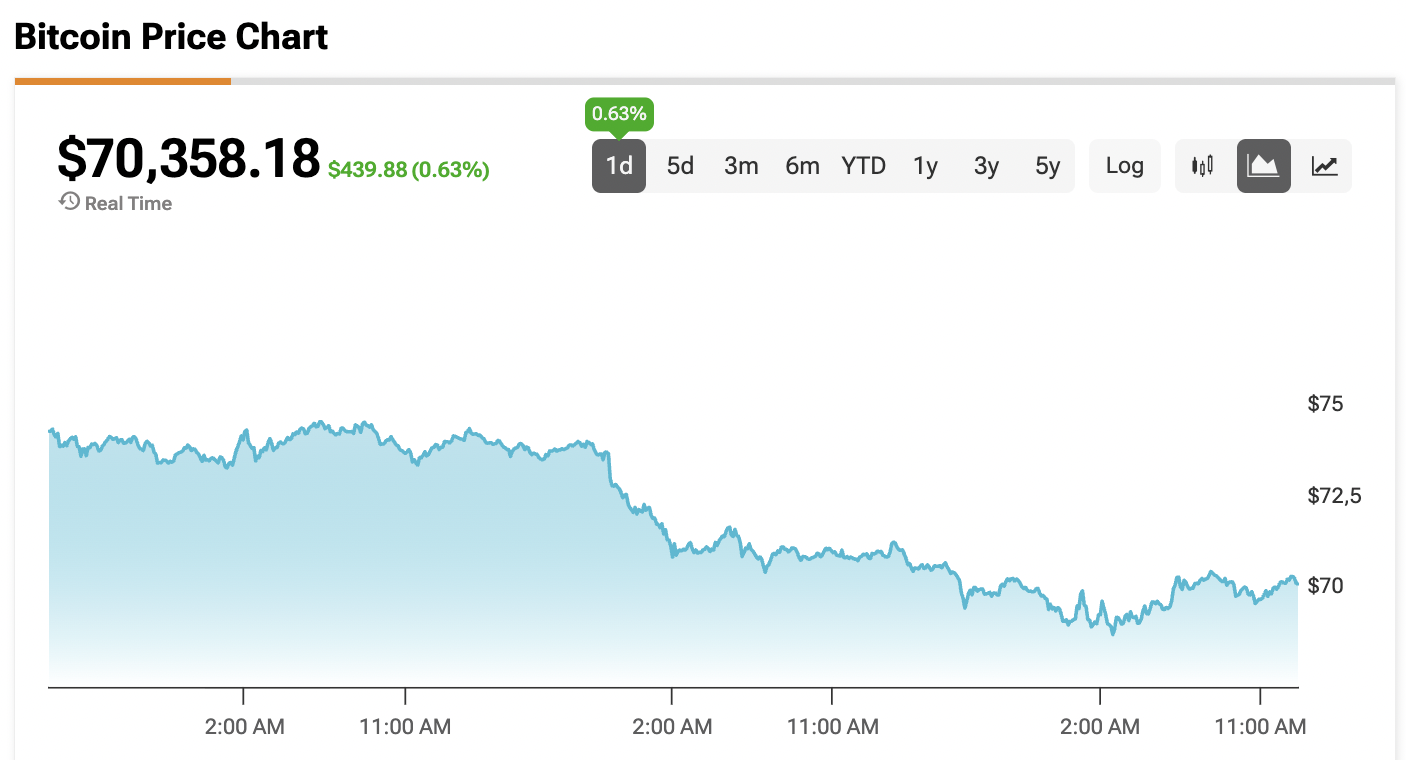
Bitcoin (BTC-USD) dipped below the $70,000 mark on Thursday, pulling back into a familiar trading range after briefly reaching highs above $76,000. This slide happens as investors face a mix of high oil prices, conflict in the Middle East, and a massive derivatives event in traditional finance known as “quadruple witching.” While the price action looks shaky, some analysts believe a specific chart pattern could still trigger a quick rebound.
Claim 70% Off TipRanks Premium
- Unlock hedge fund-level data and powerful investing tools for smarter, sharper decisions
- Stay ahead of the market with the latest news and analysis and maximize your portfolio's potential
Futures Selling and Stalling U.S. Demand Drive Prices Down
The recent drop aligns with a shift in how Bitcoin is being traded. Data shows that selling pressure is currently coming more from professional futures traders than from people buying the actual coins on exchanges. This is visible in the Coinbase premium gap, which turned negative, suggesting that demand from U.S. investors has cooled off.
Crypto analyst IT Tech pointed out a clear imbalance, noting that while spot selling fell by about $40 million, selling in the perpetual futures market dropped by a much larger $506.75 million. This indicates that traders using borrowed money (leverage) are the ones driving the current downward trend.
Historical Fractals Hint at Potential Rebound for BTC
Despite the drop, some traders see a bullish fractal forming. This is a pattern that looks like a previous market move. Specifically, Bitcoin is mimicking a correction from early March where the price fell to trap shorts before reversing higher.
If Bitcoin can quickly reclaim the $70,000 level, it may open a path back toward $76,000. However, the setup is time-sensitive. A drop below $68,300 could shift the focus toward lower support levels at $65,000 or even $62,000.
“Quadruple Witching” Adds to Market Stress
Adding to the uncertainty is a major event in traditional markets called “quadruple witching” on Friday. This happens four times a year when trillions of dollars in various stock and index derivatives expire at once. In 2025, Bitcoin often saw flat performance on these days followed by a week or two of price drops.
Cole Kennelly, CEO of Volmex Finance, warned that “quadruple witching could trigger a spike in cross-asset volatility as large derivatives positions expire.” This volatility often spills over from the stock market into crypto.
Outside of the charts, the war in Iran and rising energy costs are making investors nervous. With oil prices swinging toward $100 a barrel, there are fears that central banks will keep interest rates high. Wintermute trader Bryan Tan suggested that “being flat is a strong position” right now. He recommends that investors keep “dry powder” (cash) ready until the market shows a clearer direction.
At the time of writing, Bitcoin is sitting at $70,358.18.
Copyright © 2026, TipRanks. All rights reserved.
Disclaimer: The content of this article solely reflects the author's opinion and does not represent the platform in any capacity. This article is not intended to serve as a reference for making investment decisions.
You may also like
British Pound gains as US Dollar weakens despite hawkish Fed, geopolitical tensions
Volatility Divergence Between Individual Stocks and Index! Popular US Stock Trading: Go Long on Stock Options, Hedge with Index Options
With the divergence in the AI narrative, drastic fluctuations in oil prices, and U.S. Treasury yields soaring to a 20-year high, the degree of dispersion among S&P 500 constituents has risen to the 95th percentile in 30 years. As single-stock volatility continues to compress, entry costs have become relatively low, and the volatility gap between individual stocks and the index has widened again. This has opened a rare window for dispersed trading strategies such as "long single-stock options + short index options."
US Treasury yield curve approaches inversion! Is the bond market questioning the outlook for the US economy?
The U.S. Treasury yield curve is rapidly approaching the inversion threshold—the spread between the 10-year and 2-year yields has narrowed to historic lows, and bank stocks have responded with a technical correction. This warning signal, regarded as a "hard rule" for recession, is tearing apart market consensus: some are betting the curve will soon invert, while others firmly believe economic resilience will mitigate the risk. Amid ongoing Federal Reserve rate hikes, the outcome of this bond market game may reshape the narrative logic of the entire asset market.

From ICU to KTV! The Polarized "AI Narrative" Leaves Investors "Exhausted"
In just two weeks, the Nasdaq 100 experienced an extreme rollercoaster: first losing $600 billion in market value due to “AI threat” concerns, then rebounding to reclaim $3 trillion thanks to the viral Meta assistant. Analysts believe that market sentiment is swinging violently between fear and greed, detached from fundamentals. The turmoil has driven Nvidia’s valuation to a ten-year low, intensified the bull-bear divide, and the high volatility driven by narratives has become a long-term norm for investors. This week, Micron will release its financial report; regardless of the outcome, the sharp swings in market sentiment are unlikely to subside.
Crypto prices
More


