
SEC Chair explains why NFTs fall outside of securities laws

After the US Securities and Exchange Commission (SEC) outlined four broad categories of digital assets that fall outside securities laws, Chair Paul Atkins offered further clarity on why nonfungible tokens (NFTs) generally do not meet that definition.
In a Wednesday interview with CNBC, Atkins reiterated that the agency’s recent interpretive release identified four types of digital assets that are typically not considered securities: digital commodities, digital tools, digital collectibles such as NFTs, and stablecoins.
During the interview, host Andrew Ross Sorkin pressed Atkins on digital collectibles, noting they could more easily resemble securities depending on how they are structured.
“Well, that’s true with anything,” Atkins replied, emphasizing that the SEC’s analysis still hinges on the facts and circumstances of each asset, particularly whether it involves an investment contract under longstanding legal precedent.
Atkins said digital collectibles are generally treated as items that are bought and held, similar to physical collectibles, rather than as investment contracts — the defining feature of securities.
“Some of these collectibles, like a baseball card, a meme or one of those memecoins, NFTs — those are something that somebody buys,” he said. “It’s an immutable purchase… it’s not something like another asset where people are trading it.”
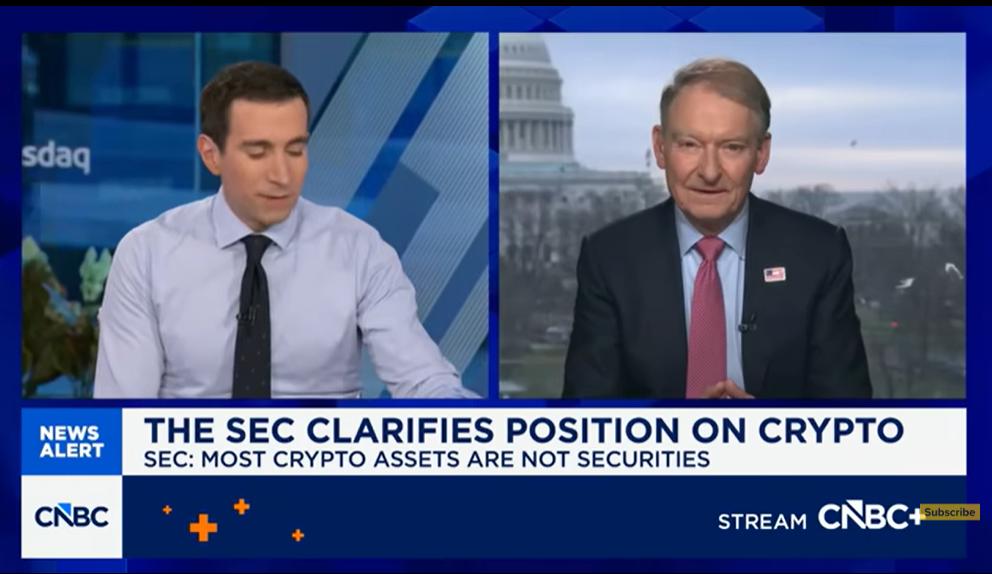 Paul Atkins appears on CNBC. Source:
Related: SEC chair Paul Atkins floats ‘safe harbor’ exemptions for crypto
SEC continues to move away from enforcement-led crypto policy
The securities regulator has recalibrated its approach to digital assets under Atkins, a shift that has coincided with the arrival of a more crypto-friendly Trump administration in early 2025.
“We’re breaking with the past,” Atkins said during the CNBC interview, describing the SEC’s push to provide clearer guidance and a more predictable regulatory framework for the digital asset sector.
Last year, Atkins criticized the agency’s previous reliance on “regulation through enforcement” and pledged to move away from that approach. He also pointed to tokenization as a key innovation that regulators should support rather than restrict.
He has since reiterated that past regulatory missteps have left the United States lagging behind in crypto development by as much as a decade, and has vowed to reverse that trend.
Related: CFTC issues ‘no-action’ letter for crypto wallet provider Phantom
Disclaimer: The content of this article solely reflects the author's opinion and does not represent the platform in any capacity. This article is not intended to serve as a reference for making investment decisions.
You may also like
From connecting users to hosting computing power, Philippine telecom giant Globe bets on AI data centers! Targeting the next billion-dollar business.
Globe Telecom Inc. plans to invest at least $1 billion by 2027 to expand its data business. The company regards its data center business as the next billion-dollar venture, with the rapid development of artificial intelligence being a key driving factor behind this goal.
Quantum Computing Reaches Historic Turning Point: Moving Beyond "Physical Experiments," Supply Chain and Manufacturing Become Key to Success
After attending the Quantum World Congress, Jefferies issued a major evaluation: the industry's core challenge has shifted from "creating good qubits" to "building truly usable computers." The source of competitive advantage has fully moved from physics innovation to system engineering and manufacturing barriers. The U.S. government has elevated its role from a funding provider to a rule-maker, with federal funding now linked to performance and the NQI Act about to be implemented. Whoever first achieves repeatable manufacturing and supply chain resilience will earn the ticket to compete in commercializing this technology.
Crypto prices
More


