
Modest upward movement in gold and silver prices before PPI release and FOMC decision

Gold and Silver Market Update
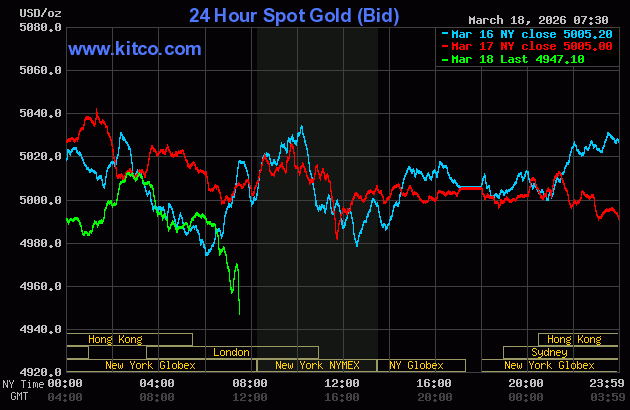
Early Tuesday trading in the U.S. saw gold and silver prices slightly lower, as investors anticipate important economic reports later this week. April gold futures slipped by $38.10 to $4,970.10, while May silver dropped $0.351 to $79.57.
Federal Reserve Meeting and Economic Outlook
The Federal Open Market Committee (FOMC) concludes its meeting today, with expectations that U.S. monetary policy will remain unchanged. Market participants are closely watching Federal Reserve Chair Jerome Powell for guidance on how the central bank is assessing economic risks, especially in light of ongoing conflict in the Middle East. The Fed is likely to keep interest rates steady and unveil new economic forecasts, reflecting their interpretation of recent data and global events. Powell is set to address the media this afternoon, likely stressing the need for more time to evaluate the duration and impact of the U.S.-Iran conflict on growth and inflation.
According to Bloomberg, bond traders have reduced aggressive bets on rate cuts, with markets now anticipating at least one quarter-point cut by the end of 2026. This shift follows a sell-off in short-term Treasuries, driven by inflation concerns as oil prices surpassed $100 per barrel.
Producer Price Index Insights
The U.S. Producer Price Index (PPI) is released today. February's PPI is forecasted to rise 0.3% month-over-month, a slower pace than January's 0.5% increase and the smallest gain in three months. Core PPI, which excludes food and energy, is also expected to climb 0.3%, compared to a 0.8% jump previously. Year-over-year, headline producer inflation is projected to hold steady at 2.9%. Core producer inflation may edge up to 3.7%, marking the highest level since March last year, up from 3.6% in January.
Developments in the Iran Conflict
- Iran has launched new missile and drone attacks in the Persian Gulf, targeting the UAE, Saudi Arabia, and Kuwait.
- These strikes came after Iran confirmed the death of its security chief, Ali Larijani, in an Israeli attack. With Larijani gone, Iran's leadership is now dominated by hardliners, who may be less inclined to pursue diplomatic solutions.
- Former President Trump stated that the U.S. will soon be prepared to end its involvement in the conflict: "We're not ready to leave yet. But we'll be leaving in the near future."
- Israel has intensified its operations in Lebanon, resulting in over 900 fatalities, according to Lebanese authorities.
- Iran continues to transport crude oil through the Strait of Hormuz at levels similar to those before the conflict began.
- Oil prices have softened as Iraq agreed to resume exports via Turkey, bypassing the Strait of Hormuz, and as the U.S. pushes for reopening the strategic waterway.
- The U.S. plans to relax sanctions on Venezuela to increase oil supply amid the Middle East turmoil.
- China intends to utilize its extensive crude reserves to counteract the effects of the Iran crisis.
Market Overview
Today, the U.S. dollar index is slightly higher, Nymex crude oil is trading lower near $94.50 per barrel, and the yield on the 10-year U.S. Treasury note stands at 4.2%.
Understanding Gold Pricing
The gold market relies on two main pricing methods: the spot market, which reflects immediate purchase and delivery prices, and the futures market, which sets prices for future delivery. Due to year-end trading activity, the December gold futures contract is currently the most traded on the CME.
Technical Analysis: Gold and Silver Futures
For April gold futures, bullish traders aim to close above strong resistance at the March peak of $5,434.10. Bears are targeting a drop below firm support at $4,700.00. Initial resistance is at this week's high of $5,049.40, followed by $5,100.00. First support is at this week's low of $4,970.10, then at $4,900.00. Wyckoff's Market Rating: 6.0.
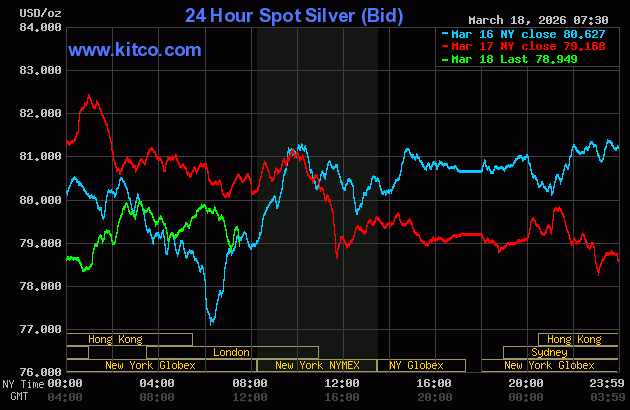
May silver futures bulls are looking to close above solid resistance at $90.00. Bears are focused on pushing prices below strong support at $72.405. Initial resistance is at this week's high of $82.76, then at $85.00. First support is at this week's low of $77.125, followed by $76.00. Wyckoff's Market Rating: 5.0.
Weekly Market Insights

Disclaimer: The content of this article solely reflects the author's opinion and does not represent the platform in any capacity. This article is not intended to serve as a reference for making investment decisions.
You may also like
Why Is SKY Up 15%? S&P Rating, Galaxy’s $100M Bet, and Singapore
23 days after launch, consumer-grade Agent explodes! Morgan Stanley's in-depth analysis of "6 key issues about Muse"
Morgan Stanley believes that in the short term, Muse should focus on user growth, while in the long term, it is expected to achieve commercialization through consumer transactions, enterprise services, and APIs. The high computational cost is both a pressure and may become a competitive barrier; Meta's existing CPU reserves are sufficient to support further expansion. Meanwhile, the collaboration with Amazon will affect the Agent e-commerce entry point, and the enterprise market provides new revenue opportunities. The current valuation has already reflected some expectations, and the key going forward remains in the realization of commercialization.
AI frenzy faces the “funding cutoff line” test? Renowned Wall Street strategist warns: With the US dollar and Treasury yields not peaking, risk appetite remains difficult to recover
Michael Hartnett from Bank of America stated that investors will avoid higher-risk trades until signs emerge that the recent surge in the US dollar has peaked. The strategist also noted in a report that market turbulence may persist until bond yields retreat from their highest levels in more than two decades. He suggested that investors should "buy the dip" in heavily hit assets and prefers to increase bond holdings in portfolios.
September New Jobs Expected to Drop to 90,000: Tonight’s Real “Bombshell” in Nonfarm Payrolls May Be Whether August Data Is Significantly Revised Down
Wall Street generally expects that new jobs added in September will drop to 90,000 and the unemployment rate will remain at 4.1%. The strong data in August was mainly boosted by unusual seasonal factors; the extent of their revision will directly affect perceptions of the strength of the September figures. As recent statements by Federal Reserve officials have pushed the probability of a rate hike in October down to 25%, market attention has shifted to long-term rates. Currently, systematic funds hold about $390 billion in global bond short positions. If the employment data unexpectedly disappoints, it could trigger severe market turbulence.
Crypto prices
More


