
Vitalik Buterin promotes an update simplifying Ethereum node software

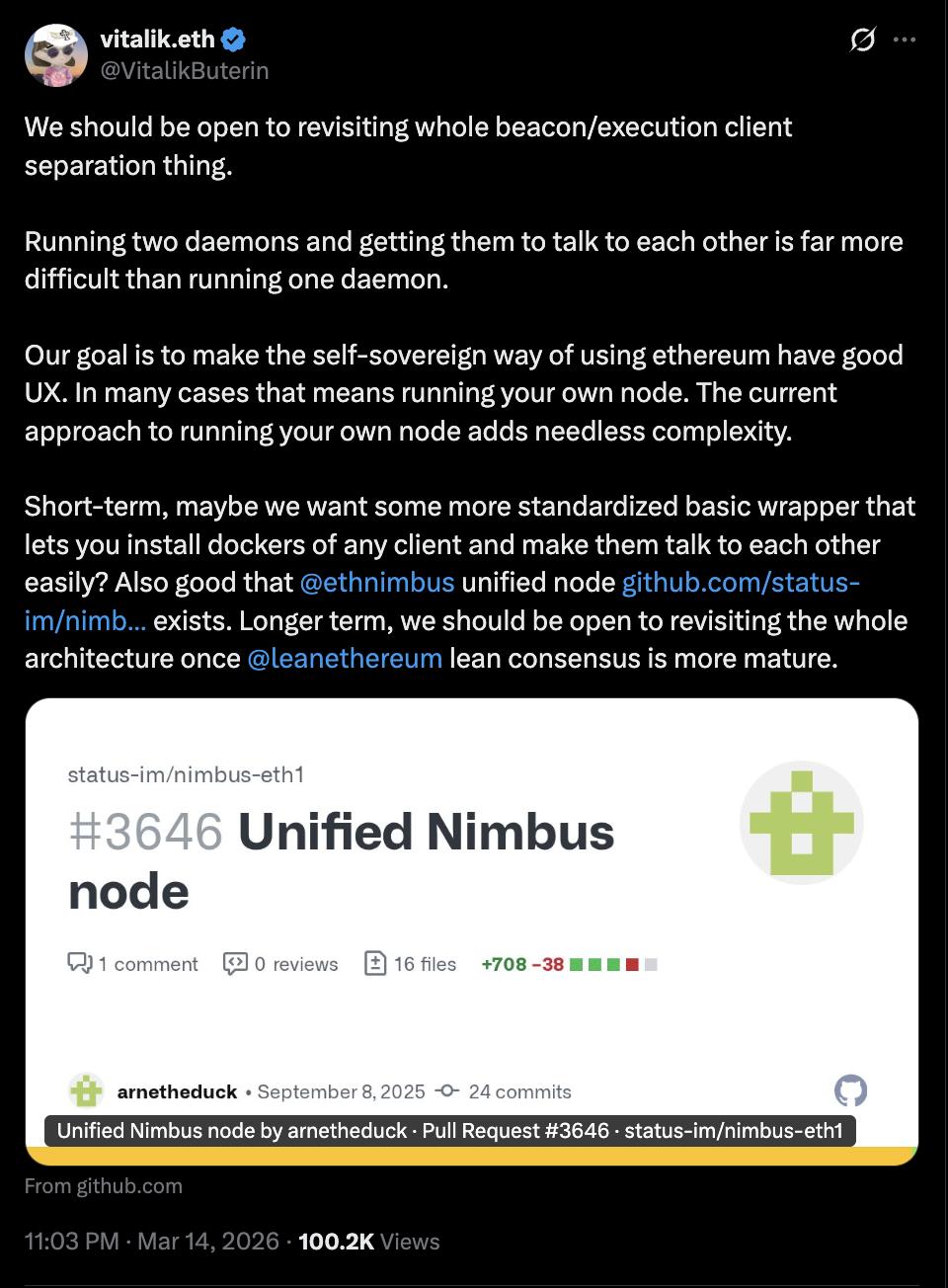
Ethereum co-founder Vitalik Buterin posted a proposal, or a pull request, on Saturday that would merge the backend programs used by nodes to interact with Ethereum’s Beacon Chain, which handles consensus and staking, and the protocol’s execution layer into one unified code structure to simplify node setup.
Ethereum node runners, also called validators, currently have to run two separate programs, which each require setup and synchronization to coordinate and communicate the data produced by Ethereum’s consensus and execution layers.
This raises the technical complexity of running a node or providing validation services for the Ethereum network, preventing ordinary users from running their own infrastructure and forcing reliance on third-party service providers.
 Source:
Vitalik Buterin
Source:
Vitalik Buterin
“I feel like at every level, we have implicitly made this decision that running a node is this oh so scary DevOps task that it is ok to leave to professionals,” Buterin said in a post on X. He continued:
“It is not. We need to reverse this. Running your own Ethereum infrastructure should be the basic right of every individual and household. ‘The hardware requirement is high, therefore it's okay for the DevOps skill and time requirements to also be high,’ is not an excuse.”
Even those who can afford the high-end computing hardware to set up an Ethereum node and have the technical expertise typically lack the time to set them up, Buterin said, adding that “nodes should be easy.”
The Ethereum network and other smart contract blockchains have faced criticism for the technical complexity and hardware requirements to run a node, which has also raised centralization concerns about those networks.
Related: Ethereum Foundation publishes mandate clarifying role and goals
Buterin proposes partially stateless nodes to further decentralize the network
In May 2025, Buterin proposed partially stateless nodes, which do not maintain the full block history and only keep data that the node runner requires.
This reduces the hardware costs and data storage requirements for users running nodes for personal purposes, like sending transactions and verifying the blockchain.
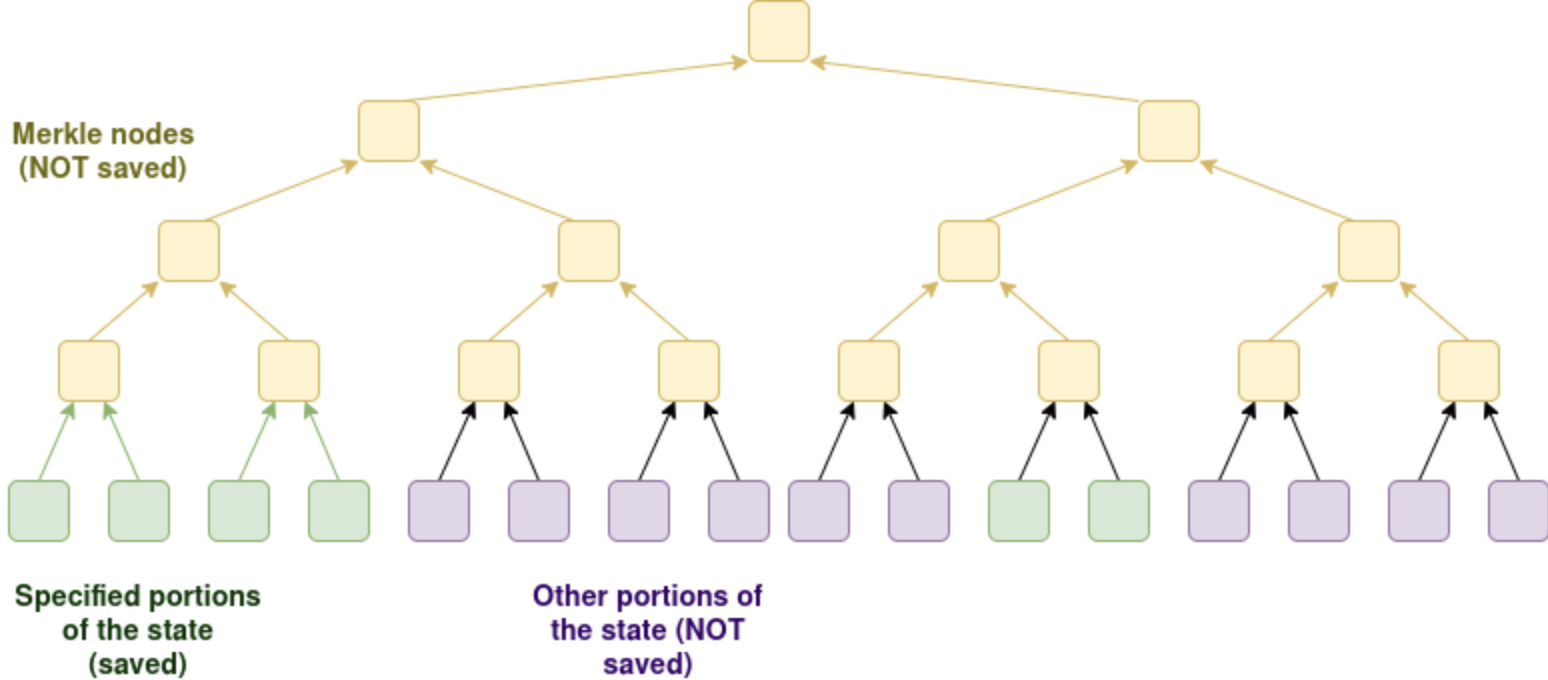 An illustration showing how partially stateless nodes would only save portions of the blockchain state. Source:
Ethereum Research
An illustration showing how partially stateless nodes would only save portions of the blockchain state. Source:
Ethereum Research
Disk space is usually the primary bottleneck for node operators, according to Go-Ethereum (GETH). Smart contract blockchain networks, like Ethereum, generate significant quantities of data that require ever-increasing storage space, making specialized node hardware a necessity.
“A market structure dominated by a few remote procedure call (RPC) providers is one that will face strong pressure to deplatform or censor users. Many RPC providers already exclude entire countries,” Buterin wrote.
In late January, Buterin said he had set aside 16,384 Ether, worth about $45 million, from his personal holdings to support privacy-preserving technologies, open hardware and secure, verifiable software. He added that the funds would be deployed gradually over the coming years as the Ethereum Foundation enters a period of what he described as “mild austerity,” while continuing to pursue its technical roadmap.
Magazine: Ethereum’s Fusaka fork explained for dummies: What the hell is PeerDAS?
Disclaimer: The content of this article solely reflects the author's opinion and does not represent the platform in any capacity. This article is not intended to serve as a reference for making investment decisions.
You may also like
British Pound gains as US Dollar weakens despite hawkish Fed, geopolitical tensions
Volatility Divergence Between Individual Stocks and Index! Popular US Stock Trading: Go Long on Stock Options, Hedge with Index Options
With the divergence in the AI narrative, drastic fluctuations in oil prices, and U.S. Treasury yields soaring to a 20-year high, the degree of dispersion among S&P 500 constituents has risen to the 95th percentile in 30 years. As single-stock volatility continues to compress, entry costs have become relatively low, and the volatility gap between individual stocks and the index has widened again. This has opened a rare window for dispersed trading strategies such as "long single-stock options + short index options."
US Treasury yield curve approaches inversion! Is the bond market questioning the outlook for the US economy?
The U.S. Treasury yield curve is rapidly approaching the inversion threshold—the spread between the 10-year and 2-year yields has narrowed to historic lows, and bank stocks have responded with a technical correction. This warning signal, regarded as a "hard rule" for recession, is tearing apart market consensus: some are betting the curve will soon invert, while others firmly believe economic resilience will mitigate the risk. Amid ongoing Federal Reserve rate hikes, the outcome of this bond market game may reshape the narrative logic of the entire asset market.

From ICU to KTV! The Polarized "AI Narrative" Leaves Investors "Exhausted"
In just two weeks, the Nasdaq 100 experienced an extreme rollercoaster: first losing $600 billion in market value due to “AI threat” concerns, then rebounding to reclaim $3 trillion thanks to the viral Meta assistant. Analysts believe that market sentiment is swinging violently between fear and greed, detached from fundamentals. The turmoil has driven Nvidia’s valuation to a ten-year low, intensified the bull-bear divide, and the high volatility driven by narratives has become a long-term norm for investors. This week, Micron will release its financial report; regardless of the outcome, the sharp swings in market sentiment are unlikely to subside.
Crypto prices
More


