
Is Bitcoin price at risk if private credit breaks?

There is a growing risk that a looming crisis in the private credit market, fueled by rising redemptions and defaults, could spill over into Bitcoin (BTC) and crypto markets, according to analysts.
Key takeaways:
The $2 trillion private credit sector faces a crisis from defaults, redemptions, and limited oversight.
A liquidity crunch may force investors to sell readily accessible assets, like Bitcoin, first.
Historical crises show Fed interventions often lead to strong Bitcoin price rallies as a hedge against money supply expansion.
The private credit ticking time bomb?
The private credit sector, the non-bank lending sector that has grown to over $2 trillion from $500 billion in the past five years, is flashing warning signs of an impending crisis.
Fueled by low rates and investor hunger for high yields, it now rivals traditional banks but lacks the same oversight.
Related: Will Bitcoin crash if oil prices hit $100 per barrel?
In 2024, the International Monetary Fund (IMF) warned that the private credit sector “warranted closer watch,” adding:
“Rapid growth of this opaque and highly interconnected segment of the financial system could heighten financial vulnerabilities given its limited oversight.”
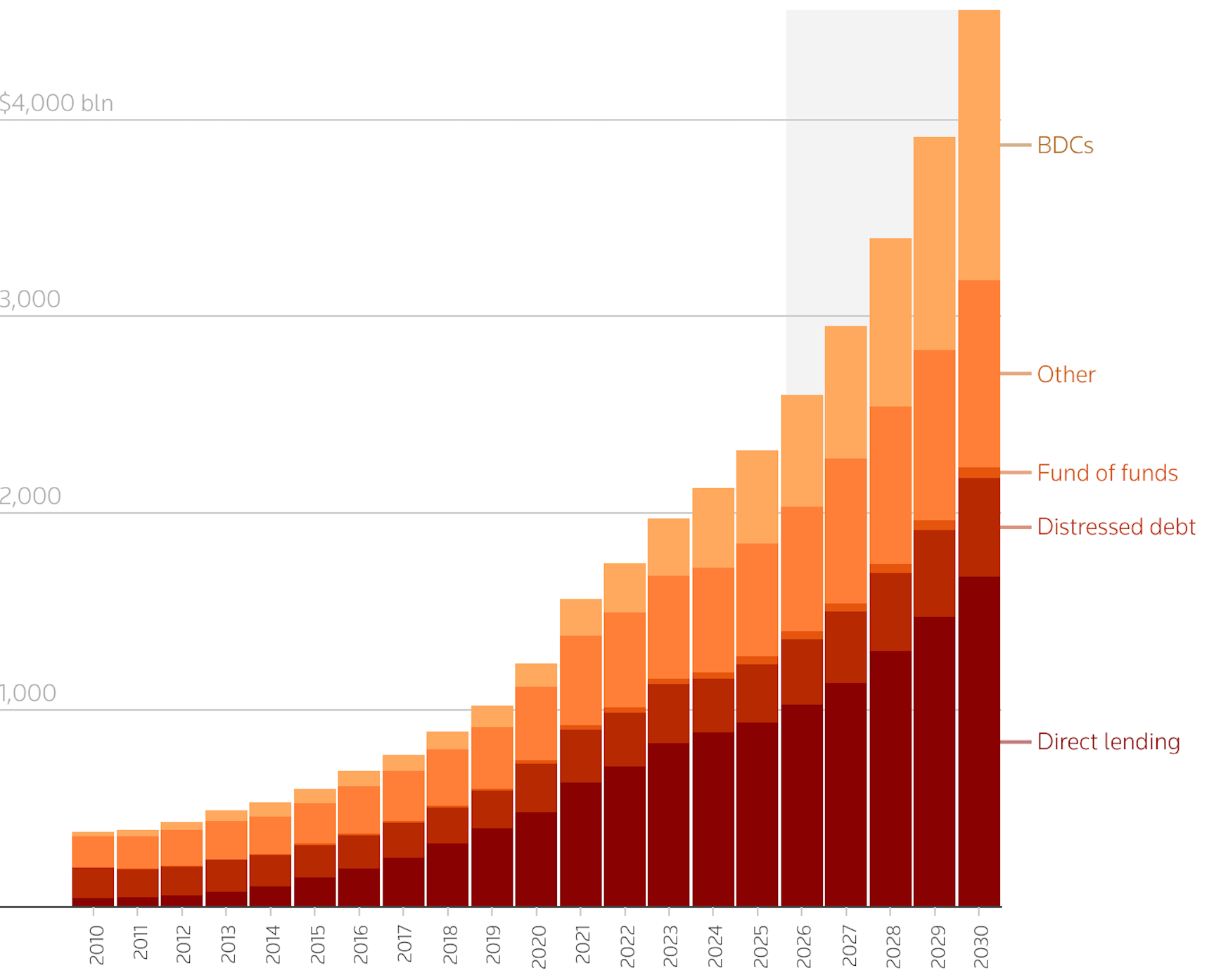 Private credit assets under management to double by 2030. Source: Preqin
Now, the private credit market shows cracks that threaten triggering a financial crisis.
BlackRock, the world's largest asset manager, with over $10 trillion under management, limited withdrawals from its $26 billion flagship credit funds, reported Bloomberg.
Blue Owl Capital halted redemptions amid software sector woes from AI disruptions, while UBS warns of default rates hitting 15% in worst-case scenarios.
On Wednesday, Reuters reported that JPMorgan restricted lending to its private credit funds while Morgan Stanley and Cliffwater Private Credit Fund joined the growing list of asset managers under distress.
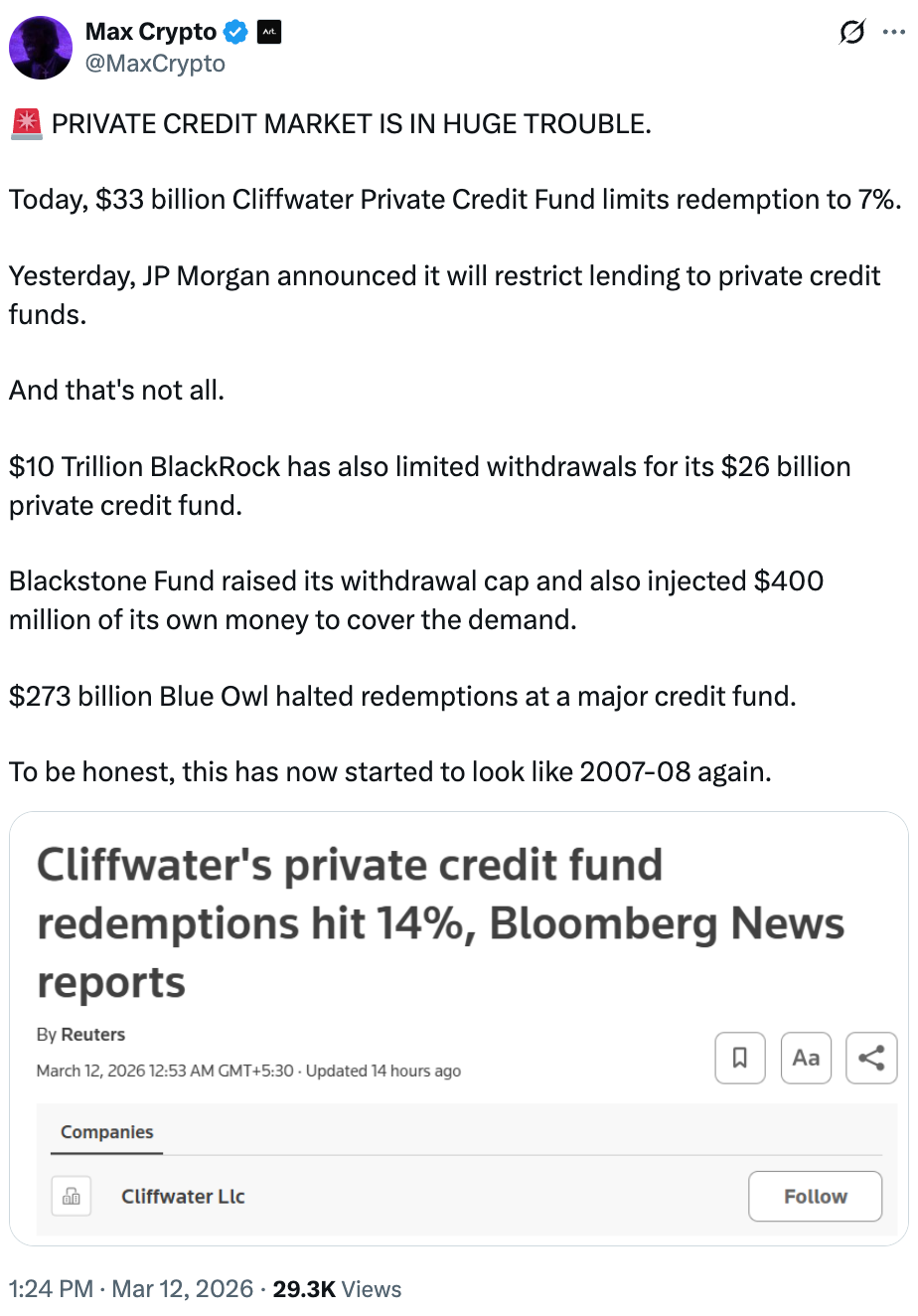 Source: X/Max Crypto
”Bond King” Jeffrey Gundlach, founder at Double Line said that the private credit fund of funds in 2026 closely mirrors CDO-squared in early 2007, before the 2008 global financial crisis.
“Financial repression is incoming,” market analyst MartyParty said in an X post on Thursday, attributing the problems to the sector’s rapid growth in the face of ‘increasing scrutiny’ over liquidity during periods of investor outflows.
“Either the Fed injects liquidity, or we go into crisis.”
Global conflict and macroeconomic uncertainties exacerbate this, potentially delaying Fed easing while putting pressure on equities and the Bitcoin price.
As Cointelegraph reported, futures markets are pricing less than a 1% chance of Fed rate cuts at the March 18 FOMC meeting.
Liquidity crunch could crash Bitcoin price, at first
While the withdrawal limitations directly affect the private credit market, the implications extend far beyond traditional finance.
Withdrawal limits are a “big deal for crypto,” crypto investor Paul Barron said in a recent post on X, adding:
“When giants like Blackrock lock the gates on private funds, it signals a ‘liquidity crunch.’ Investors stuck in private credit might sell their ‘liquid’ assets (Bitcoin/ETH) to raise cash elsewhere.”
This means that if investors cannot access funds from illiquid private credit portfolios, they may turn to assets that can be sold instantly in public markets.
Bitcoin, which trades 24/7, often serves as the first pressure valve. Its price dropped sharply by 50% in March 2020 as the market priced in the COVID-19 crisis.
But this usually forces government interventions: emergency liquidity injections and rate cuts, aimed at averting systemic collapse.
In 2020, Fed actions post-crash fueled Bitcoin’s surge to its previous all-time high of $69,000 by year-end from $4,400, a 1,400% rally.
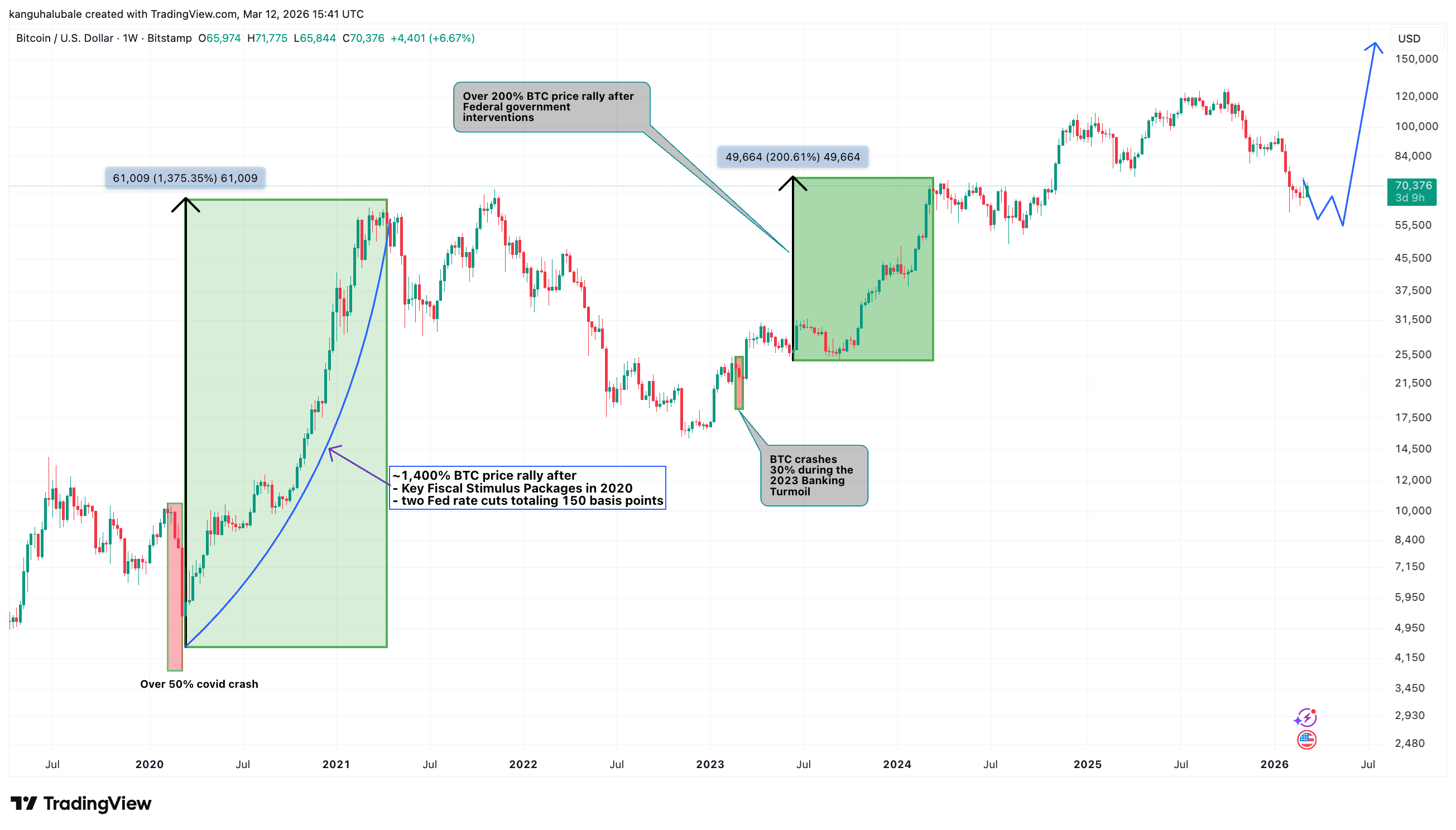 BTC/USD weekly chart. Source: Cointelegraph/
TradingView
BTC/USD weekly chart. Source: Cointelegraph/
TradingView
Similarly, during the March 2023 banking turmoil, Bitcoin initially sold off on contagion fears, then rallied more than 200% as markets priced in a Fed pause on rate hikes.
This suggests that a private credit breakdown might ultimately result in the further expansion of the money supply, sending BTC price to new highs.
As Cointelegraph reported, BitMEX co-founder Arthur Hayeshe will wait untill until the Fed loosens its monetary policy before buying any more Bitcoin. BTC price will then rise to $250,000, he predicted.
Disclaimer: The content of this article solely reflects the author's opinion and does not represent the platform in any capacity. This article is not intended to serve as a reference for making investment decisions.
You may also like
Altcoin Price Targets Point to Six 2027 Levels
The AI frenzy withstands the "5% US Treasury yield"! Nasdaq hits new highs, strengthening the "80/20" pattern as Wall Street reassesses stock-bond allocation
The 30-year US Treasury yield briefly reached about 5.53%, hitting its highest level since 2004, while Brent crude remains above $100 per barrel. Risk assets have once again withstood the pressure, reflecting investors' continued belief that the commercialization of AI applications and corporate profit growth can to some extent offset the impact of rising financing costs and discount rates.
AI infrastructure hits a "wall"! Marvell: Copper interconnects and memory bottlenecks become key to the next stage of computing power expansion
The AI computing power competition is evolving into a system-level game encompassing interconnection and memory. According to Marvell executives, inference models have driven KV cache growth by about 10 times in nine months, and rack-level memory can no longer meet demand. Copper connections are approaching their limits, making optical interconnection and memory expansion core to computing power growth. Customization has become an industry trend, and Marvell is set to benefit from its expertise in analog SerDes, photonic fabric memory, and end-to-end customization.
Which Top RWA Tokens Have the Most Real-World Use in 2026?

Crypto prices
More


