
CFTC chair opens prediction markets rulemaking to public comment

Michael Selig, chair of the US Commodity Futures Trading Commission (CFTC), has proposed a rule that could amend or issue new regulations over event contracts on prediction markets platforms like Kalshi and Polymarket.
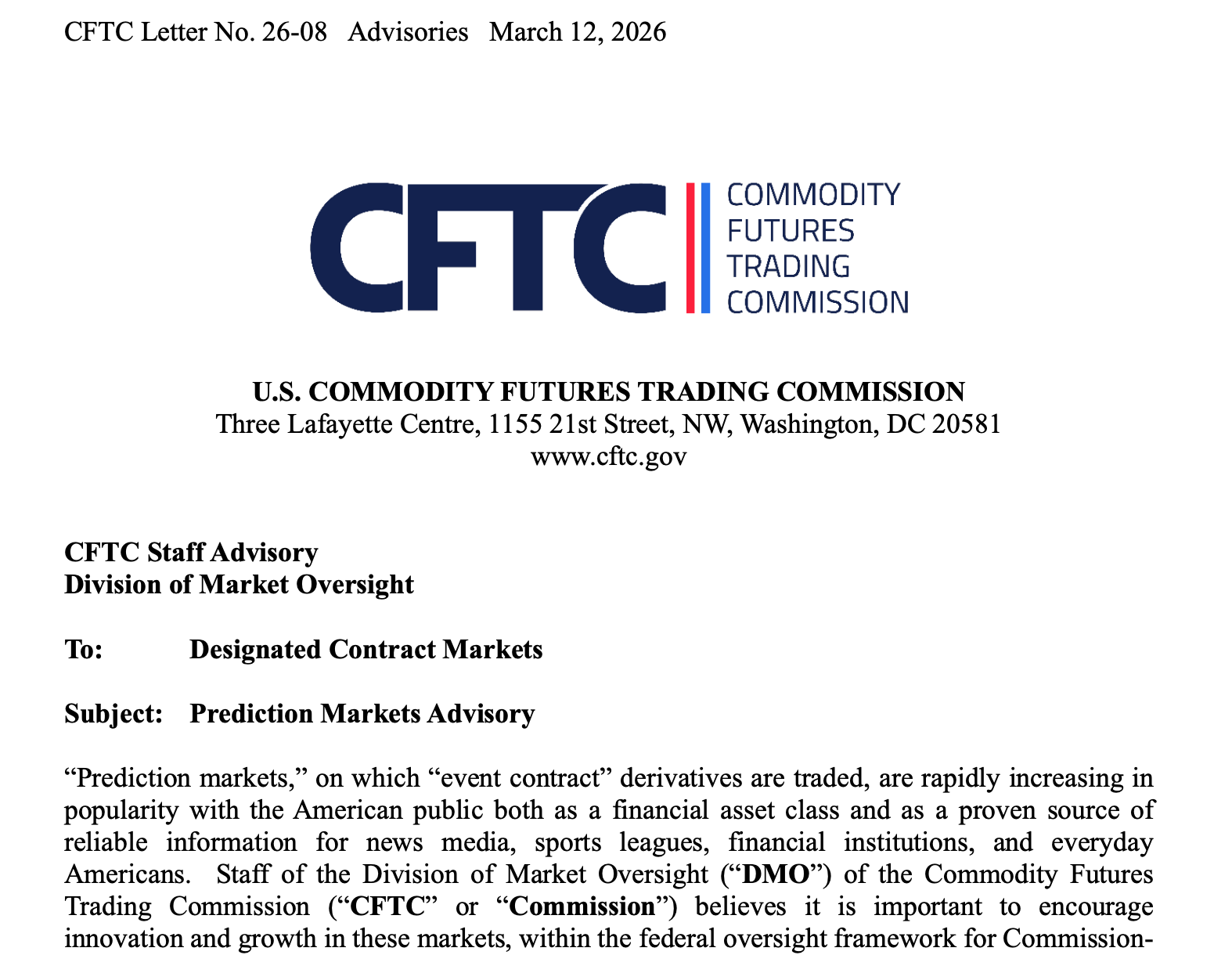
In a Thursday notice, the CFTC issued a staff advisory classifying event contracts on prediction markets as a “financial asset class.” The regulator also submitted an Advanced Notice of Proposed Rulemaking to be published in the Federal Register, asking for public comment on how the Commodity Exchange Act (CEA) would apply to prediction markets.
“Prediction markets are one of the most exciting innovations in financial markets,” said Selig in a Thursday X post. “Yet for too long, the CFTC has failed to provide guidance for these markets being used by millions of Americans. This ends today.”
 Source:
CFTC
Source:
CFTC
The staff advisory and proposed rule followed Selig publicly reiterating claims that the CFTC had “exclusive jurisdiction” over prediction markets in response to many state-level authorities filing lawsuits against companies like Kalshi and Polymarket for unlicensed sports betting. The CFTC chair said that he would take to court any state-level challenges to the agency’s authority over prediction markets.
Related: Utah set to block prediction markets as state-federal tensions rise
On Monday, an Ohio judge pushed back against Selig’s narrative in her denial of a preliminary injunction by Kalshi against Ohio gaming authorities and the state’s attorney general. She said in the ruling that the company had failed to show the CEA “would necessarily preempt Ohio’s sports gambling laws,” or that sports event contracts were subject to the “exclusive jurisdiction” of the CFTC.
Selig is sole CFTC commissioner absent any White House nominations for vacant seats
Selig noted that he “voted in the affirmative” on the matter, while “no commissioner voted in the negative.” The CFTC chair sits alone in the agency’s leadership following the departure of acting chair Caroline Pham in December, on a panel normally filled with a bipartisan group of five commissioners.
Because only a majority of the quorum of CFTC commissioners are needed to sign off on a rule, Selig may have the sole authority to approve the prediction markets proposal after the required public notice and comment periods. As of Thursday, US President Donald Trump had not announced any additional nominations to the agency.
The public will have 45 days to submit comments following publication of the proposed rule in the Federal Register.
Magazine: Fly’s mind ‘uploaded,’ human brain cell wetware plays Doom: AI Eye
Disclaimer: The content of this article solely reflects the author's opinion and does not represent the platform in any capacity. This article is not intended to serve as a reference for making investment decisions.
You may also like
From connecting users to hosting computing power, Philippine telecom giant Globe bets on AI data centers! Targeting the next billion-dollar business.
Globe Telecom Inc. plans to invest at least $1 billion by 2027 to expand its data business. The company regards its data center business as the next billion-dollar venture, with the rapid development of artificial intelligence being a key driving factor behind this goal.
Quantum Computing Reaches Historic Turning Point: Moving Beyond "Physical Experiments," Supply Chain and Manufacturing Become Key to Success
After attending the Quantum World Congress, Jefferies issued a major evaluation: the industry's core challenge has shifted from "creating good qubits" to "building truly usable computers." The source of competitive advantage has fully moved from physics innovation to system engineering and manufacturing barriers. The U.S. government has elevated its role from a funding provider to a rule-maker, with federal funding now linked to performance and the NQI Act about to be implemented. Whoever first achieves repeatable manufacturing and supply chain resilience will earn the ticket to compete in commercializing this technology.
Crypto prices
More


