
Outset Media Index Goes Live as Audiences Grow More Selective About News Sources

The first standardized index for benchmarking media outlets, Outset Media Index (or OMI for short), began its soft launch on March 12.

At this stage, early users can access the system and explore the data while the team observes how it fits into the daily work of people who analyze media. The index will then undergo further refinement before the full launch based on the collected feedback.
Outset Media Index is built for professionals including:
- Media buyers and advertisers who decide where campaigns should run,
- PR, marketing and communications teams that compare outlets before pitching stories or negotiating placements,
- Publishers and editorial teams who want to understand how their publication performs compared with other outlets,
- Researchers and analysts who study how media influence changes over time.
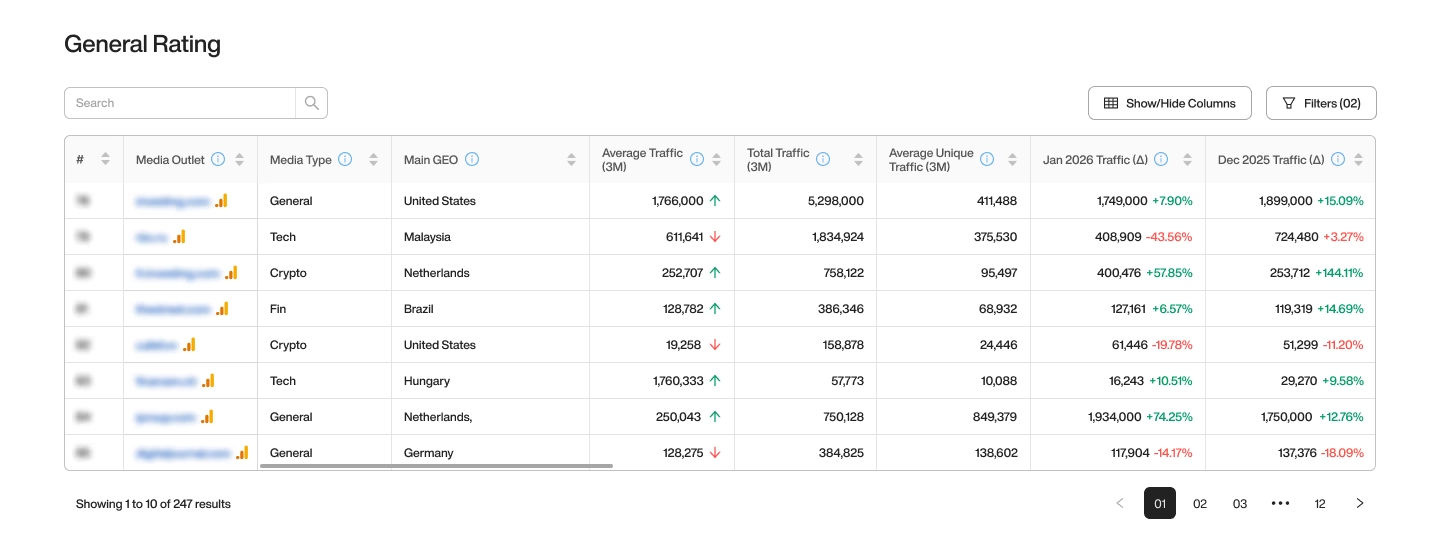
These professionals already work with large amounts of media data but often have to piece it together across different tools. OMI brings those signals into one interface, where more than 340 crypto-covering outlets can be reviewed side by side or individually, with information on their traffic, geographic reach, SEO, AI visibility, audience engagement, and working convenience.
That approach helps answer practical questions – which publications attract readers who stay and continue browsing, which outlets show steady audience growth, or where stories spread after the first publication. The index reduces the time needed for this analysis while helping teams plan campaigns, manage budgets more carefully, and reach their goals with less busywork.
A Closer Look at Outset Media Index
The main screen shows media outlets in a ranking table. Each row represents a publication, and each column reflects a metric. Filters make it possible to narrow the list according to different needs. Outlets can be filtered by media type, main GEO, traffic levels, audience engagement metrics, domain authority, price per post, and several scoring indicators.
Users can also choose which metrics appear in the table, which allows outlets to be analyzed using only the signals relevant to a particular case.
 source:
omindex.io
source:
omindex.io
Behind the interface sits a set of 37 metrics covering several areas of media analysis. Many of the signals will be familiar to anyone who works with media data — traffic levels, unique visitors, referral traffic, domain authority, and other widely used indicators. They help show how large a publication’s audience is, where readers come from, and how stories spread across the web.
Alongside those standard parameters, the index also includes several metrics developed by the OMI team. They combine multiple data points into clearer measures of performance and operational comfort. For example, Composite Score tracks whether an outlet’s audience is growing or declining over time, while Editorial Rigidity shows how strict that outlet’s editorial team is about materials submitted by external contributors.
All of these signals eventually shape the platform’s dual scoring framework: General Rating, which reflects how strongly a publication performs compared with others in the dataset, and Convenience Rating, which positions outlets based on how easy they are to work with.
To keep the rankings credible, the index draws on several established sources. Traffic and audience estimates are based on data from platforms such as Similarweb, while Moz provides domain authority figures. All metrics are reviewed and normalized before they appear in the dataset. This ensures that different outlets can still be analyzed using the same framework, without distortions or inflated metrics.
Importantly, visibility within the OMI platform is not sold or negotiated and media outlets cannot pay to influence their position in the rankings. Scores are generated automatically from the dataset and the method remains the same for every publication listed in the system.
Outset Media Index was developed by Outset PR, a data-driven communications agency that spends a lot of time studying how media actually perform online. The index grew out of that work.
The same dataset feeds Outset Data Pulse, a series of reports that examine the media market from a wider angle.
“The index lets people explore the dataset themselves,”
said Sofia Belotskaia, product lead at Outset Media Index.
“Outset Data Pulse takes the same information and explains in text form what the numbers are showing.”
The reports review media trends across different regions and outline practical conclusions for teams that apply media data in their daily work.
The launch of Outset Media Index comes at a time when audiences themselves are becoming more selective about where they get their news. Public confidence in news organizations continues to lag behind trust in business and other organizations in many countries.
Edelman Trust Barometer Shows Audiences Growing More Selective About News Sources
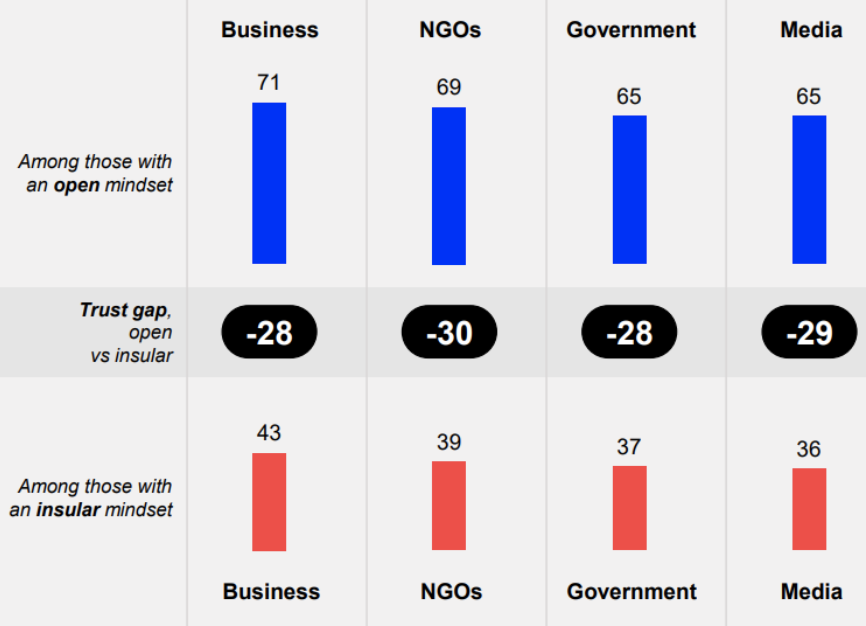
The 2026 Edelman Trust Barometer, which surveyed tens of thousands of respondents across more than 25 countries, shows that trust in media remains uneven. Among respondents with what the report describes as an “insular trust mindset,” only 36% say they trust the media, compared with 65% among those with a more open outlook.
This gap suggests that many people rely on a smaller circle of information sources they already consider credible, rather than trusting institutions broadly.
 source:
edelman.com
source:
edelman.com
The report also highlights how trust often concentrates around familiar figures rather than institutional voices. Among respondents with an insular trust mindset, 61% say they trust their own CEO and their neighbors, compared with 48% who say they trust journalists and 43% who trust government leaders.
These findings help explain why understanding media influence has become more complex. A publication’s impact is no longer defined only by how many people visit its homepage.
Taken together, these conclusions suggest that the way people judge information is changing. Trust is less tied to institutions themselves and more to relationships, familiarity, and perceived credibility.
At the same time, the path news takes before reaching readers has also become more complicated as stories often show up through search engines, aggregators, messaging platforms, and social networks before audiences even see the original outlet.
Outset Media Index is the primary example of how researchers and media professionals are beginning to examine those dynamics more closely.
Disclaimer: The content of this article solely reflects the author's opinion and does not represent the platform in any capacity. This article is not intended to serve as a reference for making investment decisions.
You may also like
The co-branded card approval stalemate awaits a breakthrough: JPMorgan Chase (JPM.US) reportedly plans a "second review" scheme, intending to introduce private credit to handle rejected applications.
J.P. Morgan has recently studied a plan aimed at resolving long-standing conflicts with its co-branded credit card partners, such as airlines and retailers. If this plan is implemented, private credit funds will gain new opportunities to enter the consumer credit sector.
AI agents ignite a frenzy for Mac! Apple (AAPL.US) joins the battle for AI computing power budget, advancing into the AI infrastructure sector
Apple has launched new Mac computers, aiming to compete with Microsoft and Nvidia, and striving to significantly reduce the cost of AI computing resources.
Has the poor performance of new stocks in the same track dampened subscription enthusiasm? Bamboo makes an emergency halt the night before pricing, doubling its valuation in a year but struggling to find a "buyer".
Bamboo, the master underwriter for homeowners insurance in California and Texas, postponed its IPO on Tuesday. The company had planned to issue 35 million existing shares at $18–$20 per share to raise $665 million.

Is the AI replacement wave overestimated? Barclays: Only 20% of core workplace skills can be highly replicated, but amplification effects are quietly spreading
The impact of AI on the workforce is milder, yet more profound than previously imagined. Barclays' latest research dispels the panic of a "replacement wave"—only about 20% of core professional skills can truly be replicated by AI, but its "amplification effect" permeates almost every corner of every profession. What is more concerning is that the demand for AI skills is spreading from tech positions to management roles, and the rise of physical AI could even make human professional skills a new, scalable form of intellectual property.
Crypto prices
More


