
US Bitcoin ETFs add $167M as altcoin funds extend outflows

US spot Bitcoin exchange-traded funds posted net inflows on Monday, snapping a two-session stretch of outflows as Bitcoin rose toward $70,000 and investor demand returned to the largest cryptocurrency.
Spot Bitcoin (BTC) ETFs recorded $167 million of inflows on Monday, following around $577 million in outflows on Thursday and Friday, according to SoSoValue data.
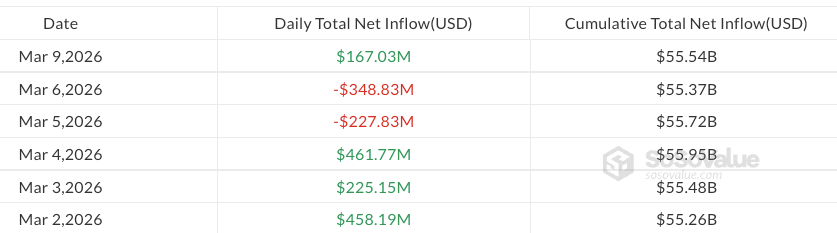
Demand was weaker across other crypto-linked ETFs. Altcoin funds experienced significant selling pressure, with outflows persisting across Ether (ETH), XRP (XRP) and Solana (SOL) ETFs even as the underlying tokens rose 3-5% over the past 24 hours, according to CoinGecko data.
The gains followed US President Donald Trump telling reporters on Monday that the war with Iran could be coming to an end, easing geopolitical fears and pushing oil prices lower.
Ether, XRP and Solana now on a three-day outflow streak
Ether, XRP and Solana ETFs saw outflows totaling $51 million, $18 million and $2.5 million, respectively, on Monday, according to SoSoValue. This marked a three-day outflow streak, with Ether seeing the largest cumulative losses at $225 million.

While ETH and SOL selling have been subsiding over the past three trading sessions, XRP outflows increased, totaling around $41 million since Thursday. Solana’s outflows amounted to roughly $16 million over the same period.
Crypto funds gain $619M as markets hold up despite oil and war fears
The sideways trading in crypto ETFs came as analysts warned that it’s still early to declare a structural bottom in Bitcoin, which traded at $70,015 at the time of writing, according to CoinGecko.
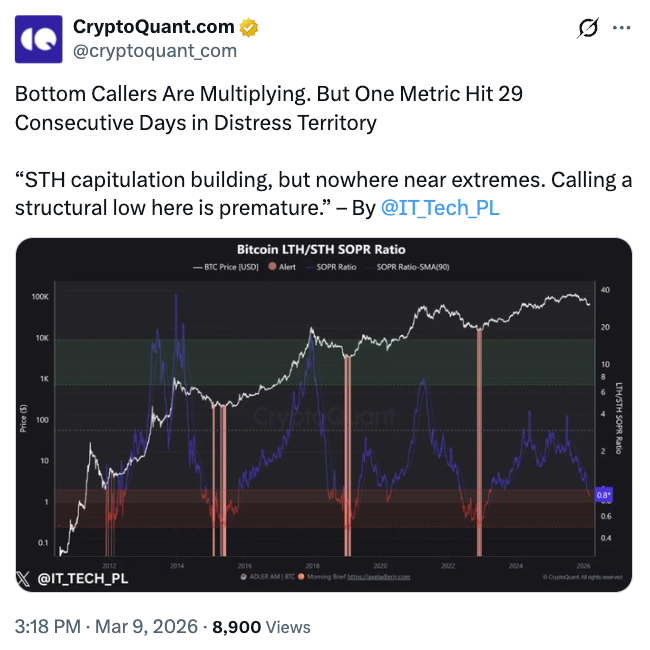
CryptoQuant’s analyst IT cited the Bitcoin long-term holder to short-term holder spent output profit ratio, which hit 0.89, showing short-term holders selling at a loss.
The data suggests market stress is building, but has not yet reached capitulation levels, meaning a clearer bottom may still be ahead.
The debate over Bitcoin’s four-year cycle is over: Benjamin Cowen
Disclaimer: The content of this article solely reflects the author's opinion and does not represent the platform in any capacity. This article is not intended to serve as a reference for making investment decisions.
You may also like
AI demand drives TSMC to accelerate capacity expansion, 2nm monthly production aims for 120,000 wafers by year-end
According to reports, industry giants such as Apple, Nvidia, and AMD have collectively increased their orders by 10% to 20%, directly boosting TSMC's 2nm monthly production capacity to 120,000 wafers by the end of the year, which exceeds the previous estimate by more than 20% and brings forward the 2027 target by two years. For the first time in history, five factories will ramp up production simultaneously, and the annual compound growth rate of capacity from 2026 to 2028 will reach as high as 70%.
Long-term US Treasury Sell-off Continues! 10-Year Treasury Yield Breaks 5.2% Again, “AI Boom vs. Rising Financing Costs” Narrative Showdown Intensifies
On Monday, oil prices rose and US Treasury bonds were sold off again as former US President Donald Trump rejected Iran's latest proposal to reopen the Strait of Hormuz, heightening concerns about inflation.
Banks Have Been Earning Effortlessly from Idle Funds for Years—Will AI Agents Change Everything?
For years, banks have profited from customers' idle funds, but AI agents may be about to change this situation.
Goldman Sachs: US stocks are showing a "strong index, weak confidence" pattern; catch-up rally may become the main theme of the next phase
Goldman Sachs stated that the current U.S. stock market is showing an unusual pattern: while index performance is strong, investor confidence remains weak. This suggests that the market still has further upside potential, and stocks that previously lagged behind leading AI stocks may soon experience a catch-up rally.

Crypto prices
More


