
US Treasury report acknowledges legitimate uses of crypto mixers

The United States Treasury Department acknowledged the legitimate use of mixers, which obfuscate crypto transfers to preserve user privacy, in its report to Congress on “Innovative Technologies to Counter Illicit Finance Involving Digital Assets.”
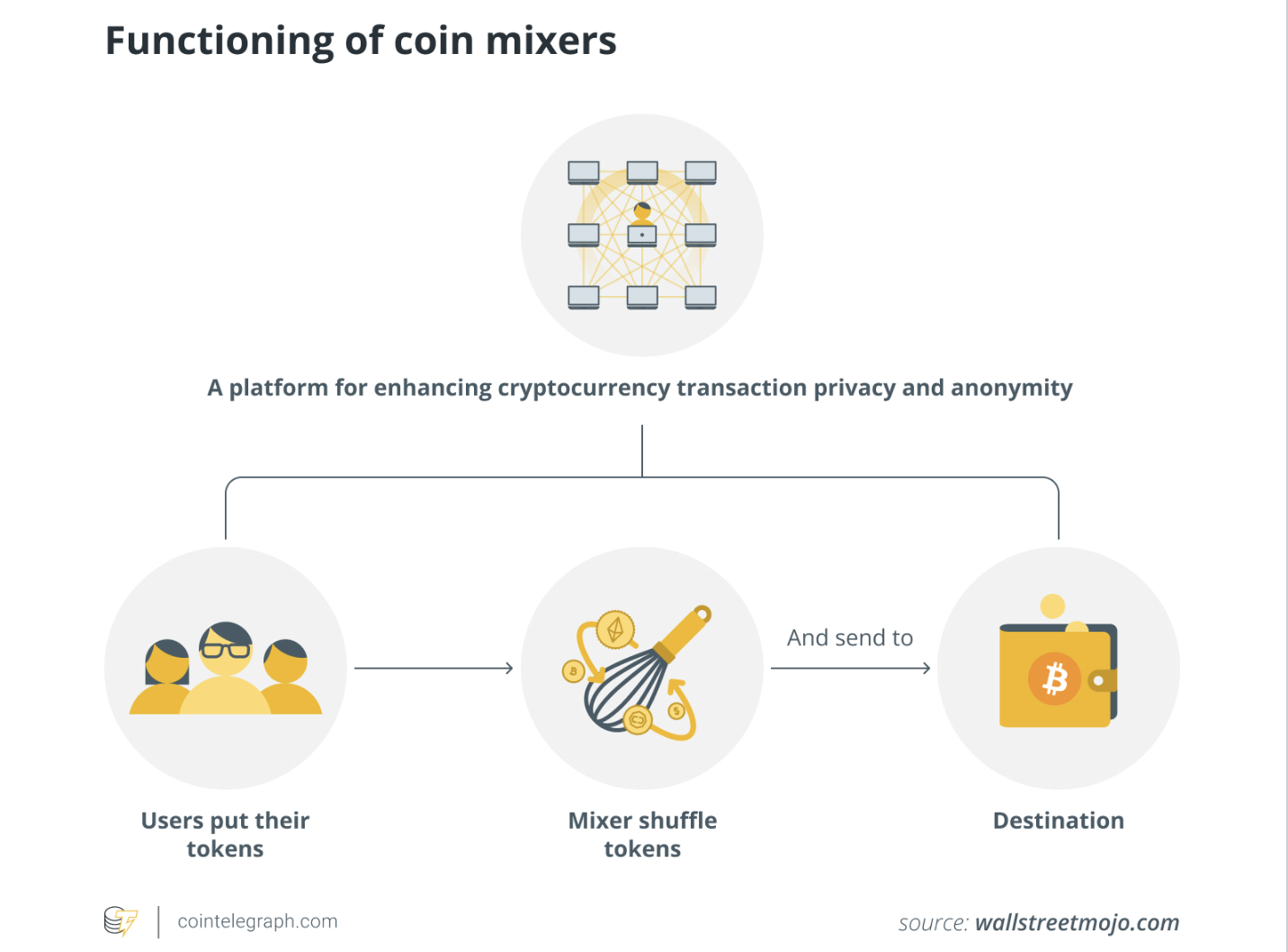
“As consumers increase their use of digital assets for payments, individuals may want to use mixers to maintain more privacy in their consumer spending habits,” the report said. The Treasury report continued:
“Lawful users of digital assets may leverage mixers to enable financial privacy when transacting through public blockchains. For instance, individuals may use mixers to protect sensitive information on personal wealth, business payments or charitable donations from appearing on a public blockchain.”
However, the report also noted the dangers of “darknet” or non-custodial, decentralized mixers. The Treasury said that non-custodial mixers are used for money laundering or shifting illicit funds by cybercriminals, including North Korea-linked hackers.
The authors suggested that custodial mixers, centralized services that take possession of user funds during the process, could provide identifying information that could be used to track users and transaction flows.
Privacy in crypto became a hot-button issue in 2025, as financial surveillance increases and US lawmakers attempt to impose know-your-customer (KYC) requirements on digital asset service providers and even decentralized finance (DeFi) platforms.
Related: Dash Evolution chain integrates Zcash Orchard privacy pool
DeFi leaders and seasoned investors warn about the threat to privacy
DeFi leaders and advocates sounded the alarm on ambiguous language in the Digital Asset Market Clarity Act of 2025, also known as the CLARITY bill, that could force DeFi platforms to collect identifying information from users.
The bill also lacked sufficient protections for open-source software developers in the US, according to Alexander Grieve, vice president of government affairs at crypto investment company Paradigm.
Former hedge fund manager Ray Dalio also warned that central bank digital currencies (CBDCs), onchain fiat currencies managed by a central banking institution or the government, are coming and pose a major risk to digital privacy.
In an interview with independent journalist Tucker Carlson, Dalio said CBDCs are a “very effective controlling mechanism” for the government.
Magazine: Can privacy survive in US crypto policy after Roman Storm’s conviction?
Disclaimer: The content of this article solely reflects the author's opinion and does not represent the platform in any capacity. This article is not intended to serve as a reference for making investment decisions.
You may also like
Anthropic files for IPO: lost $4.2 billion last year, revenue grew 12x to $4.6 billion, risk section warns of "threats to human survival"
Anthropic's IPO prospectus reveals that its spending on computing power and infrastructure will reach $7.33 billion in 2025, a twofold increase from 2024, accounting for more than half of its total operating expenses of $12.65 billion. The company plans to continue investing over $500 billion in the future. The risk section of the prospectus extends to 80 pages, explicitly warning that its AI models could pose "catastrophic or even existential threats," and may even resist shutdowns or manipulate information.
Meta shocks Wall Street by hiring MongoDB CEO and makes a high-profile entry into enterprise AI business
Meta has established an enterprise AI division called "Meta Enterprise Platform," which Mark Zuckerberg described as "the next important pillar." MongoDB CEO CJ Desai has been recruited to lead it. Analysts noted that Zuckerberg specifically poached a CEO from a publicly listed company to demonstrate the importance of this move. Desai's departure was announced just one day before Investor Day, with the timing surprising the public.
RBA set to hike interest rate to 4.60% in September as inflation remains elevated
AstraZeneca invests $2 billion in Summit, optimistic about Akeso's Ivose
This 18.6% premium subscription is not only a substantial endorsement, but both parties will also deeply collaborate on the joint development of combination therapies such as ADCs. The core of this deal is Akeso's Ivonescimab—the world’s first PD-1/VEGF bispecific antibody, and so far the only drug to have surpassed "K-drug" in head-to-head trials on both PFS and OS endpoints. The median OS reached 30.8 months, compared to 22.6 months for "K-drug", representing a 27% reduction in risk of death.
Crypto prices
More


