
High-yield bond surge signals rising risk, demand in BTC mining, AI infrastructure

The AI and data center boom partly driven by Bitcoin miners is increasingly being financed through high-yield bond issuance, underscoring how lenders are pricing both risk and opportunity in the sector.
According to TheEnergyMag’s latest newsletter, companies tied to AI data center development have raised about $33 billion in long-term senior notes over the past 12 months, excluding convertible debt — bonds that can later be converted into equity and typically carry different risk dynamics.
The interest rate spread is notable: While regulated utilities and traditional energy companies generally borrow at 4% to 5%, AI- and crypto-linked issuers pay closer to 7% to 9%.
The average coupon on newly issued US dollar high-yield debt has was close to 7.2% in late 2025, from 8% to 9% in 2023, according to Janus Henderson Investors, citing BofA Global Research, average coupon, as of Nov. 30.
Those at the higher end of the spectrum are largely current or former digital asset mining companies that have pivoted into AI infrastructure, suggesting capital remains comparatively expensive for the group.
TheEnergyMag cited recent raises, including CoreWeave at 9.25% and 9% in May and July 2025, Applied Digital at 9.2% in November, TeraWulf at 7.75% and Cipher Mining at 7.125% and 6.125%.
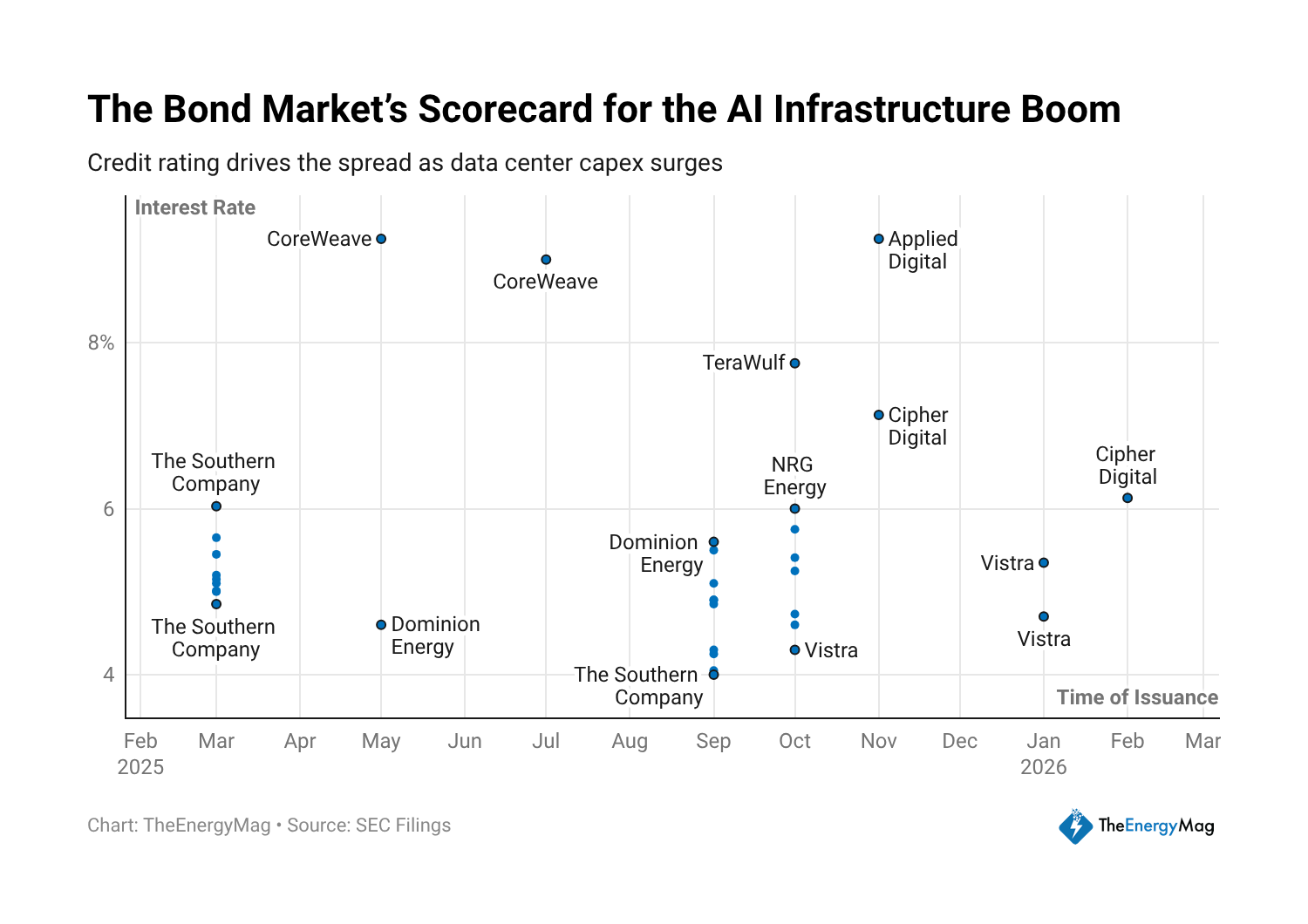 Credit ratings and perceived risks drive interest rate spreads in AI infrastructure development. Source: TheEnergyMag
“The message from lenders is clear,” TheEnergyMag wrote. “Regulated load and contracted generation still get treated as infrastructure. AI and bitcoin, even when attached to long-term offtake agreements, are still treated as growth credit.”
Related:
AI infrastructure boom intensifies
Despite concerns about overspending and potential overcapacity, the AI data center build-out remains one of the most visible trends in the economy, and a major driver of demand on Wall Street.
The scale of that momentum was underscored on Wednesday when chipmaker Nvidia posted blockbuster fourth-quarter results, with profit rising 94% and revenue climbing 73% year-on- year. The chipmaker reported $43 billion in net income and $68.1 billion in revenue.
Meanwhile, Bitcoin mining companies are planning about 30 gigawatts of new power capacity aimed at AI workloads, nearly triple the capacity they currently operate. Much of it remains in development pipelines or early-stage planning, but the industry has made clear that AI infrastructure is a strategic priority.
Related:
Disclaimer: The content of this article solely reflects the author's opinion and does not represent the platform in any capacity. This article is not intended to serve as a reference for making investment decisions.
You may also like
September New Jobs Expected to Drop to 90,000: Tonight’s Real “Bombshell” in Nonfarm Payrolls May Be Whether August Data Is Significantly Revised Down
Wall Street generally expects that new jobs added in September will drop to 90,000 and the unemployment rate will remain at 4.1%. The strong data in August was mainly boosted by unusual seasonal factors; the extent of their revision will directly affect perceptions of the strength of the September figures. As recent statements by Federal Reserve officials have pushed the probability of a rate hike in October down to 25%, market attention has shifted to long-term rates. Currently, systematic funds hold about $390 billion in global bond short positions. If the employment data unexpectedly disappoints, it could trigger severe market turbulence.
Retail Investors Stage a "Big Shrinking Circle"! JPMorgan Fund Flows Reveal Nvidia and SanDisk Attracting Funds Against the Trend, US Treasury ETF Returns to Retail Investors' Radar
Retail investors are concentrating their stock selections on a few targets related to computing power, storage, and large technology companies. On the bond side, another clear trend has emerged: amid continued pressure on long-term U.S. Treasury prices and persistently high yields, long-term Treasury ETFs saw a net inflow of $260 million during the week.

Strive stock closes at $30.11, up 2.38% as RSI flashes overbought signal
Macron calls for G7 coordination to address rising diesel prices, oil prices plunge in response, European stocks collectively rise
On October 2 local time, French President Macron called on the G7 to take coordinated action to avoid implementing export restrictions and jointly curb the rise in fuel prices. During a conference call among EU member country governments on Friday, parties discussed a proposal put forward by France: European countries would release 50 million barrels of diesel, and at the same time, International Energy Agency members would release 50 million barrels of crude oil.
Crypto prices
More


