
Tether flashes Bitcoin bottom signal: Can BTC stage another 100% rally?

Bitcoin (BTC) may form a bottom in the coming weeks as Tether’s USDt (USDT) market cap dropped to levels that preceded BTC’s 2022 bear market lows.
Key takeaways:
Tether’s USDt triggers a signal that last time preceded a 100% Bitcoin price rally.
BTC price is testing two major support zones that have historically triggered significant price rebounds.
Tether flashes a bottom signal reminiscent of 2022
On Sunday, Tether USDt’s 60-day market cap change was down by $3.1 billion (see chart below), revisiting a historically significant zone that aligned with Bitcoin’s 2022 bear market lows.
The only other time USDT’s market cap declined by $3 billion in 60 days was in late 2022, just as Bitcoin was carving its cycle bottom near $15,500, amid maximum fear and forced selling.
Related: Hodlers have ‘given up’ at $65K: Five things to know in Bitcoin this week
When USDt’s market cap drops sharply, it implies liquidity withdrawal, risk-off sentiment, or forced redemptions.
“The current 60-day contraction suggests sustained capital outflows, reflecting structural tightening in crypto-native liquidity,” CryptoQuant contributor MorenoDV_ said in a Monday Quicktake analysis, adding:
“Extreme liquidity stress has historically marked opportunity, but only once selling exhaustion is confirmed.”
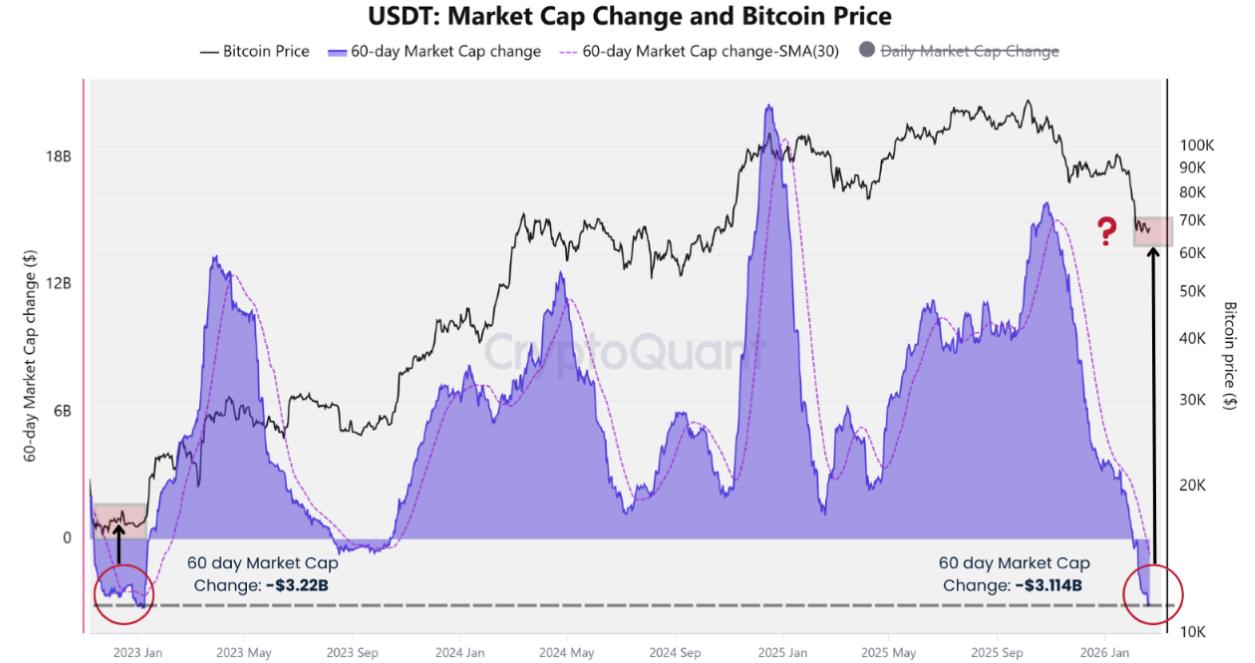 USDT 60-day market cap change vs. BTC price. Source: CryptoQuant
The chart above shows that after USDT’s 60-day market cap change dropped below -$3 billion at the end of 2022, Bitcoin then climbed to above $31,000 by March 2023, a 100% rally from the $15,500 cycle bottom.
Moreover, Tether’s market cap shed $1 billion over the past day, which has only occurred twice in the past. Each episode coincided with local/macro bottoms or sharp volatility in the price of Bitcoin.
Major drops in USDt market cap typically reflect institutional or large-holder exits from the market, which “tend to occur at or near exhaustion rather than at the beginning of sustained downtrends,” the analyst said.
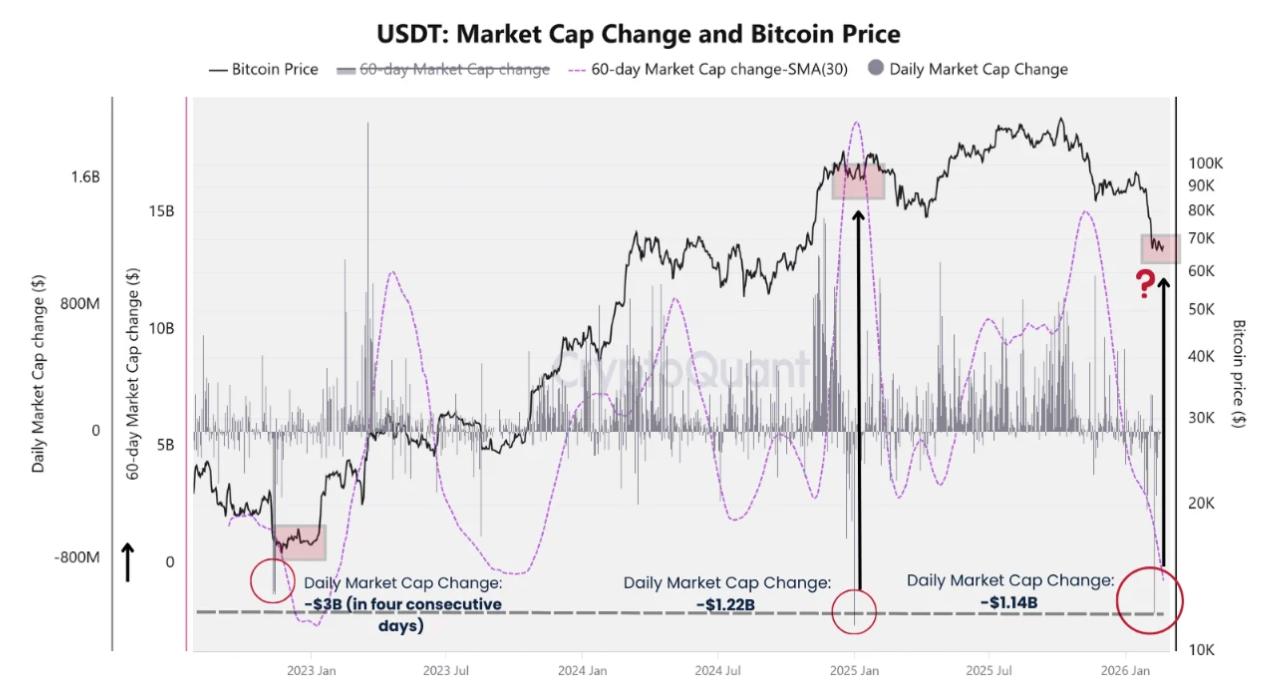 USDT 60-day market cap change vs. BTC price. Source: CryptoQuant
As Cointelegraph reported, Tether’s USDt stablecoin dominance reached a key resistance level that preceded BTC’s 2022 cycle low.
As such, Bitcoin’s odds of bottoming in the coming weeks may rise if USDt dominance trends lower and seller exhaustion is confirmed.
Bitcoin chart fractal echoes previous bottoms
Bitcoin is also showing a familiar technical setup on the weekly chart that has coincided with macro bottoms in the past.
“Bitcoin is testing two major support zones at the same time,” analyst Mags said in a recent post on X.
The analyst referred to the ascending trendline support that marked the 2022 and the horizontal support zone derived from the 2021 all-time high.
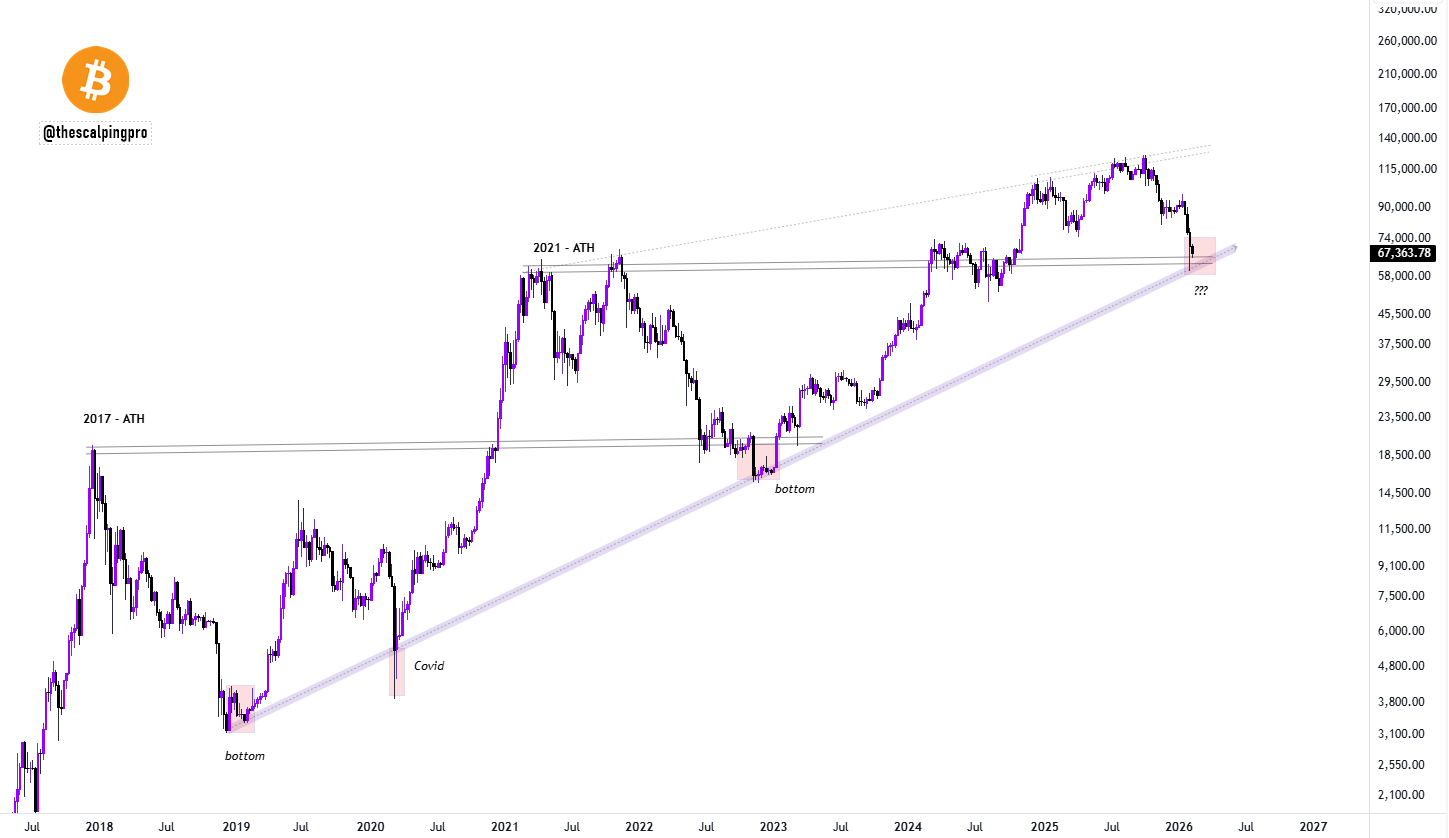 BTC/USD weekly chart. Source: Mags
Historically, this combination has preceded multimonth price rebounds. Namely, the 376% BTC price rally between November 2022 and March 2024, and 380% gains in 2018-2019.
As Cointelegraph reported, other market experts continue to bet on a major BTC price recovery in 2026.
Among them is former Binance business development executive Chase Guo, who said Bitcoin will reach a new all-time high in 2026, due to liquidity positioning and evolving market mechanics.
Disclaimer: The content of this article solely reflects the author's opinion and does not represent the platform in any capacity. This article is not intended to serve as a reference for making investment decisions.
You may also like
Anthropic files for IPO: lost $4.2 billion last year, revenue grew 12x to $4.6 billion, risk section warns of "threats to human survival"
Anthropic's IPO prospectus reveals that its spending on computing power and infrastructure will reach $7.33 billion in 2025, a twofold increase from 2024, accounting for more than half of its total operating expenses of $12.65 billion. The company plans to continue investing over $500 billion in the future. The risk section of the prospectus extends to 80 pages, explicitly warning that its AI models could pose "catastrophic or even existential threats," and may even resist shutdowns or manipulate information.
Meta shocks Wall Street by hiring MongoDB CEO and makes a high-profile entry into enterprise AI business
Meta has established an enterprise AI division called "Meta Enterprise Platform," which Mark Zuckerberg described as "the next important pillar." MongoDB CEO CJ Desai has been recruited to lead it. Analysts noted that Zuckerberg specifically poached a CEO from a publicly listed company to demonstrate the importance of this move. Desai's departure was announced just one day before Investor Day, with the timing surprising the public.
RBA set to hike interest rate to 4.60% in September as inflation remains elevated
AstraZeneca invests $2 billion in Summit, optimistic about Akeso's Ivose
This 18.6% premium subscription is not only a substantial endorsement, but both parties will also deeply collaborate on the joint development of combination therapies such as ADCs. The core of this deal is Akeso's Ivonescimab—the world’s first PD-1/VEGF bispecific antibody, and so far the only drug to have surpassed "K-drug" in head-to-head trials on both PFS and OS endpoints. The median OS reached 30.8 months, compared to 22.6 months for "K-drug", representing a 27% reduction in risk of death.
Crypto prices
More


