
Ethereum risks going under $1.5K as Vitalik Buterin sells ETH 'faster'

Ethereum’s native token, Ether (ETH), is on track to test and potentially break the $1,500 support level in the coming days.
Key takeaways:
Ethereum has entered the breakdown phase of its prevailing bearish continuation pattern.
ETH price may decline below $1,500 by early March amid founder-led selling.
ETH bear pennant breakdown targets $1,475
On Monday, ETH’s price dropped by more than 5.60% to about $1,850 amid a broader de-risking sentiment led by nervousness surrounding tariffs.
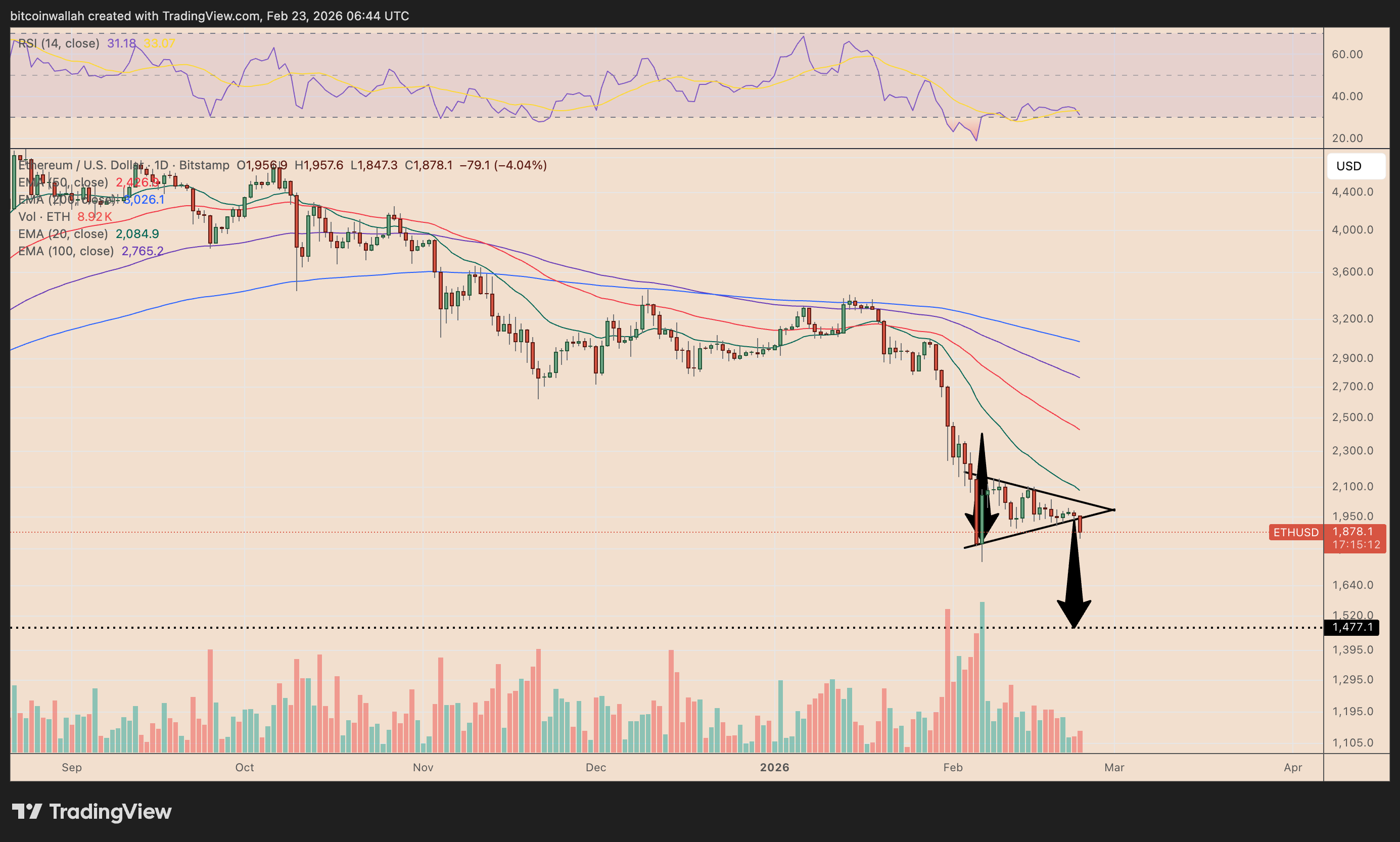
In doing so, the biggest altcoin broke below the lower trendline of its prevailing bear pennant pattern, with rising volumes indicating traders’ conviction behind the breakdown move.
 Edit the caption here or remove the text
A bear pennant breakdown typically resolves when the price falls by as much as the previous downtrend’s height.
Applying the same principle to ETH’s charts would bring its downside target to $1,475, close to the psychological support level of $1,500, by the end of February or early March.
Related: Ethereum price: Classic chart pattern puts sub-$2K ETH in focus
The bulls must therefore reclaim the pennant’s lower trendline as support, followed by a continued rally above the 20-day exponential moving average (20-day EMA, the green line) at $2,085, which may invalidate the bearish outlook.
Vitalik Buterin will likely sell more ETH soon
Ethereum co-founder Vitalik Buterin’s planned ETH sales have not helped the bulls regain their footing in February.
On Jan. 30, Buterin said he would withdraw and sell 16,384 ETH via his Kanro entity to fund ecosystem work, open-source software and other long-term initiatives during an Ethereum Foundation “mild austerity” phase.
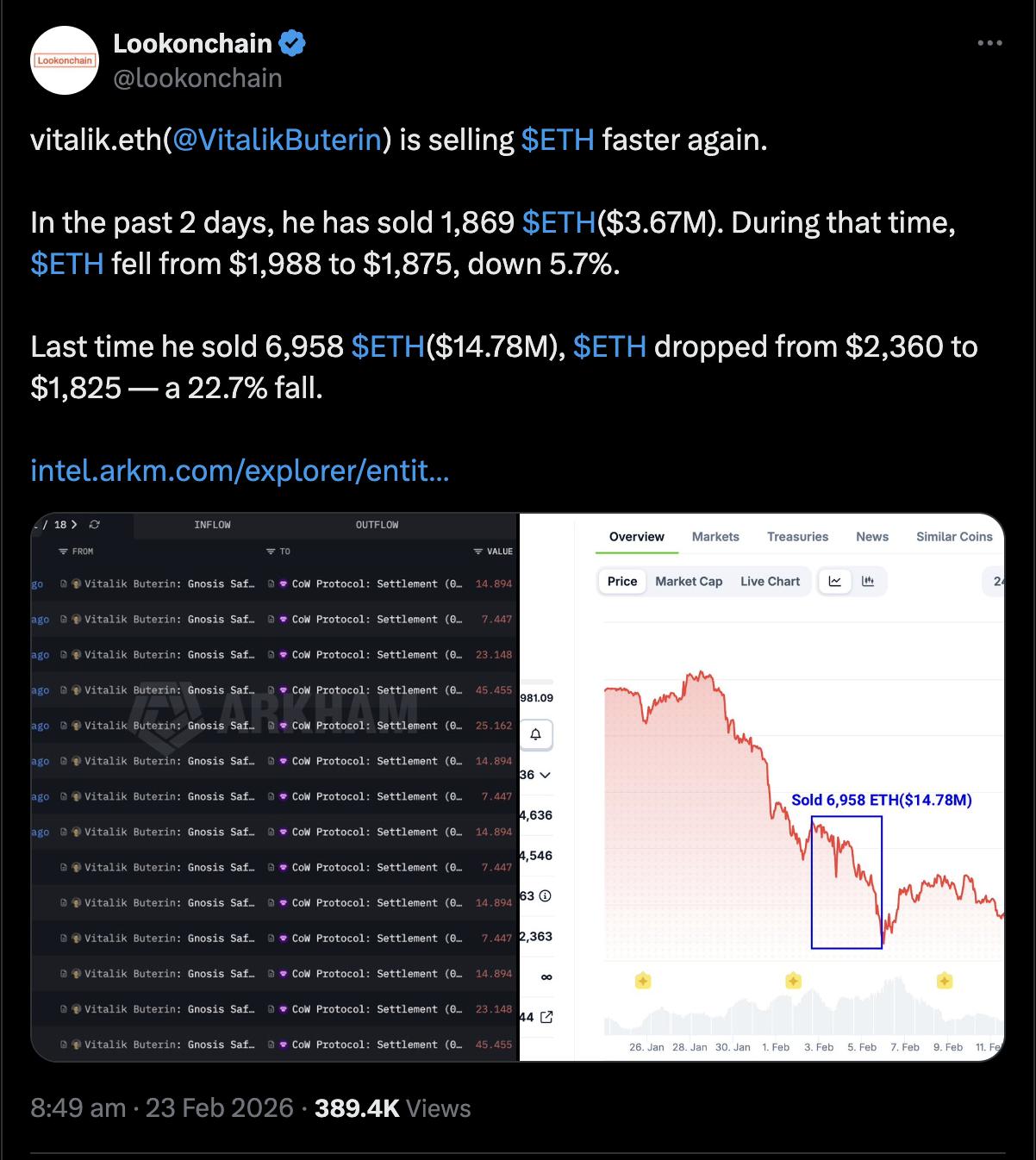
Since early February, onchain tracker Arkham Intelligence has flagged about 9,000 ETH sold in batches, with the pace picking up again over the past 48 hours after a 3,500 ETH withdrawal from Aave.
Vitalik Buterin “is selling ETH faster again,” said onchain monitoring resource, Lookonchain, on Monday.
 Source:
X
Source:
X
Ethereum’s price has dropped 18.55% so far in February, aligning with Buterin’s ETH distribution. The overhang could grow if he liquidates the remaining ~7,350 ETH.
History shows how founder-linked supply, including Ethereum Foundation treasury transfers, can amplify bearish sentiment among traders.
For instance, the May 2021 35,000 ETH transfers (about $125 million at that time) preceded a 50% ETH price drop within weeks.
Later, the foundation transferred another 20,000 ETH ($95 million) to Kraken on Nov. 11, 2021, a move that, in hindsight, coincided with Ether’s price peaking near $4,700 before the next leg lower.
Such conditions further increase ETH’s odds of hitting its pennant target below $1,500 in the coming days.
Disclaimer: The content of this article solely reflects the author's opinion and does not represent the platform in any capacity. This article is not intended to serve as a reference for making investment decisions.
You may also like
Meta (META.US) "cuts" the camera: $349 Ray-Ban glasses equipped with Muse and hearing aid functions
Meta Platforms (META.US) is expanding its smart glasses product line with a camera-free model, support for the popular new assistant Muse, and a hearing aid mode.
Is Tesla (TSLA.US) about to release its most expensive model? Roadster launch imminent, but options market remains indifferent
Tesla Roadster is scheduled for release on October 1st, and may become its most expensive model, but the options market has not heated up in advance.
Catering giant ventures into advertising! McDonald's (MCD.US) builds its own media network, targeting a $1 billion high-profit business
McDonald's is following in the footsteps of retail giants such as Amazon and Walmart by announcing plans to build its own media network.
Understanding the US Treasury's "Black Wednesday": The "Perfect Storm" Impact and the Rising Tide of "October Rate Hike"
U.S. Treasury bonds suffered their worst single-day sell-off in nearly 18 months: surging oil prices, explosive PMI data, hawkish comments from the Federal Reserve, and a lackluster 5-year Treasury auction combined to create four simultaneous negative factors. The 10-year yield broke above 5.1%, reaching a new high since 2007; the market's probability of another rate hike in October soared to 68%, and the swap market is now pricing in expectations of three rate hikes over the next year. Analysts believe that more than 80% of this sell-off is driven by real interest rates, with the 30-year mortgage rate surpassing 7% and doubts persisting about the effectiveness of the Treasury’s buyback plan.
Crypto prices
More


