
Brazilian Stock Market in High Demand: Up 17% in January, Foreign Capital Inflows Surpass All of Last Year, Major Investors Heavily Invested

With improving fundamentals and a shift in global asset allocation logic, the Brazilian stock market became a hotspot for global capital at the beginning of 2026. Driven by a weaker US dollar, rising commodity prices, and expectations of interest rate cuts, the Brazilian market not only experienced a long-awaited robust rebound, but also attracted massive inflows of overseas funds, including from top hedge funds.
According to Bloomberg, citing recent regulatory filings, billionaire investor Stanley Druckenmiller's Duquesne Family Office made significant investments in Brazil in the fourth quarter of last year. During the three months ending December 31, the family office purchased about 3.5 million shares of the iShares MSCI Brazil ETF (EWZ), and also bought call options on the fund, precisely betting on the subsequent market surge.
This positioning quickly paid off. The iShares MSCI Brazil ETF soared 17% in January this year, marking its best single-month performance since 2020. This rally was mainly driven by a weaker US dollar and higher commodity prices, which pushed heavyweight stocks such as mining giant Vale SA and state-owned oil producer Petroleo Brasileiro SA to double-digit gains.
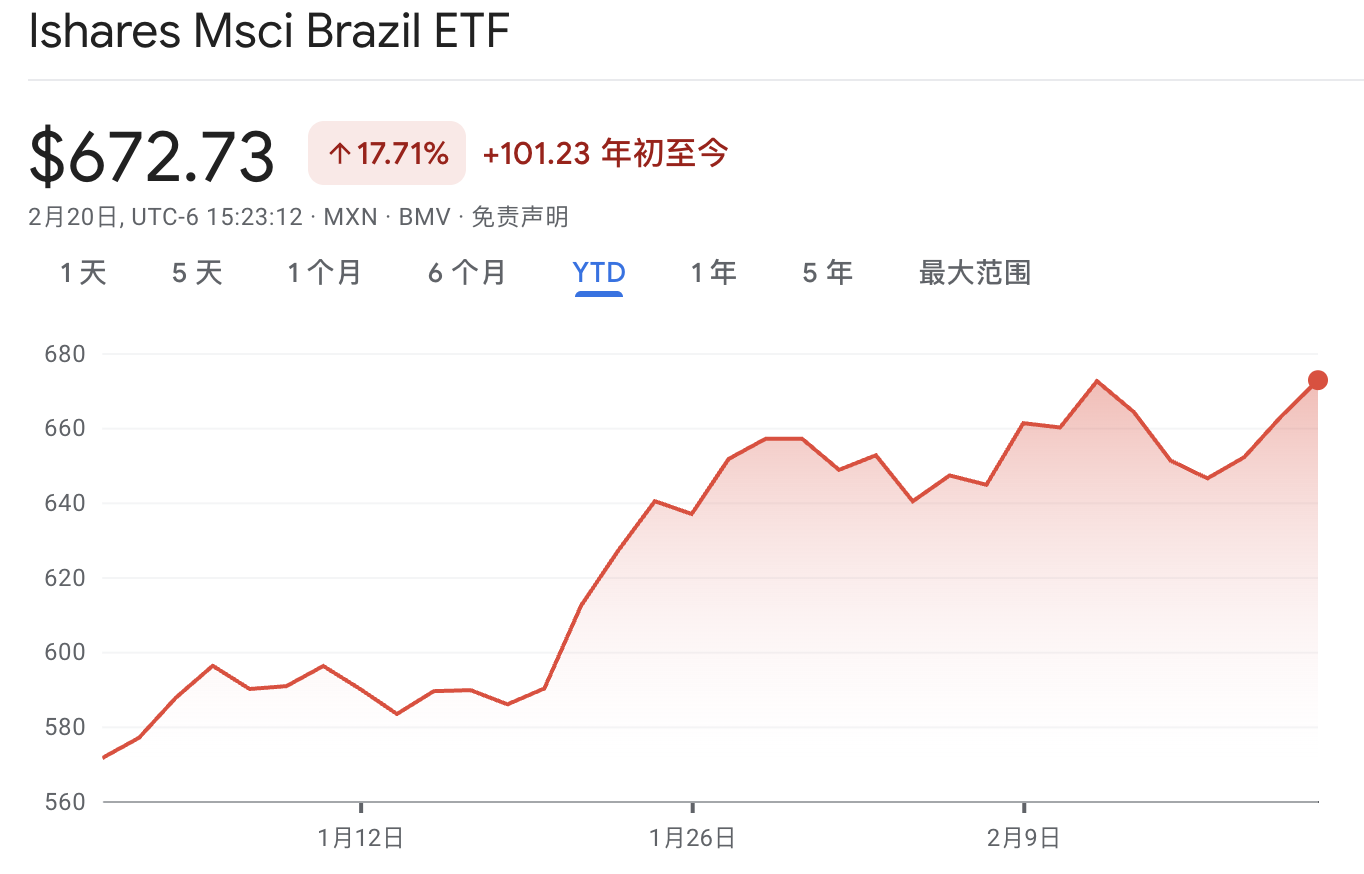
The reversal in market sentiment sparked a rush among foreign investors to buy in. Data shows that since the start of this year, foreign investors have poured more than 34 billion Brazilian reals (BRL) into Brazil's stock market. Strategists point out that global fund managers are ending their "underweight" positions in Latin America and are instead seeking diversified allocations in emerging markets to hedge against the risks of being heavily invested in the US market long-term.
Top Investors Position Themselves Early
Regulatory filings revealed Stanley Druckenmiller's precise timing for entry. As one of the most closely followed macro investors globally, his family office, Duquesne Family Office, made significant purchases of the iShares MSCI Brazil ETF at the end of last year. This $9.1 billion ETF is the largest exchange-traded fund tracking Brazilian stocks.
In addition to directly holding about 3.5 million shares, the documents show the firm also bought call options on the fund, signaling a strong bullish stance on the Brazilian market.
Meanwhile, Duquesne Family Office liquidated its holdings in the Global X MSCI Argentina ETF, indicating a clear shift in its investment focus within Latin America.
Double Boost from Exchange Rate and Commodities
This round of gains in the Brazilian stock market was led by the most liquid large-cap stocks, which are typically the top picks for foreign investors. Behind January's 17% surge was a significant improvement in the macro environment.
The weakness of the US dollar eased exchange rate pressures on emerging markets, while strong commodity prices directly boosted the valuations of Brazil's core resource assets.
In addition, expectations of a shift in monetary policy also supported market sentiment. The general market consensus is that, as the largest economy in Latin America, Brazil will begin cutting interest rates next month. This expectation has further enhanced the appeal of equity assets, driving an overall recovery in market valuations.
Foreign Capital Inflows and Institutional Expectations
Global capital is casting its vote with real money. Bloomberg data shows that so far this year, foreign inflows into Brazil's stock market have exceeded 34 billion BRL.
According to a report by Itau BBA strategists including Daniel Gewehr, after completing a roadshow in seven North American cities, they noticed a significant increase in global investor interest in Brazil. The report says global investors seem to be reducing their "underweight" positions in Latin America, and multi-asset funds are seeking to increase their exposure to Brazilian stocks through tools such as EWZ.
Institutions remain optimistic about the market outlook. According to a Bank of America survey of Latin American fund managers, about 64% of respondents expect Brazil's benchmark Ibovespa index to climb above 190,000 points by the end of 2026. This target implies about 2% upside from last Friday's closing price.
With emerging market assets performing strongly at the start of this year, the trend of capital inflows may continue, driven by improved fundamentals and the need for global diversification.
Disclaimer: The content of this article solely reflects the author's opinion and does not represent the platform in any capacity. This article is not intended to serve as a reference for making investment decisions.
You may also like
September New Jobs Expected to Drop to 90,000: Tonight’s Real “Bombshell” in Nonfarm Payrolls May Be Whether August Data Is Significantly Revised Down
Wall Street generally expects that new jobs added in September will drop to 90,000 and the unemployment rate will remain at 4.1%. The strong data in August was mainly boosted by unusual seasonal factors; the extent of their revision will directly affect perceptions of the strength of the September figures. As recent statements by Federal Reserve officials have pushed the probability of a rate hike in October down to 25%, market attention has shifted to long-term rates. Currently, systematic funds hold about $390 billion in global bond short positions. If the employment data unexpectedly disappoints, it could trigger severe market turbulence.
Retail Investors Stage a "Big Shrinking Circle"! JPMorgan Fund Flows Reveal Nvidia and SanDisk Attracting Funds Against the Trend, US Treasury ETF Returns to Retail Investors' Radar
Retail investors are concentrating their stock selections on a few targets related to computing power, storage, and large technology companies. On the bond side, another clear trend has emerged: amid continued pressure on long-term U.S. Treasury prices and persistently high yields, long-term Treasury ETFs saw a net inflow of $260 million during the week.

Strive stock closes at $30.11, up 2.38% as RSI flashes overbought signal
Macron calls for G7 coordination to address rising diesel prices, oil prices plunge in response, European stocks collectively rise
On October 2 local time, French President Macron called on the G7 to take coordinated action to avoid implementing export restrictions and jointly curb the rise in fuel prices. During a conference call among EU member country governments on Friday, parties discussed a proposal put forward by France: European countries would release 50 million barrels of diesel, and at the same time, International Energy Agency members would release 50 million barrels of crude oil.
Crypto prices
More


