
Microsoft Stock Trades As If ChatGPT Never Happened: Is It A Buy Now?

Microsoft Corp. (NASDAQ:MSFT) is quietly experiencing one of the most dramatic relative downturns in its modern history.
The Redmond-based technology giant is now the worst-performing stock among the "Magnificent Seven" in 2026, down 17% year-to-date.
But more concerning than the absolute decline, however, is the magnitude of its underperformance versus the broader market.
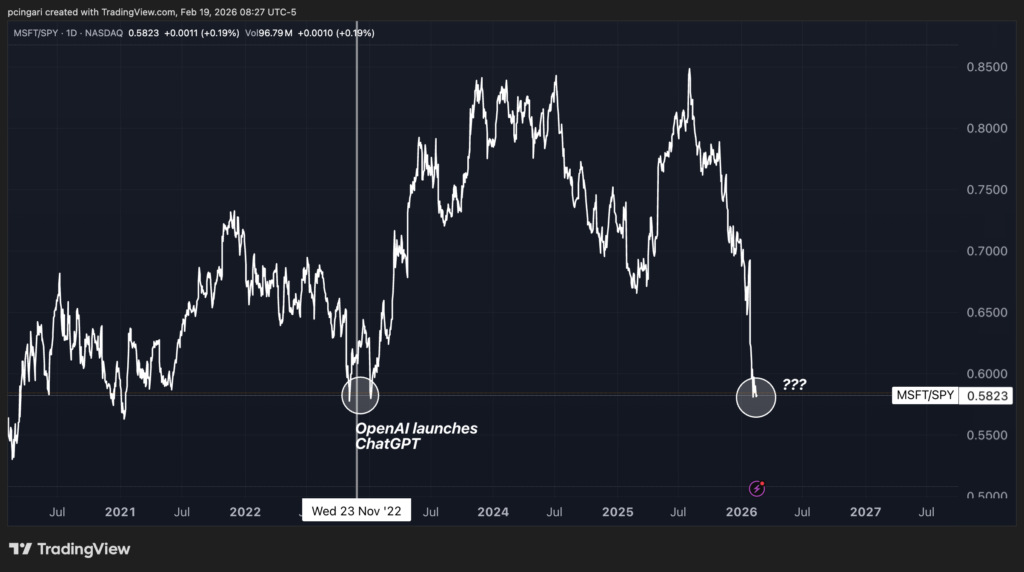
Since early August 2025, Microsoft has lagged the SPDR S&P 500 ETF Trust (NYSE:SPY) by more than 30%. That marks its worst stretch of relative performance since 2000 — the height of the dot-com bubble.
Microsoft's Worst Stretch Since 2000: Is The Market Pricing AI Out Of The Story?
The company has now underperformed the S&P 500 for seven consecutive months, including a 6% negative relative gap thus far in February 2026.
A seven-month losing streak against the benchmark has NEVER occurred in Microsoft's 40-year public market history.
Even more striking: Microsoft’s relative strength versus the broader market has fallen to its lowest level since November 2022.
That was the month OpenAI launched ChatGPT, igniting the artificial intelligence boom.
The message from the chart below appears stark. Microsoft now trades as if the artificial intelligence revolution never happened.
Why Is Microsoft Selling Off?
According to veteran Wall Street strategist Ed Yardeni, investors have focused on Microsoft's aggressive capital expenditures.
Last quarter, capex jumped 65.9% year over year to $37.5 billion. Roughly two-thirds of that spending went toward short-lived assets such as graphics processing units and central processing units for Azure cloud services.
Azure revenue rose 39% year over year. That topped Wall Street estimates but slowed from 40% growth in the prior quarter.
Adoption of Copilot has also drawn scrutiny.
Microsoft sold 15 million Microsoft 365 Copilot seats. Analysts had expected a stronger rollout given that more than 450 million paid seats use Microsoft 365 business software.
The comparison with rivals stands out. Google's Gemini counts 560 million monthly users. ChatGPT reports 900 million weekly active users.
Competitive Threats Are Expanding
“And then there’s the growing competition. A myriad of competitors are building software infused with Al to compete with Microsoft 365’s office productivity software,” Yardeni said.
Alphabet Inc.‘s Google Workspace — long a competitor to Microsoft Office — is embedding Gemini across Docs, Sheets and Slides.
OpenAI is reportedly developing collaborative document tools, a browser and AI-powered content products — moves that encroach on Microsoft's productivity software stronghold.
The push is notable given Microsoft owns a 49% stake in OpenAI's for-profit entity.
Tesla Inc. (NASDAQ:TSLA) CEO Elon Musk has also announced plans for a tongue-in-cheek AI software venture dubbed "Macrohard," signaling that new entrants continue targeting the productivity space.
Smaller firms also target niche use cases. Grammarly acquired Superhuman, an artificial intelligence email app, in 2025. Gamma, founded in 2020, raised $68 million at a $2.1 billion valuation in November to challenge PowerPoint and Google Slides.
Apps such as Shortcut AI promise to automate financial models and competitive analysis once handled by entry level analysts.
Valuation Looks Cheaper
Despite the selloff, analysts project forward earnings growth of 17.1% and long-term earnings growth of 16.2% over the next three to five years.
Forward revenue, operating earnings per share and profit margins stand at record levels. Yet Microsoft's forward price-to-earnings ratio has dropped more than 10 points to 22.0.
That multiple now sits well below levels seen during the peak artificial intelligence enthusiasm of 2023 and 2024.
Is It Time To Buy?
The debate now centers on execution. If Microsoft converts its $37.5 billion quarterly capex into durable cloud and artificial intelligence revenue, the current valuation could appear attractive.
If growth in Azure and Copilot continues to decelerate while competitors erode pricing power, the stock's historic underperformance may persist.
For now, the charts show a company facing its toughest period since the dot-com era.
Whether that marks a rare opportunity or the start of a longer reset remains the central question for investors.
Photo: Shutterstock
Disclaimer: The content of this article solely reflects the author's opinion and does not represent the platform in any capacity. This article is not intended to serve as a reference for making investment decisions.
You may also like
Tom Lee Agrees Ethereum 5-Year Consolidation Is the Launchpad for a Mega Price Rally
Silver’s tight supply creates yield opportunity as Theo launches new tokenized product

U.S. Treasury sell-off intensifies! 7-year Treasury auction sees weak demand, Treasury buyback falls short of the cap again, municipal bond yields hit highest in 15 years
On Thursday, the yield on the U.S. Treasury Department's $44 billion 7-year note auction soared to 5.085%, marking a historical high for this maturity. The allocation ratio to overseas investors dropped to a near two-year low. The Treasury's expanded repurchase operations only reached 68% of the cap, lower than the previous 86%, indicating less liquidity support than expected. The pressure spread to the U.S. municipal bond market, with the 30-year yield breaking above 5%, the highest since 2011, and the scale of sell-off reaching levels unseen since the early days of the pandemic. On Thursday, the yield on the 10-year U.S. Treasury exceeded 5.2% for the first time since 2007.
Macron: France will provide military aid to Saudi Arabia to protect the Red Sea Yanbu oil facilities
Macron stated that France will deploy troops to Yanbu and provide radar systems and defense systems. He emphasized that the mission is to protect Yanbu facilities, not to intervene in regional conflicts. Last Friday, he mentioned that after the blockage of the Strait of Hormuz, Saudi Arabia's East-West oil pipeline temporarily became a key alternative transport route, but oil shipments through the pipeline dropped sharply due to attacks on Yanbu by Yemeni Houthi forces.
Crypto prices
More


