
Hyperliquid launches DeFi lobby amid ‘critical time’ for US policy

Crypto platform Hyperliquid has launched a new advocacy organization aimed at pushing through policy changes involving decentralized finance in Congress.
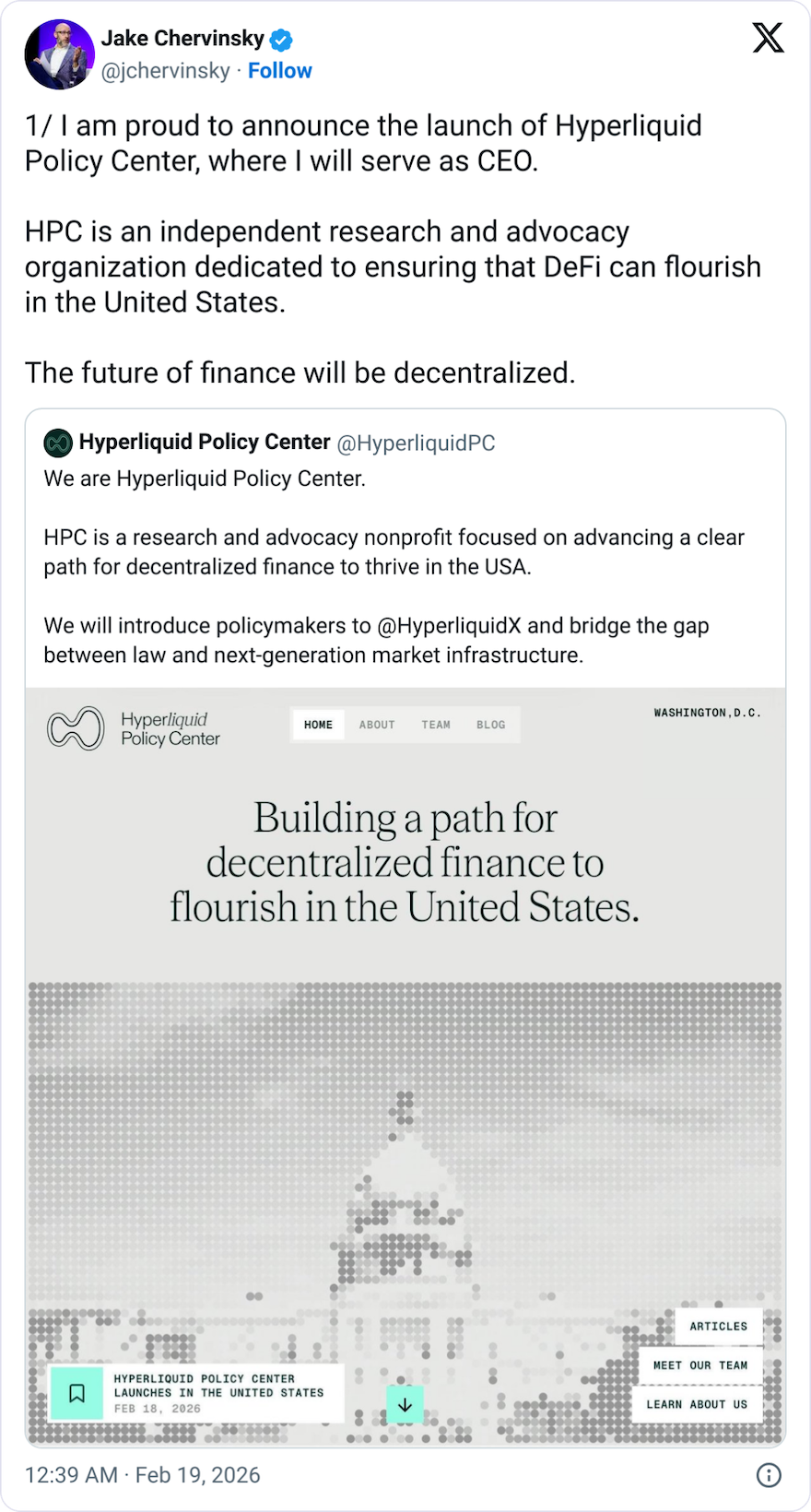
The Hyperliquid Policy Center said on Wednesday that it had launched in Washington, DC, and named Jake Chervinsky as founder and CEO, a veteran crypto lawyer who was the legal head at crypto venture fund Variant and former policy chief at crypto lobbyist Blockchain Association.
The organization said it will look to advance “a clear, regulated path for decentralized finance to thrive in the United States” and will push policy “with a specialty in perpetual derivatives and blockchain-based financial infrastructure.”
Hyperliquid is a layer-1 blockchain and perpetual futures exchange that has recently exploded in popularity as traders turned to commodities trading amid a broad market downturn, and the platform has looked to expand into prediction markets.
The Hyper Foundation, an independent body that backs Hyperliquid, will contribute 1 million Hyperliquid (HYPE) tokens to fund the policy center’s launch.
“Critical time” for policy, says Hyperliquid CEO
Chervinsky said more traditional finance companies are launching blockchain-based products or services because the technology offers “efficiency, transparency, and resilience that legacy systems cannot match.”
“This technology is poised to become the base layer of the global financial system,” he added. “Now the United States must choose: we can either adopt new rules that allow this innovation to thrive here at home, or we can wait and watch as other nations seize the opportunity.”
 Source:
Jake Chervinsky
Source:
Jake Chervinsky
Hyperliquid co-founder and CEO Jeff Yan said on X that it was a “critical time in policy discussions” in the US and that the platform had “lacked a unified voice in important policy discussions until now.”
Related: Coin Center urges Senate not to axe crypto developer protection bill
“There is a tangible and urgent possibility of upgrading the tech stack of the existing financial system,” he said. “Global financial regulation will be shaped in the United States, and we must work to ensure that these new policies thoughtfully embrace the potential of the new financial system.”
Congress is working to pass a bill defining how market regulators are to police crypto, but the legislation is stalled in the Senate as lawmakers, along with the crypto and bank lobbies, disagree on provisions pertaining to stablecoins.
The Hyperliquid Policy Center said its founding team also included the newly-appointed policy director, Salah Ghazzal, Variant’s former policy lead, and policy counsel, Brad Bourque, a former associate at Sullivan & Cromwell, a law firm famously tied to the fraudulent crypto exchange FTX.
Magazine: How crypto laws changed in 2025 — and how they’ll change in 2026
Disclaimer: The content of this article solely reflects the author's opinion and does not represent the platform in any capacity. This article is not intended to serve as a reference for making investment decisions.
You may also like
Dow Jones Industrial Average bounces on Iran's latest Hormuz offer
U.S. stocks opened higher and fluctuated, the Japanese yen rebounded more than 1% intraday, 10-year U.S. Treasury yields broke above 5.22% again, and U.S. crude oil once fell nearly 3%.
After the release of U.S. consumer confidence data, the S&P and Nasdaq turned negative, while the Dow is poised to break a three-day losing streak but is set for a fourth consecutive weekly decline. Meta pulled back, falling more than 3% during the session. The U.S. 10-year Treasury yield surpassed 5.22% again, marking a new high for the third day in a row since 2007, while the 30-year yield reached its highest level since 2004. The yen/dollar pair surged 1.2% intraday, as Japanese and U.S. officials successively signaled concerns over the weak yen. Expectations for a diplomatic resolution between the U.S. and Iran are rising, halting crude oil's two-day climb.
US Treasury volatility surges, triggering alarms! BofA’s Hartnett warns of rising deleveraging risks as higher yields become main threat to the market
Bank of America strategist Michael Hartnett warns that the recent sharp rise in volatility in the US bond market is increasing the risk of broader deleveraging in financial markets.
U.S. diesel prices surge 83% this year! Apollo Chief Economist warns: Cost pass-through may make core inflation more stubborn, Federal Reserve can't ignore it
Torsten Slok, Chief Economist at Apollo Global Management, has warned that the inflation threat posed by the surge in U.S. diesel prices to historic highs may be more serious than the Federal Reserve currently realizes.
Crypto prices
More


