
Wall Street Analysts Believe Karyopharm Therapeutics (KPTI) Could Rally 56.06%: Here's is How to Trade

The mean estimate comprises six short-term price targets with a standard deviation of $5.32. While the lowest estimate of $6.00 indicates a 36.2% decline from the current price level, the most optimistic analyst expects the stock to surge 123.4% to reach $21.00. It's very important to note the standard deviation here, as it helps understand the variability of the estimates. The smaller the standard deviation, the greater the agreement among analysts.
While the consensus price target is a much-coveted metric for investors, solely banking on this metric to make an investment decision may not be wise at all. That's because the ability and unbiasedness of analysts in setting price targets have long been questionable.
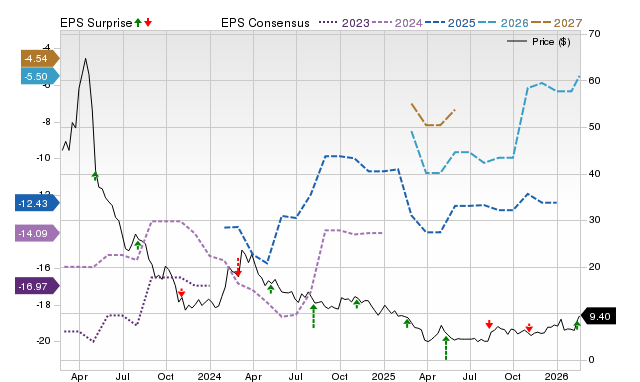
However, an impressive consensus price target is not the only factor that indicates a potential upside in KPTI. This view is strengthened by the agreement among analysts that the company will report better earnings than what they estimated earlier. Though a positive trend in earnings estimate revisions doesn't give any idea as to how much the stock could surge, it has proven effective in predicting an upside.
Price, Consensus and EPS Surprise
Here's What You Should Know About Analysts' Price Targets
According to researchers at several universities across the globe, a price target is one of many pieces of information about a stock that misleads investors far more often than it guides. In fact, empirical research shows that price targets set by several analysts, irrespective of the extent of agreement, rarely indicate where the price of a stock could actually be heading.
While Wall Street analysts have deep knowledge of a company's fundamentals and the sensitivity of its business to economic and industry issues, many of them tend to set overly optimistic price targets. Are you wondering why?
They usually do that to drum up interest in shares of companies that their firms either have existing business relationships with or are looking to be associated with. In other words, business incentives of firms covering a stock often result in inflated price targets set by analysts.
However, a tight clustering of price targets, which is represented by a low standard deviation, indicates that analysts have a high degree of agreement about the direction and magnitude of a stock's price movement. While that doesn't necessarily mean the stock will hit the average price target, it could be a good starting point for further research aimed at identifying the potential fundamental driving forces.
That said, while investors should not entirely ignore price targets, making an investment decision solely based on them could lead to disappointing ROI. So, price targets should always be treated with a high degree of skepticism.
Why KPTI Could Witness a Solid Upside
There has been increasing optimism among analysts lately about the company's earnings prospects, as indicated by strong agreement among them in revising EPS estimates higher. And that could be a legitimate reason to expect an upside in the stock. After all, empirical research shows a strong correlation between trends in earnings estimate revisions and near-term stock price movements.
For the current year, two estimates have moved higher over the last 30 days compared to no negative revision. As a result, the Zacks Consensus Estimate has increased 13.3%.
Moreover, KPTI currently has a Zacks Rank #2 (Buy), which means it is in the top 20% of more than 4,000 stocks that we rank based on four factors related to earnings estimates. Given an impressive externally-audited track record, this is a more conclusive indication of the stock's potential upside in the near term. You can see the complete list of today's Zacks Rank #1 (Strong Buy) stocks here >>>> .
Therefore, while the consensus price target may not be a reliable indicator of how much KPTI could gain, the direction of price movement it implies does appear to be a good guide.
Want the latest recommendations from Zacks Investment Research? Today, you can download 7 Best Stocks for the Next 30 Days.
Disclaimer: The content of this article solely reflects the author's opinion and does not represent the platform in any capacity. This article is not intended to serve as a reference for making investment decisions.
You may also like
AI demand drives TSMC to accelerate capacity expansion, 2nm monthly production aims for 120,000 wafers by year-end
According to reports, industry giants such as Apple, Nvidia, and AMD have collectively increased their orders by 10% to 20%, directly boosting TSMC's 2nm monthly production capacity to 120,000 wafers by the end of the year, which exceeds the previous estimate by more than 20% and brings forward the 2027 target by two years. For the first time in history, five factories will ramp up production simultaneously, and the annual compound growth rate of capacity from 2026 to 2028 will reach as high as 70%.
Long-term US Treasury Sell-off Continues! 10-Year Treasury Yield Breaks 5.2% Again, “AI Boom vs. Rising Financing Costs” Narrative Showdown Intensifies
On Monday, oil prices rose and US Treasury bonds were sold off again as former US President Donald Trump rejected Iran's latest proposal to reopen the Strait of Hormuz, heightening concerns about inflation.
Banks Have Been Earning Effortlessly from Idle Funds for Years—Will AI Agents Change Everything?
For years, banks have profited from customers' idle funds, but AI agents may be about to change this situation.
Goldman Sachs: US stocks are showing a "strong index, weak confidence" pattern; catch-up rally may become the main theme of the next phase
Goldman Sachs stated that the current U.S. stock market is showing an unusual pattern: while index performance is strong, investor confidence remains weak. This suggests that the market still has further upside potential, and stocks that previously lagged behind leading AI stocks may soon experience a catch-up rally.

Crypto prices
More


