
Bitcoin's tech stock divergence is a 'fire alarm' for fiat: Arthur Hayes

The divergence between Bitcoin and tech stocks is a warning sign of a potential artificial intelligence-driven credit crisis that will result in more central bank money printing, says Arthur Hayes.
“Bitcoin is the global fiat liquidity fire alarm. It is the most responsive freely traded asset to the fiat credit supply,” said the crypto entrepreneur in his latest blog post on Wednesday.
Hayes went on to caution that the recent divergence between Bitcoin (BTC) and the tech-heavy Nasdaq 100 Index “sounds the alarm that a massive credit destruction event is nigh.”
When these two previously correlated asset classes diverge, “it warrants further investigation into any trigger that could cause a destruction of fiat” — mostly dollars and credit, which is also known as deflation, he said.
Hayes believes that job losses due to AI adoption will have a major impact on consumer credit and mortgage debt “because of the inability of white-collar knowledge worker debt donkeys to meet their monthly payments.”
“That’s a bold statement to call for a financial crisis because of job losses caused by AI adoption.”
AI job losses could trigger another banking crisis
In 2025, companies cited AI when announcing 55,000 job cuts, more than 12 times the number of layoffs attributed to AI just two years earlier, reported CBS News in early February.
“This AI financial crisis will restart the money printing machine for realz,” said Hayes.
His loose model suggests that a 20% reduction in the 72 million “knowledge workers” in the US could produce around $557 billion in consumer credit and mortgage losses, representing a 13% write-down of US commercial bank equity.
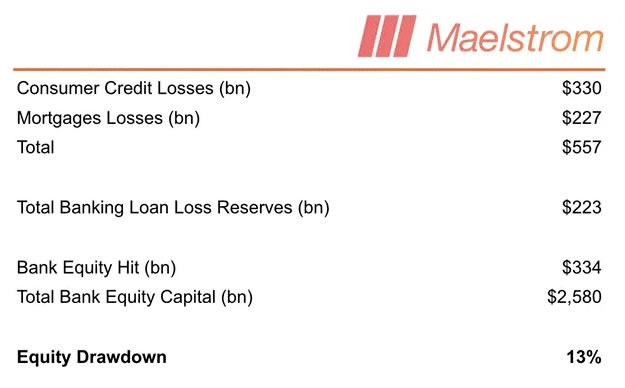 Predicted losses assuming a 20% AI job loss. Source:
Maelstrom
Predicted losses assuming a 20% AI job loss. Source:
Maelstrom
Hayes speculates that weaker regional banks would buckle first, depositors would flee, and credit markets would seize. The Federal Reserve would eventually panic and start printing money.
“While the Fed is fighting windmills, AI-related job losses will destroy the balance sheets of American banks,” he said.
“Finally, the monetary mandarins panic and press that Brrrr button harder than I shred pow the morning after a one-meter dump.”
Related: 1 in 4 CEOs expect to sack staff due to AI this year
Hayes predicted that this surge in fiat credit creation would “pump Bitcoin decisively off its lows,” and that the future expectation of increased fiat creation to save the banking system would “propel Bitcoin to a new all-time high.”
In addition to Bitcoin, Hayes said that the two altcoins that his company, Maelstrom, will “deploy excess stables into once the Fed blinks” are Zcash (ZEC) and Hyperliquid (HYPE).
More money-printing theories abound
However, this is not the first radical money-printing thesis Hayes has proposed.
In January, he said that the Federal Reserve would print money to alleviate the Japanese bond crisis.
In December 2025, he predicted that BTC would surge to $200,000 by March due to money printing through a new Fed liquidity tool called Reserve Management Purchases, which resembles quantitative easing.
Magazine: Chinese New Year boosts interest, TradFi buying crypto exchanges: Asia Express
Disclaimer: The content of this article solely reflects the author's opinion and does not represent the platform in any capacity. This article is not intended to serve as a reference for making investment decisions.
You may also like
APT breaks resistance, CRYPTO ME targets $4 if support at $0.75 holds
Multiple Factors Weigh In, Intensifying U.S. Treasury Sell-Off! 5-Year Yield Breaks 5% for the First Time Since 2007, 10-Year Yield Surpasses 5.1%
The stronger-than-expected U.S. September PMI, international crude oil prices returning above $100, and Fed governors signaling possible rate hikes have all negatively impacted the bond market. The disappointing 5-year Treasury auction has further worsened market sentiment. The psychological barrier of a 5% yield on the 10-year U.S. Treasury is losing its significance as a "ceiling," with the market now starting to discuss a potential 6%. In addition to rate hike expectations, fiscal and supply pressures are also driving up long-term bond yields.
According to reports, the Trump administration considered a 90-day diesel export ban, but this was later denied, with the US Secretary of Energy openly opposing it.
On Wednesday, according to Politico, the Trump administration was preparing a 90-day ban on diesel exports. Shortly after, Reuters reported that the United States was not preparing to implement such a ban. On the same day, the U.S. Secretary of Energy stated that banning diesel exports would "definitely not work," as it would force refineries to cut production, thereby driving up gasoline and jet fuel prices. After Politico's report, U.S. diesel futures fell by more than 7% before rebounding slightly, but the losses were not fully recovered.
Glassnode Has Turned Bullish on Bitcoin—They Revealed the Level They’re Waiting For
Crypto prices
More


