
US Economic Data Rekindles "Soft Landing" Hopes, But Is the Next Phase Up to the New Fed Chair?

The U.S. economy is now exhibiting its clearest combination of factors since before the pandemic: declining inflation, stable employment, and solid growth, reigniting hopes that a “soft landing” may be within reach.
Recent data has reinforced the view that inflation could gradually return to the Federal Reserve’s 2% target without triggering a recession. However, policymakers and forecasters remain cautious about declaring victory too soon.
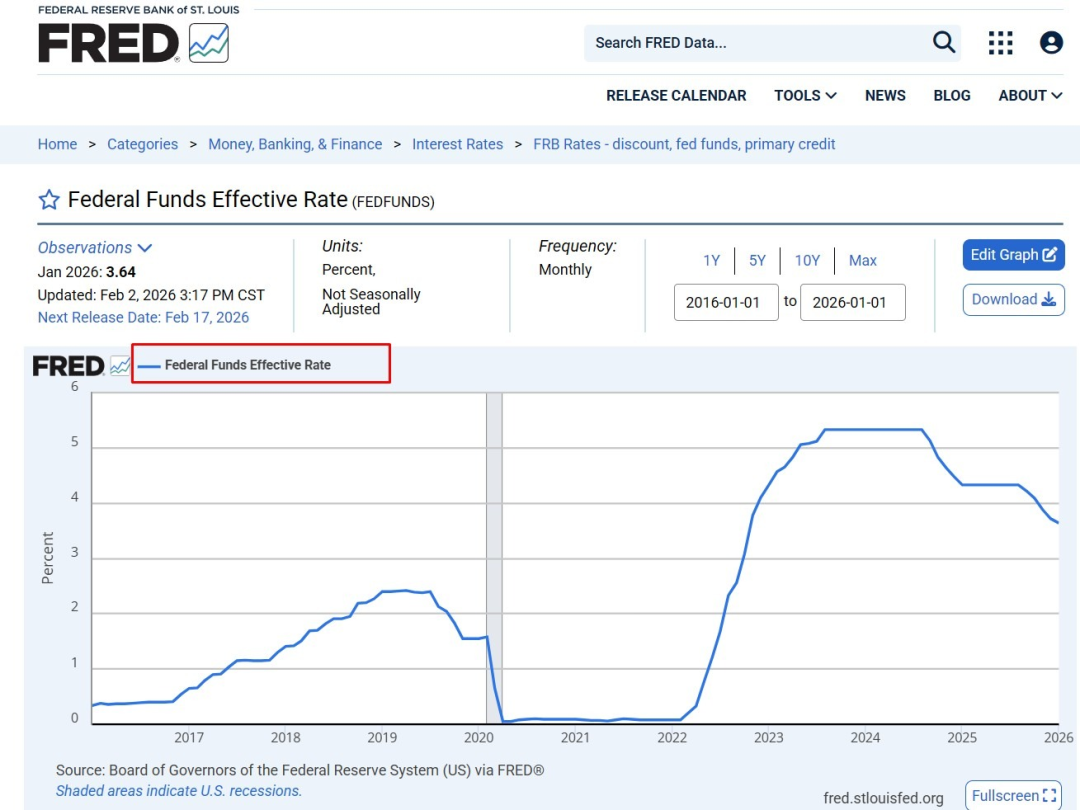
(Source: Federal Reserve)
The January inflation report showed that underlying price pressures continue to ease. Core consumer prices rose 2.5% year-over-year, the lowest since 2021. Although some of this improvement is due to technical factors, the reading also suggests that the “re-inflation” signs typically seen at the beginning of recent years, which have unsettled markets, are now less evident. On the employment front, the unemployment rate has fallen to 4.3%, and nonfarm payrolls increased by about 130,000, indicating that the labor market is cooling but not “breaking.”
However, confidence remains limited because the Fed’s preferred inflation indicators (such as the PCE measure) are still closer to 3% rather than 2%, and the progress in bringing down inflation since mid-2025 has been uneven.
Some forecasters expect inflation to be stickier this year, as tariff-related costs work their way down the supply chain and into retail pricing. Against this backdrop, the Fed’s concerns have shifted from “a resurgence of inflation” to another risk: that inflation could stabilize above the target.
The resilience of the labor market is also in question. Revised data shows that last year’s job creation was not strong by historical standards and was concentrated in a few industries. The unemployment rate has remained stable partly because companies are slowing hiring, but there have not been widespread layoffs—a delicate balance that could quickly change if growth or corporate profits come under pressure.
Potential triggers include: in the AI-driven “reshuffling of winners and losers,” affected companies may accelerate cost-cutting; or a sustained stock market pullback could hit household wealth and consumption. But the more immediate inflation risk may be the opposite: if consumers remain resilient, service inflation could stay stubbornly high, keeping price pressures above 2%. Structurally, housing inflation seems to be cooling, but non-housing services remain sticky, and goods categories more sensitive to tariffs are showing signs of re-acceleration.
Overall, the U.S. economy is closer to a soft landing than many imagined a few years ago, but the outcome is not set in stone. If growth remains resilient, even if traditional reasons for rate cuts are insufficient, there may be greater political pressure for the Fed to cut rates. Meanwhile, the Fed is about to undergo a leadership change, and the next phase may depend as much on policy choices as on the data itself.
Disclaimer: The content of this article solely reflects the author's opinion and does not represent the platform in any capacity. This article is not intended to serve as a reference for making investment decisions.
You may also like
Meta (META.US) "cuts" the camera: $349 Ray-Ban glasses equipped with Muse and hearing aid functions
Meta Platforms (META.US) is expanding its smart glasses product line with a camera-free model, support for the popular new assistant Muse, and a hearing aid mode.
Is Tesla (TSLA.US) about to release its most expensive model? Roadster launch imminent, but options market remains indifferent
Tesla Roadster is scheduled for release on October 1st, and may become its most expensive model, but the options market has not heated up in advance.
Catering giant ventures into advertising! McDonald's (MCD.US) builds its own media network, targeting a $1 billion high-profit business
McDonald's is following in the footsteps of retail giants such as Amazon and Walmart by announcing plans to build its own media network.
Understanding the US Treasury's "Black Wednesday": The "Perfect Storm" Impact and the Rising Tide of "October Rate Hike"
U.S. Treasury bonds suffered their worst single-day sell-off in nearly 18 months: surging oil prices, explosive PMI data, hawkish comments from the Federal Reserve, and a lackluster 5-year Treasury auction combined to create four simultaneous negative factors. The 10-year yield broke above 5.1%, reaching a new high since 2007; the market's probability of another rate hike in October soared to 68%, and the swap market is now pricing in expectations of three rate hikes over the next year. Analysts believe that more than 80% of this sell-off is driven by real interest rates, with the 30-year mortgage rate surpassing 7% and doubts persisting about the effectiveness of the Treasury’s buyback plan.
Crypto prices
More


