
J&J's MedTech Shows Strong Growth in 2025: Will 2026 be Better?

Johnson & Johnson's JNJ medical devices segment, known as MedTech, offers products in the orthopedics, surgery, cardiovascular and vision markets. The MedTech segment accounts for around 36% of J&J’s total revenues. In 2025, J&J delivered nearly $34 billion in sales in its MedTech segment, showing growth of 5.4% on an operational basis supported by 15 major new product launches.
In the MedTech segment, J&J is successfully shifting its portfolio to high innovation, high growth markets, particularly in Cardiovascular. With the acquisitions of Shockwave in 2024 and Abiomed in 2022, J&J has become a category leader in four of the largest and highest-growth cardiovascular intervention MedTech markets. Sales in its Cardiovascular segment rose 15.8% to $8.9 billion in 2025.
J&J’s MedTech business has improved in the last three quarters, driven by the acquired cardiovascular businesses, Abiomed and Shockwave, as well as accelerated momentum across Surgical Vision and wound closure in Surgery. Improvements in J&J’s electrophysiology business also drove the growth. MedTech sales rose 4.3% on an organic basis in 2025.
However, the company continues to face headwinds in China. Sales in China are being hurt by the impact of the volume-based procurement (VBP) program, which is a government-driven cost containment effort in China. Competitive pressure is also hurting sales growth in some MedTech businesses.
In 2026, J&J expects better growth in the MedTech business than 2025 levels, driven by increased adoption of newly launched products across Cardiovascular, Surgery and Vision portfolios. Some key new product launches are VARIPULSE in Electrophysiology, ETHICON4000 in Surgery and the OASYS MAX family in Vision. J&J expects continued impacts from VBP issues in China in 2026. Also, potential tariff costs of approximately $500 million, much higher than in 2025, should hurt MedTech margins in 2026.
The potential separation of its Orthopaedics franchise into a standalone orthopedics-focused company, called DePuy Synthes, potentially by mid-2027, should improve its MedTech unit’s growth and margins over the long term. The Orthopaedics franchise has been a slow-growth business for J&J.
J&J’s Key Competitors in the Medical Devices Market
J&J’s MedTech unit faces strong competition from several major players in the medical device industry, like Medtronic MDT, Abbott, Stryker SYK and Boston Scientific BSX.
While Medtronic has a strong presence in cardiovascular, neuroscience and surgical technologies, Stryker is a global leader in medical technology, specializing in innovative solutions across surgical, neurotechnology, orthopedics and spine care. Boston Scientific markets products for cardiovascular, endoscopy, urology and neuromodulation. Abbott is known for its medical device products across cardiovascular, diagnostics and diabetes care.
J&J Stock Price, Valuation and Estimates
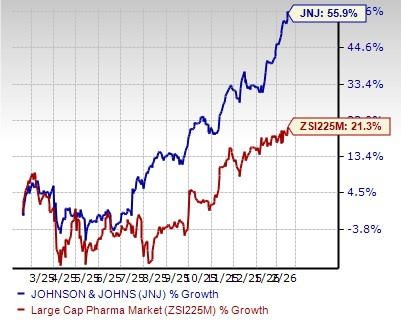
J&J’s shares have outperformed the industry in the past year. The stock has risen 55.9% in the past year compared with a 21.3% appreciation of the industry.
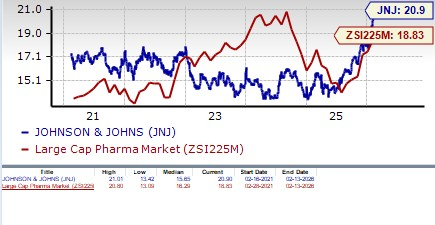
From a valuation standpoint, J&J is slightly expensive. Going by the price/earnings ratio, the company’s shares currently trade at 20.90 forward earnings, higher than 18.83 for the industry. The stock is also trading above its five-year mean of 15.65.
The Zacks Consensus Estimate for 2026 earnings has risen from $11.47 to $11.54 over the past 30 days, while that for 2027 has gone up from $12.25 per share to $12.40 per share over the same timeframe.
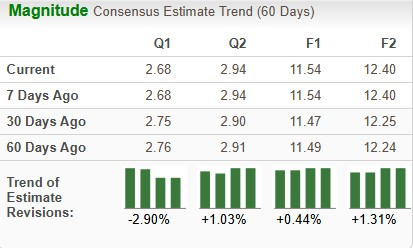
JNJ Estimate Movement
J&J has a Zacks Rank #3 (Hold) at present. You can see the complete list of today’s Zacks #1 Rank (Strong Buy) stocks here.
Disclaimer: The content of this article solely reflects the author's opinion and does not represent the platform in any capacity. This article is not intended to serve as a reference for making investment decisions.
You may also like
XRP $10 Target Remains Unmet Nearly Nine Years After 2017 Forecasts
Expert Analyst Identifies Critical Level for Bitcoin: “It Shouldn’t Close the Week Below This Level”

5 Crypto Events to Have on Your Radar This Fall
Crypto prices
More


