

Author: David Hoffman
Translation: TechFlow
"If Bitcoin falls, cryptocurrency will perish with it."
Bitcoin supporters are deeply enamored with this statement.
My friend Nic Carter recently revived this old cliché—the idea that Bitcoin is the center of the crypto universe, and everything else is merely a celestial body orbiting around it.
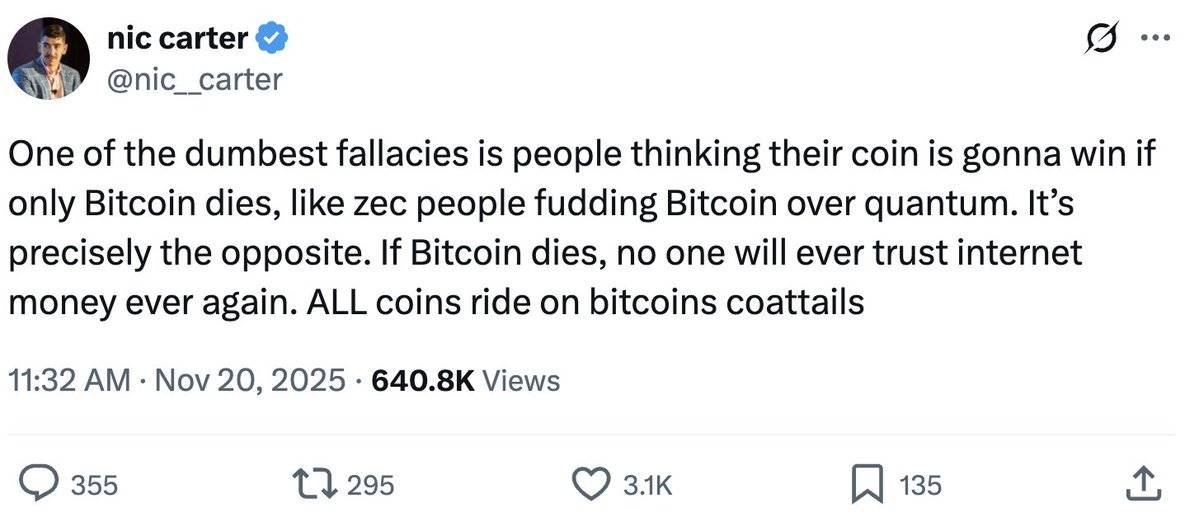
Original link
This notion seems to be a stubborn undertone in discussions among Bitcoin supporters. Every now and then, a Bitcoin supporter will tweet to reiterate this view in response to some emerging hot topic. Subsequently, other Bitcoin supporters flock to like the tweet until its popularity reaches "escape velocity."
However, this sweeping view is incorrect, and could only come from those who believe Bitcoin is the center of the crypto universe.
This Bitcoin-centric perspective is as primitive and outdated as geocentrism. To be clear, in our solar system, the other planets do not actually revolve around the Earth.

From first principles, Ethereum has no technical dependency on Bitcoin. As a protocol, Ethereum is completely indifferent to Bitcoin's existence.
Even if Bitcoin stopped producing blocks, literally "nothing would happen" to Ethereum.
The $16.5 billions stablecoin market, the $6.5 billions decentralized finance (DeFi) ecosystem, the $55 millions worth of Ethereum (ETH) burned annually, and countless startups, venture capital industries, and developer markets—all of these are unique products of Ethereum, and they would continue to operate as usual the next day.
This is precisely Ethereum's original intention.

The Threat of Quantum Computing
Over the past week, discussions about the risks quantum computing poses to Bitcoin have heated up again. Scott Aaronson, regarded as a top quantum researcher, wrote on his blog Shtetl-Optimized:
Given the astonishing pace of current hardware progress, I now believe that before the next U.S. presidential election, we may have a fault-tolerant quantum computer capable of running Shor's algorithm.
Since the birth of Bitcoin, this has always been a topic of discussion—people have long known that the ECDSA signatures used by most early Bitcoin wallets cannot withstand quantum attacks, and that Bitcoin's private keys will eventually be cracked by quantum computers, allowing attackers to steal those bitcoins.
In his recent podcast, Nic even mentioned that some of Bitcoin's negative price performance may be due to the market already pricing in quantum risk.
The key point to remember here is that this is entirely a problem that Bitcoin needs to solve. Ethereum has long protected itself against the types of attacks that Bitcoin is currently anxious about.
From the very beginning, Ethereum hid public keys behind addresses (keccak-256 hashes), meaning your public key is not exposed until you spend, greatly reducing the attack surface for quantum attackers.
Moreover, since The Merge, Ethereum has shifted to a validator model, with withdrawal keys also hidden behind hashes. More importantly, Ethereum's roadmap clearly plans to replace ECDSA signatures with quantum-safe signature schemes (such as BLS variants or post-quantum cryptographic alternatives) through future upgrades like Verkle trees and EOF layer restructuring.
Ethereum's culture has always been highly forward-thinking—sometimes perhaps even too far ahead, as other ecosystems often exploit Ethereum's short-term weaknesses through shortcuts. But when it comes to addressing the quantum threat, Ethereum is certainly not like that!
In the face of the quantum threat to blockchain security, Ethereum has chosen to confront the challenge head-on, fully aware that quantum computing will one day become ubiquitous.
The Default Internet Currency
"If Bitcoin disappears, people will never trust internet money again."
This is simply not true.
The demise of Bitcoin would undoubtedly create a vacuum of trust in the short term, but the needs and value that Ethereum fulfills would not disappear as a result. In fact, this event might provide Ethereum with an opportunity to demonstrate its long-term resilience.
I do hope Bitcoin can overcome the quantum threat, but I also believe that the demise of the "number one currency" in crypto could greatly benefit the "number two currency."
Bitcoin enjoys a huge monetary premium, and Ethereum also has a certain monetary premium. If Bitcoin exits the equation, Ethereum will have a clear path to becoming the native currency of the internet. From the perspective of someone who only cares about ETH's value, Bitcoin's demise due to the quantum threat could be the most bullish event for ETH.
Ethereum will continue to produce blocks, transfer trillions of dollars in stablecoins, host the world's most resilient DeFi ecosystem, and continuously optimize its economic model by burning ETH.
Therefore, although Bitcoin faces an "unimaginably huge task," which is "the biggest infrastructure change in Bitcoin's history" (quoting Nic Carter from his recent podcast), Ethereum has been thinking about these issues for a decade and is prepared with solutions for the future.
So, Bitcoin's technical shortcomings are not my problem.
Thank you for your attention to this issue.


