
What is the future of Bitcoin treasury companies?

Whoever can first turn BTC holdings into yield-generating assets will be able to achieve sustainable premiums again.
Whoever is the first to turn BTC holdings into yield-generating assets will be able to regain sustainable premiums.
Written by: Yue Xiaoyu
Recently, the bitcoin treasury company MicroStrategy is about to be removed from global index funds. This could mean an outflow of $8.8 billions, which would be a huge blow to the price of bitcoin. So, what is the future for bitcoin treasury companies? What is the future of the DAT model?
The DAT model is not just about traditional companies borrowing money to buy coins. More importantly, the interests of traditional companies are now tied to the ecosystem of this token.
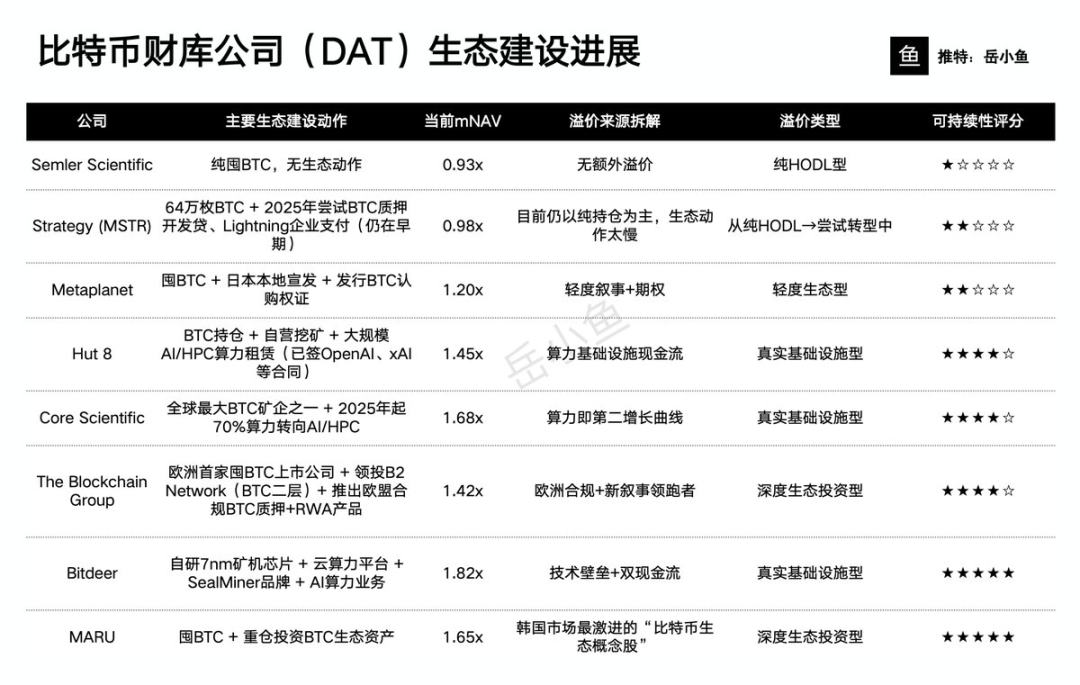
Contrary to what many people think, many bitcoin treasury companies are already actively promoting the development of the bitcoin ecosystem. Proactively building the bitcoin ecosystem is currently one of the few reliable ways for DAT companies to reignite their market value premium. During bearish market periods, this approach can even create more sustainable premiums than simply hoarding more BTC. The market has already voted with real money to prove this point. Here is a table listing the ecosystem development progress of some mainstream bitcoin treasury companies.
Breaking the Pure Holding Deadlock
For companies that hoard coins, as long as BTC does not rise, or financing channels are blocked, CPS (supplementary bitcoin) will not be able to increase in value, and the price will inevitably go to zero. Building an ecosystem is like installing a second or even third engine for themselves, allowing for supplementation, technological barriers, and new growth narratives.
Turning Dead Assets into Active Yields
For example, Hut 8, Core Scientific, and Bitdeer turn their BTC holdings and computing power into HPC resources that can be leased to large model companies like OpenAI and xAI, generating an annualized yield of 8-15% and directly producing USD revenue. The market’s valuation logic becomes: BTC holdings (1.0x) + value-added yield (an additional 0.5-1.0x premium).
Seizing New Narrative Cycles
In fact, the bitcoin ecosystem still supports new narratives, from the initial Ordinals protocol to later bitcoin Layer2 and BTCFi, etc. As long as a company is willing to invest money, teams, and branding to become the new leading listed company in this cycle, retail and institutional investors are willing to give a 2-3x premium again. MARU and Blockchain Group are typical examples.
From Capital Game to Open Platform
The old logic: premium → additional issuance → buy BTC → push up stock price (closed, reflexive, extremely fragile). The current logic: BTC holdings + ecosystem project portfolio + external developers / capital inflow → platform value → sustainable premium.
In Summary
The market is increasingly skeptical that simply hoarding coins can maintain a premium.
The only way to truly reignite mNAV is for companies to turn bitcoin from dead gold into a living ecosystem. Whoever is the first to turn BTC holdings into yield-generating assets will be able to regain sustainable premiums.
Disclaimer: The content of this article solely reflects the author's opinion and does not represent the platform in any capacity. This article is not intended to serve as a reference for making investment decisions.
You may also like
US Stock IPO Preview: Rapid Revenue Expansion, How Will TTG International (TTG.US) Seek New Growth Opportunities in Cross-Border Logistics?
In the future, changes in the company's business scale, customer structure, and profitability will be key dimensions to observe its growth potential.
$100 Oil Ignites BP (BP.US) Revaluation Expectations! JPMorgan Calls for "Overweight"
From a cash flow perspective, as long as production and costs are controllable, high oil prices can expand the operating cash surplus of oil and gas producers, providing support for debt repayment, dividends, and stock buybacks. This is also why Wall Street financial giants such as JPMorgan, Goldman Sachs, and Morgan Stanley have recently been frequently issuing bullish research reports to energy giants.

Microsoft (MSFT.US) Makes Heavy Bet on the Middle East! Plans to Invest Over $10 Billion in AI and Cloud Computing Infrastructure by 2030, But Geopolitical Risks Remain the Biggest Variable
Microsoft announced on Wednesday that it plans to invest over $10 billion in capital and operating expenditures in the Middle East by 2030 to expand its cloud computing and artificial intelligence (AI) infrastructure in the region.
Meta (META.US) goes all-in on Muse AI Agent, building full-scene access via VR headsets, smart glasses, and Charm
On September 23 local time, Meta held its annual Connect developer conference in Menlo Park, California.
Crypto prices
More


