
Wisconsin Lawmakers Push Bill to Ease Crypto Rules

Contents
Toggle- Quick breakdown
- Key provisions of the bill
- Legislative path and challenges
Quick breakdown
- Wisconsin’s Assembly Bill 471 seeks to exempt crypto mining, staking, and blockchain development from money transmitter licencing.
- The bill also safeguards the right to use self-hosted wallets and accept digital assets for payments.
- It faces hurdles, with only 25% legislative progress and several stages left for approval.
Wisconsin legislators have introduced a new bill that could exempt individuals and businesses engaged in crypto activities from obtaining money transmitter licences. The proposal, Assembly Bill 471, aims to create clearer regulatory boundaries for digital asset use in the state.
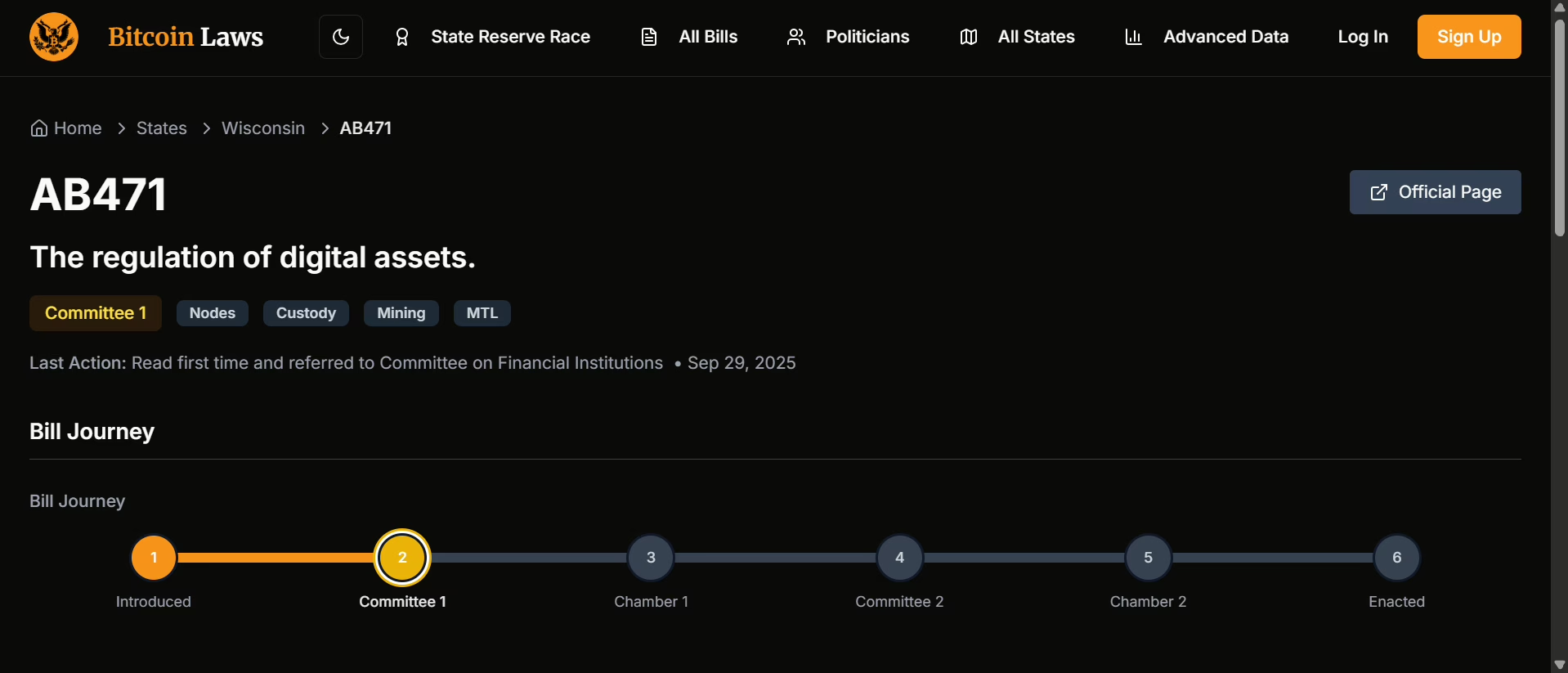 Progress of AB471 Bill. Source: Bitcoin Laws
Key provisions of the bill
According to the Wisconsin Legislative Reference Bureau, the measure would allow residents to engage in mining, staking, and blockchain software development without requiring a license from the Department of Financial Institutions (DFI).
The exemptions would also cover the exchange of digital assets, provided the transactions do not involve converting tokens into legal tender or bank deposits.
“Under the bill, neither a state agency nor a political subdivision may prohibit or restrict a person in accepting digital assets as a method of payment for legal goods and services or in taking custody of digital assets using a self-hosted wallet or hardware wallet,”
the document reads, adding that,
“The bill also specifies that a person in this state may 1) operate a node for the purpose of connecting to a blockchain protocol and participating in the blockchain protocol’s operations; 2) develop software on a blockchain protocol; 3) transfer digital assets to another person utilizing a blockchain protocol; and 4) participate in staking on a blockchain protocol.”
Legislative path and challenges
The bill has bipartisan interest but is currently sponsored by seven Republican Assembly members and two Republican senators. It has been referred to the Committee on Financial Institutions for review.
According to Legiscan data, the measure has reached just 25% progress and still needs to clear one chamber and two additional committees before it can be enacted into law.
Notably, the Wisconsin DFI launched a publicly accessible tracker to combat cryptocurrency and other investment scams. This initiative comes in response to nearly $3.55 million lost by Wisconsinites to financial grooming and cryptocurrency fraud between January 2022 and June 2024.
Disclaimer: The content of this article solely reflects the author's opinion and does not represent the platform in any capacity. This article is not intended to serve as a reference for making investment decisions.
You may also like
Metals fade as long yields offset cooler inflation, lower Fed odds - Kitco PM Report
Bitwise brings NEAR to Wall Street – But the chart isn’t impressed
Synopsys and OpenAI reach AI chip design partnership, stock price surges over 7%
Synopsys has signed a multi-year legally binding agreement with OpenAI to jointly develop GPT-Synopsys, a model specifically trained and fine-tuned for chip design tasks. OpenAI will pay Synopsys a subscription fee for tool licensing, and both parties will share revenue based on improvements in chip design achieved by customers using the product.
How does Wall Street view the PCE? Goldman Sachs delays expectation for Fed rate hike
After the lower-than-expected US August PCE data was released, Goldman Sachs delayed its expectation for the Federal Reserve's second rate hike from October to December, and stated that it does not rule out the possibility that the Fed may eventually decide no further hikes are necessary. "New Fed Newsletter" Timiraos noted that the PCE does not change the previously known trend of rising inflation. Currently, the market prices in a 39% probability of a rate hike in October, down from 45% before the PCE release; and a 90% probability in December. The yield on 2-year US Treasury notes dipped slightly after the PCE announcement and then rebounded, while the 10-year yield continued to rise.
Crypto prices
More


