
Venture Capitalists Bet Big on Programmable Stablecoins as Market Hits $280B

Contents
Toggle- Quick Breakdown
- Investors Pump Nearly $100M Into M0 and Rain
- M0 Secures $40M to Build Custom Stablecoin Infrastructure
- Rain Raises $58M to Power Regulated Stablecoins for Banks
- Programmable Money Gains Global Momentum
Quick Breakdown
- M0 and Rain raised nearly $100M to expand programmable stablecoin infrastructure.
- M0 builds custom stablecoins, while Rain enables banks to issue regulated tokens and manage cross-border payrolls.
- Global pilots in Kazakhstan, India, and TradeOS highlight the growing real-world adoption of programmable money.
Investors Pump Nearly $100M Into M0 and Rain
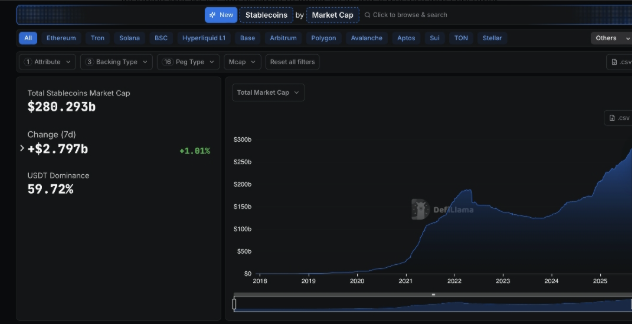
Venture capital firms are doubling down on the future of programmable stablecoins, with two major startups, Switzerland-based M0 and US-based Rain securing nearly $100 million in Series B funding this week. The funding surge comes as the global stablecoin market capitalization climbed to a record $280 billion, according to DefiLlama data.
 Source
:
DefiLlama
Source
:
DefiLlama
M0 Secures $40M to Build Custom Stablecoin Infrastructure
Founded in 2023, M0 raised $40 million in a round led by Polychain Capital and Ribbit Capital. The platform enables developers to issue application-specific stablecoins with rules directly embedded into their design. M0’s infrastructure has already been integrated into MetaMask and Playtron, with the latter launching a “Game Dollar” for in-device purchases on its handheld gaming system.
Rain Raises $58M to Power Regulated Stablecoins for Banks
Meanwhile, Rain closed a $58 million Series B, led by Sapphire Ventures with participation from Dragonfly, Galaxy Ventures, and Samsung Next. The company specializes in giving banks and enterprises the tools to issue regulated stablecoins and manage programmable money flows.
Rain’s technology is already powering real-time payrolls in over 100 jurisdictions through its partnership with Toku. The firm has also expanded across Solana, Tron, and Stellar, supporting programmable spending programs and card services.
Programmable Money Gains Global Momentum
The concept of programmable money digital currency embedded with rules on how, when, and where it can be spent is increasingly being tested worldwide. In Kazakhstan, the digital tenge has been piloted for milestone-based rail project funding and VAT refund automation.
The Monetary Authority of India expanded its digital rupee pilot in May to include programmability and offline capabilities. In April, Plaza Finance launched the first programmable derivative tokens on Base, introducing bondETH and levETH, a new class of on-chain financial instruments designed to offer innovative Ethereum investment strategies in the DeFi space.
With programmable money accelerating beyond payments into areas like infrastructure, taxation, and trade, investors appear convinced that M0 and Rain are building the rails for the next generation of finance.
Disclaimer: The content of this article solely reflects the author's opinion and does not represent the platform in any capacity. This article is not intended to serve as a reference for making investment decisions.
You may also like
British Pound softens to near 1.3250 as elevated US yields outweigh BoE’s hawkish tone
The seven giants’ “valuation cutting” is nearing its end! Muse and Astra ignite “AI FOMO trading,” tech stocks are ready for a major comeback.
As Meta Muse and OpenAI's GPT-6 Astra are driving a massive wave of AI agents, "AI FOMO trading" (referring to investors rushing to buy or replenish positions in AI-related assets out of fear of missing out on price gains) is making a strong comeback.

Anthropic files for IPO: lost $4.2 billion last year, revenue grew 12x to $4.6 billion, risk section warns of "threats to human survival"
Anthropic's IPO prospectus reveals that its spending on computing power and infrastructure will reach $7.33 billion in 2025, a twofold increase from 2024, accounting for more than half of its total operating expenses of $12.65 billion. The company plans to continue investing over $500 billion in the future. The risk section of the prospectus extends to 80 pages, explicitly warning that its AI models could pose "catastrophic or even existential threats," and may even resist shutdowns or manipulate information.
Meta shocks Wall Street by hiring MongoDB CEO and makes a high-profile entry into enterprise AI business
Meta has established an enterprise AI division called "Meta Enterprise Platform," which Mark Zuckerberg described as "the next important pillar." MongoDB CEO CJ Desai has been recruited to lead it. Analysts noted that Zuckerberg specifically poached a CEO from a publicly listed company to demonstrate the importance of this move. Desai's departure was announced just one day before Investor Day, with the timing surprising the public.
Crypto prices
More


